|
|
|
[Majorityrights Central] Ukraine, Israel, Taiwan … defend or desert Posted by Guessedworker on Sunday, 14 April 2024 10:34. [Majorityrights News] Moscow’s Bataclan Posted by Guessedworker on Friday, 22 March 2024 22:22. [Majorityrights News] Soren Renner Is Dead Posted by James Bowery on Thursday, 21 March 2024 13:50. [Majorityrights News] Collett sets the record straight Posted by Guessedworker on Thursday, 14 March 2024 17:41. [Majorityrights Central] Patriotic Alternative given the black spot Posted by Guessedworker on Thursday, 14 March 2024 17:14. [Majorityrights Central] On Spengler and the inevitable Posted by Guessedworker on Wednesday, 21 February 2024 17:33. [Majorityrights News] Alex Navalny, born 4th June, 1976; died at Yamalo-Nenets penitentiary 16th February, 2024 Posted by Guessedworker on Friday, 16 February 2024 23:43. [Majorityrights News] A Polish analysis of Moscow’s real geopolitical interests and intent Posted by Guessedworker on Tuesday, 06 February 2024 16:36. [Majorityrights Central] Things reactionaries get wrong about geopolitics and globalism Posted by Guessedworker on Wednesday, 24 January 2024 10:49. [Majorityrights News] Savage Sage, a corrective to Moscow’s flood of lies Posted by Guessedworker on Friday, 12 January 2024 14:44. [Majorityrights Central] Twilight for the gods of complacency? Posted by Guessedworker on Tuesday, 02 January 2024 10:22. [Majorityrights Central] Milleniyule 2023 Posted by Guessedworker on Friday, 22 December 2023 13:11. [Majorityrights Central] A Russian Passion Posted by Guessedworker on Friday, 22 December 2023 01:11. [Majorityrights Central] Out of foundation and into the mind-body problem, part four Posted by Guessedworker on Saturday, 02 December 2023 00:39. [Majorityrights News] The legacy of Richard Lynn Posted by Guessedworker on Thursday, 31 August 2023 22:18. [Majorityrights Central] Out of foundation and into the mind-body problem, part three Posted by Guessedworker on Sunday, 27 August 2023 00:25. [Majorityrights Central] A couple of exchanges on the nature and meaning of Christianity’s origin Posted by Guessedworker on Tuesday, 25 July 2023 22:19. [Majorityrights Central] The True Meaning of The Fourth of July Posted by James Bowery on Sunday, 02 July 2023 14:39. [Majorityrights News] Is the Ukrainian counter-offensive for Bakhmut the counter-offensive for Ukraine? Posted by Guessedworker on Thursday, 18 May 2023 18:55. [Majorityrights News] Charles crowned king of anywhere Posted by Guessedworker on Sunday, 07 May 2023 00:05. [Majorityrights News] Lavrov: today the Kinburn Spit, tomorrow the (New) World (Order) Posted by Guessedworker on Friday, 07 April 2023 11:04. [Majorityrights Central] On an image now lost: Part One Posted by Guessedworker on Friday, 07 April 2023 00:33. [Majorityrights News] The Dutch voter giveth, the Dutch voter taketh away Posted by Guessedworker on Saturday, 18 March 2023 11:30. [Majorityrights Central] News of Daniel Posted by Guessedworker on Friday, 03 March 2023 05:18. [Majorityrights Central] A year in the trenches Posted by Guessedworker on Tuesday, 28 February 2023 00:40. [Majorityrights Central] Talking to normies about fascism Posted by Guessedworker on Friday, 10 February 2023 06:33. [Majorityrights News] British Treasury and Bank of England manoeuvre towards CBDC Posted by Guessedworker on Saturday, 04 February 2023 22:44. [Majorityrights Central] What lies at the core Posted by Guessedworker on Tuesday, 24 January 2023 00:01. [Majorityrights Central] Elite contests and contradictions: Part 2 Posted by Guessedworker on Wednesday, 18 January 2023 00:30. [Majorityrights News] At Davos the Chinese change strategy Posted by Guessedworker on Tuesday, 17 January 2023 23:20. [Majorityrights News] Mission creep takes a hit at the Fed Posted by Guessedworker on Wednesday, 11 January 2023 00:39. [Majorityrights Central] Hat-tip to Woes Posted by Guessedworker on Sunday, 01 January 2023 00:11. [Majorityrights Central] Scott Mannion and the being of the English Posted by Guessedworker on Saturday, 10 December 2022 01:12. [Majorityrights Central] Neil Oliver: The Re-Set has already happened Posted by Guessedworker on Saturday, 03 December 2022 22:42. Majorityrights Central > Category: Science & Technology
From Greek Antiquity to Modernity to the Very Necessary Post Modern Turn.
I was about to put up a video by The Golden One in which he expresses gratitude to the Dalai Lama for voicing his authoritative support of European ethnonationalims - “Europe belongs to the European peoples and immigrants should return and rebuild their countries.” But then I hear him saying that “the Dalai Lama is a spiritual man and is not beholden to ‘social rules” which our elite try to brow beat us with….I realize they’re at it again, that I cannot just suck it up in sympathy for the bad Swedish election; as I did in posting his last video, in which The Golden One calls the enemies “leftists.” There are still retarded people playing opposite day with me behind the scenes - encouraging misconceptions like “social rules” are Not somehow also a neutral analytic device (which of course they are) but singularly a tool of coercion for our enemies; whereas a rigorous adherence to “nature” without all that “sociology, communicolgical, White post modern stuff” will inevitably ensure our “rights” and “ethnonationalism.” This is completely retarded and backwards. Nature doesn’t give us our rights, nature doesn’t give a shit about our rights and our ehtnonationalisms. We have rights because we are part of a community of people with relative group interests - in best unit, a union of discrete European ethnonations, in which we create and negotiate rights by consensus, not foolishly believing that we discover them in objective detachment. As I have said before, The White Post Modern Project is a necessity in response to the ravages of Modernity and the inflexibility of Reactionary Traditionalism. ...and it (White Post Modernity) is particularly a necessity to hold up to the destruction of ethnonationalism that post modern conception is supposed to defend against, but rather destroys in YKW misrepresentation of the notions they’ve promoted as “post modernity.” The project, including Heidegger’s, is not to make humans and society function like automatons, like a car engine, on an engineering and physics model - not in that model of “theoria” as Aristotle calls it, but to take our concerns even for the hard sciences, but especially for the social sciences into the realm of praxis - again, as Aristotle calls it - the social realm of people, where they have some agency, and are therefore not totally predictable; where we are biological creatures and mammals, evolved to care about important relationships to our survival and in optimal, not maximal levels of need satisfaction; where we are biological creatures and our actions have reflexive effects that cause changes in course in ourselves and others; where, as second order cybernetic creatures we can learn to learn. The project, including Heidegger’s (where on target and not too individualistic in his focus), The White Post Modern Project, is to take our thinking into praxis to correct the Cartesian detached and lineal, non-interactive notion of necessity - imperviously abetting, as it does, the phony and crooked disease of quantification to the point of false comparison, toxicity and runaway; typically by means of the Charmed Loop of Didactic Incitement. To correct the Cartesian error of modernity, we need Not a “model of the mind” as tightly connected as a Porsche car engine to the exclusion of all else (to defend ourselves against all that Jewish social stuff) ...no, what we need is a better understanding of the utility and integrity of Specificatory Structures to negotiate the participatory reality of Praxis. Specificatory Structures are basically partly or nearly finished working hypotheses as it were, that allow interlocutors to engage, shape, craft, correct and refine these hypotheses. Remember, the ultimate aim of pragmatic philosophy is the rigor of operational verifiability. So, those with a penchant for engineering and scientific rigor should be satisfied; while being helped to Not promote the scientism and epistemic blunder of applying physics models (theoria) to creatura and social group concerns (praxis). Nor does social constructionism (proper) and hermeneutics deny science, biological realty or race; it enhances and complements scientific inquiry, it does not discourage science: it may criticize bad science (“we are all Africans under the skin”) and bad applications of science - physics and brute animal models to humans and our world of praxis (“its all about competition, survival of the fittest, might makes right and nothing more”) - but it is not anti-science. If GW or somebody comes up with specs, which generally track “the transit” of English and European (natural) social systems, well and good. What hermeneutics proper would do is not deny it, but refer back to it as need be in the course of operational verification. What I am saying is true, of radical and deep priority for our European interests; but “opposite day” is still being played with me. I will speculate as to why: First is obvious - YKW know what I am saying is true, want to discourage it and direct Whites to join them as right wing reactionaries. The second is right wingers - people who are lucky enough to be in position to take care of themselves, don’t feel need to care about the group as a whole - they sell our groups out. There is a third and fourth category at work, also right wing reactionary. The Jesus freak contingent I’ve said enough about - if people can’t see the plain fact that Christianity is a Jewish trick, then how much time are you supposed to waste on them? Rather you have to defend against the worm they’d insist upon introducing. But among right wing reactionaries that are a problem for me are STEM people who are not penetrating enough philosophically to get beyond their STEM predilections - which, again, would have them perpetrate the epistemic blunder of applying theoria to praxis - which, rather, requires phronesis (practical judgement of the kind that the topoi of specificatory structures would guide). By contrast, the whole “Dark Enlightenment” crap is a psy-op set up by our (((enemies))) and advanced by operatives like Brett Stevens in order to misdirect and (((boondoggle))) STEM types. These types are not only prone to this type of epistemic blunder, but have some enhanced confirmation bias as the harder matters that they’ve tended to look into are more stable and veifiable than the social world where Jewish rhetoric has wreaked havoc. Thus, their Cartesian anxiety is calmed somewhat by their concrete successes in engineering and business in boom times; say, during the Reagan/Thatcher objectivist sell-out years, in their reactionary quest for “foundations” in nature beyond human tampering. Moreover, these sorts have had a big leg up in advancing the epistemic blunder in their predilection when coming into the Internet age - for obvious reasons - computer technology is a STEM field mostly about the tight, non-human, electric/mechanical connections of theoria. While those more sympathetic to a White take on social, communicological, post modern, hermeneutic resource have been late bringing it to the table. All the while the YKW have been doing their number, taking the best ideas for social advocacy for themselves then distorting them, abusing them and weaponizing them against Whites - to where Whites react and play opposite day with me, as if I am the bad guy simply for using our words, terms and concepts properly in our interests; Whites have such heavy reactions to the negative, red cape associations they feel from these words that they react against the abused words and concepts; and in so doing rebel against their own interests, in what one cannot help but believe is a (((deliberate strategy.))) “We can’t defend ‘racism’, people wouldn’t understand (that the term is fundamentally about social classification and ethnocentrism), so we have to argue against it (and weaken the call of social classification and ethnocentrism).” “We must be against Multiculturalism (and for global monoculturalism)” ....“we must be against the Diversity industry (and for racial integration through Abrahamic/Noahide law, or ‘universal natural law’).” “I only trust my own mind” ...“we need a science of the mind” ...well go ahead… maybe that is a good perspective for holding fast to inquiries into emergentism. I’m not stopping you, but we also need, need even more inquiries from the communications perspective - taking interaction as the unit of analysis, claiming the same turf as other disciplines when taking-on investigations: whether the group (sociology - most relevant, because races are groups); philosophy (inquiries into how to live and think about life); or biology and interacting ecosystems ...and alas, even psychology. And so we’ve had a problem, as manifest acutely on Majorityrights, where the STEM people clamored here early. The site’s discourse model has been strictly Modernist - a free speech free-for-all with the errant notion that if you just keep allowing issues to be buffeted from all angles, eventually the foundational truth would be born again hard from this torturous alchemy. Of course, that’s not what happens. Modernity is an insatiable charmed loop that has run rough shod over even our most precious resources, putting them at needless risk in the sheer objectivism of scentistic experimentalism; if something is not “new” it no longer merits reverence for the modernist thinker. ...and in come the trolls, the Jews, and Jew tools, like Haller and Thorn, whose backers know this and took advantage to sew misdirection in MR’s threads under the guise of “free speech” and inquiry into discovery of “the truth.” The obnoxous “Uh”, who also displayed affinity, argued for the inclusion of the YKW and clearly does not take these matters of White advocacy most seriously, but wants a place to vent his spleen against those who had the nerve to go to college, so he can show how ‘smart’ he is… the fetish of MR in the modernist times has been ‘the one line zinger”, as Uh was so fond of… Soren et. al are other STEM people into that as well… Sublime engineering is the model…there is just that one little precise thing, said in perfect rigor which will either bring the whole edifice down or make it hum like the best car engine ever ...the streak of incisive brilliance like a sheen, gleaming like a “classic sparkle.” ... claims I ruined all this fun for him .... But it stems rather from a misunderstanding of the Specificatory Structure and its aim - its aim is to provide social topoi for people to participate, shape, craft and refine ...indeed, in rigor, as required in the post modern circumstance, to reach Operational Verifiability - that is the end point of the process of pragmatic inquiry - so the STEM-heads should not object and are only displaying just how reactionary (or dishonest) they are when they object to the terms and concepts that I set out. Brilliant though he is, indispensable ideas though he’s contributed, even Bowery was bewilderingly reactionary in this regard, acting like I was attacking science when I criticized the bad science and misapplication of science that is scientism. ...or that I was besmirching science when I set out the place and general errors of the empirical philosophers, Locke, Berkeley and Hume (I presumed that everyone knows that you are talking about them when criticizing “empirical philosophy”) in historical context of epochal bias. I knew we were in trouble when Bowery simply ignored what I said, angrily tried to prohibit me from criticizing Modernity, Cartesianism (the quest to separate mind from interaction, viz. interactive stasis, outer systemic homeostasis) and proposed to “reboot the enlightenment.” But the fact is that we have to move beyond modernity to White Post Modernity if we are to save ourselves and not be a part of human ecological destruction. It is for this reason that I will introduce an update - not removing the present “About” information for Majorityrights - but add the Post Modern fact that “Hello’, we have the Internet now,” you can interact and help to shape and craft our necessary knowledge. We are no longer beholden to the transmissions model of communication, in which we sat in front of televisions, or teachers, or preachers and were to receive the information as pure, sacrosanct, passive, no need for our input and correction…. What you are presented with at Majorityrights are specificatory structures - hypotheses well enough considered, with a likely trajectory to protect our interests as discreet European peoples; but we can always use help from honest people of good will, to shape, craft and verify our inquiries where not proposing inquiries anew. Articles are not put up as if by Moses presenting the ten commandments; nor presented as if the author thinks, in hubris, that these are immutable, always perfect ideas and objects; as if we think this is something like a sublime car engine, when it really isn’t, and what is necessary is for you to humble us, mock, in ad hominum attack. No. These are specificatory structures presented with a good deal more humility and social respect - your interaction, your help in participating in the generation of knowledge production is most appreciated. There is also a fifth unfortunate fact that we are up against a huge Irish/German demographic in America which, for reasons I’ve described, are prone to take the disposition that Hitler was simply right and needs to be redeemed - and there are White advocates of bad character, like David Duke, who will pander to that. Because we are White Post Modern now, certain inquires are recognized as a distraction at best and all too often pernicious misdirection: Jewish participation; Christianity; Nazi redemption; obviously nutty conspiracy theories; and when we have time to explain with subtlety, scientism and other errors held over from the modernist apex. And if someone, doesn’t like it - “wha! wha! I want ‘my’ Majoritrights back! - I want Jesus! I want Hitler! I want to kiss the ass of rigid Nordicism as opposed to ethnonationalism (which, among other European kinds, defends Nordics as such)! I want to trade ‘clever’ one line zingers with Uh!” - he can go grease up and get another tattoo on his neck.

Previously at MR, regarding net neutrality.
 Trump appointed Putin cronie Tillerson, Secretery of State, to join in capture there, Sakhalin, of what would, should be Japan’s natural and crucial resource Trump appointed Putin cronie Tillerson, Secretery of State, to join in capture there, Sakhalin, of what would, should be Japan’s natural and crucial resourceIf Japan were in control of Sakhalin, an island to its north, and a logical extension of its homeland, its ethno-state, and if Japan and its closely related Asian relatives were in control of their native lands of Kamchatka and Eastern Siberia, not only would Japan and its Asian relatives be in rightful control of lands that are a natural part of their ethno-states; instead of these territories being of the vast imperial aggrandizement of The Russian Federation; but instead of The Russian Federation extending its practice of aggrandizement and parasitism of the resources of aggrandized territories, Japan would have the natural gas resource that goes with its rightful north island, which could largely solve immediate critical problems of its energy requirements - resources so urgently needed, alleviating options heretofore so limited by the territorial impingement, that it was forced to take extra risks with nuclear power precisely as it was deprived of traditional fossil fuel sources; but persevered in its characteristic self reliance to place the Fukushima nuclear reactor within its constrained and populated national territory despite that obviously being far from optimal. Disaster betrayed that pattern of self reliance while the imperialist parasitism of Putin’s Russian Federation has been ramped-up with outrageous chutzpah, in alliance with Trump and Netanyahu - against Asian ethno-nationalism and its emerging alliances with European ethno-states.
Indeed, if Japan and its relatives native to the habitat of eastern Siberia were in control of territories reasonable for ethno-statism, as opposed to these territories being under the control of the Russian Federation’s imperial aggrandizement, Japan and its close Asian relatives would have access to vital natural gas resources desperately needed, and could have/might still place any supplementary nuclear reactor projects in regions remote from human populations, essential habitat and tectonic fault lines. From what I gather, The Russian Federation’s economy is based on this unjust territorial aggrandizement, resource parasitism and its raw materials sales. This is in marked contrast to the strategy of the world’s third largest economy—Japan—which builds its GNP through labor, manufacturing and technological innovation. But it is not only Japan and natives of East Asia that the Jewy parasitism of The Russian Federation’s aggrandizement impacts—it impacts all neighbors of its vast imperial overstep, an overstep of anything remotely like a Russian ethno-state. The Russian Federation and its forerunners have done so historically, it is doing so now, in a new Jewy alliance with Trump and Tillerson, and it will continue to do so, so long as the elephant in the room is not recognized: The Russian Federation is not an ethno-state! It is an imperialist enterprise aligned against our necessary Asian ethno-nationalist allies. We need ethno-nationalist alliance with our Chinese, South Korean and Japanese counterparts against Islam and against Israel. The Trumpist alternative is the opposite, it is an objectivist, civic “nationalist” alliance of a Jewed-up USA, a Jewed-up Russia, Israel and whatever Muslim compradors they can enlist to suppress ethno-national rebellion against their imperial supremacism. Their ostensible solution to the problem of “radical Islam” is nothing more than the old “solution” phase, a “solution” for the reaction to a problem that they created.
 Andrew Auernhemer a.k.a. “Weev” Weev has been a figure associated with WN for several years now and at MR since at least 2010. I had given him something of the benefit of the doubt as being on our side, since he was on friendly terms with MR prior to my coming here. Weev was well liked by Søren Renner, who, among other gestures of affinity, posted this sad video at Majorityrights, showing Weev explaining his side of the story around the time of his prosecution, just before going to jail for the ATT hack. Only a few remarks about Weev stand out from what Søren told me, otherwise I had only a general feel of Weev’s place with regard to WN, based on the impromptu “briefing” that Søren gave me about him and then from what limited attention I paid to Weev after Søren departed MR. Weev emerged from jail and posted photos of himself proudly showing-off his swastika emblazoned chest. I was disgusted with him for that and for his cooperation with The Daily Stormer. I was also disgusted with Søren for his appreciation of Angln’s approach at The Daily Stormer and I wanted to flush out what mutual position the three might occupy. I posted this picture here at MR, Weev with giant swastika tattoo on chest - - it did serve to get Søren to respond: Søren struck me as both hypersensitive in his response on the one hand and impervious on the other, given the fact that I was not exactly exposing anything heretofore a secret. If they think that this is such a sound approach then it seems to me that it could be easily defended by such I.Q. powerhouses. In fact, Søren departed MR and ended contact with me, suggesting that I was taking it too seriously (while maybe he was the one who was being too sensitive). But anyway, coming back to the few remarks that Søren had made about Weev. Søren said that “Weev is a Jew’ but he’s OK.” I didn’t carry much weight at MR at that time and didn’t feel it my prerogative to throw any around. I’d say that I went into a sort of denial about it, but really, with Weev in particular going to jail, he wasn’t going to be much harm to us no matter what or how he was. I liked Søren, quirky, cartoon character sort of guy that he is, and excuses for this remark were swimming only semi-consciously in the back of my head. Maybe he didn’t mean to say that Weev is a literal Jew, but this was Søren’s way of saying that Weev s “a bit of an a-hole, but OK” - an a-hole who is on our side, if not our a-hole. Or maybe Weev is only a little bit Jewish of his genetic background, but is really on our side. Even at the time I tended to be very skeptical that people who were any part Jewish could be on our side; but again, he was going to jail and therefore of no immanent threat. Maybe he isn’t Jewish at all and Søren is just showing off his I.Q. snobbery; or that he will make an exception for a Jew if he is a Wittgenstein or a Weev inasmuch as their “genius” is useful for our side. I don’t think these types of Jews will act reliably in our interest, but in this situation, Søren’s predilection seemed good natured, funny and fairly harmless. Even though Søren could have some susceptibility to favor I.Q. over racial distinction, the importance of the distinction from Jews was fairly well buffered - it wasn’t going to easily float past me, anyway. GW thought Weev is a Jew, though I’m not sure how he came to that opinion. At any rate, Søren’s participation at Majorityrights decreased during the time of Weev’s incarceration. I was a bit sour on him for his appreciation of The Daily Stormer angle but he was more than welcome by me to post and otherwise participate. I had been and have been busily trying to build up an alternative platform from the standard right-wing, “Hitler and Jesus are us, Jews are White like us too, and should be included if they want.” I am serious about this platform not taking on that nonsense. So, when Søren suddenly reappeared with a few gratuitously disagreeable remarks and this silly post, I decided to make a post calling to account those popular WN figures - Duke, Anglin and Weev apparently looking to redeem Hitler. As he hadn’t in years, Søren came on to Skype to chat with me, saying that I was too backward looking, that I was taking it too seriously and that I shouldn’t have brought Weev into it; then he removed me from his Skype contacts and that was the last I heard from him. OK, before too long Weev re-emerges in the right-wing after coming out of jail, now with a Swastika on his chest and as a big hero of the The Daily Stormer et al., presumably. I didn’t pay much attention to him at The Daily Stormer since that tent of the alternative right-wing tentosphere is fairly circumscribed, buffered buffoonery. However, I started to catch wind of Weev making the rounds of the tentosphere. With Weev at a safe distance now and making rounds on common subject matter, it was worth a listen to some of what he might have to say at this point. Since he is from Arkansas and has experienced blacks, it is quite reasonable to believe, in accordance with all indications, that Weev is sincere in his dislike of them - he has some sincere common interest with WN. Hell, if he is acting, he does a good job of it and of articulating grievances with Jews too. But any man who causes the name of a website called “Gay Ni****s of America” to appear on the front page of the website of US presidential candidate (and US president to be) Barack Obama, cannot be all bad. lolllzzzzllllolllzzzzzz indeed.
As another one coming to Dana Anthiochus’ leaky border between White and non-White interests, Weev came to talk with Dana on 25 September 2015 about computer technology, his concerned advice on race and state-of-the-art warfare. I insisted that Kumiko have a listen with me, and render a critique, as these concerns bear upon her expertise. We developed an outline which I will post below. A Weev article has been long on the back-burner, but has become relevant now with Dennis Fetcho’s experience and criticism, if not exposure of Weev. Though a right-winger himself, Dennis Fetcho has some interesting things to say. He did a podcast of his own and one with Nick Spero recently to discuss Weev. Fetcho finds Weev’s covering stories risible - Weev being a Christian identitarian concerned with White interests and so on. “Christian Identiy?’, Fetcho says, “before he was a Mormon, he doesn’t know what he is.” But of the fact that that Weev is Jewish and that he was always on “the enemy side” Fetcho is confident. Weev apparently made Fetcho’s life hell, attacking and damaging his websites as he apparently would do any site that was “anti-Semitic.” Fetcho maintains further, that Weev was not prosecuted by the U.S. Government singularly for hacking A.T.T. as he maintains, but because he was a nuisance who had done the same thing to many people, hacking and trolling them relentlessly as a part of a team that caused many innocent people significant problems. Now we have Weev’s triumphant return to White Nationalism, with him presenting himself as a cult hero if not integral to their right-wing sites and aspirations. He is treated like a “hero” at The Daily Stormer and other alternative right sites for his recent print station hacking stunt - at least he claims it as his handiwork; Fetcho doesn’t believe that he acted alone to cause the printers at some American universities and some in China to print-out a poster with an anti-Jewish statement, and declaring world wide “White supremacism” with two large swastikas on each side of the text. Fetcho makes the point that this is barely newsworthy. I concur and did not run the story at MR and would not have if not for the implications of Weev’s detrimental involvement with WN. What good does it do to create a “problem” of printing out anti-Semitic posters with Swastikas, proclaiming global White supremacism into print stations at the heavily Jewish American universities and in China? It is perfect public relations - for the ADL. Universities are not known for their skin head types, nor are book worms likely to be roused to enact global Nazism. The universities are replete rather with empowered Jewish folks, who can proclaim that they have a growing problem with anti-Semitism, need to clamp-down and need more assistance from the State. This kind of vainglory printing-out in China works against projects like MR’s, to build regional alliance between Asia and Europe. My reaction from the onset would suffice without any elaborate conspiracy. Our eminently noble cause of White sovereignty is only harmed by association with Nazism and “supremacism.” It will only harm Whites, set us against each other and turn-off normal Whites, needless to say how non-Whites would react. No White advocates were talking in terms of “White supremacism” until Weev brought it back in his talk with Dana Antiochus. No concerned White advocates subscribe to White supremacism because it is at odds with the separatism to which we aspire - attempting to dominate others is at odds with separatism. In trying to resurrect this concept of “White supremacism” Weev is attempting to brand us with a term as surely as he has branded himself with a corny tattoo as if to brand and represent us with it. He would libel us by associating our cause with the term that Jewish groups have been trying to smear White advocates with for decades - despite the fact that nobody, except for Weev now, promotes the term. It does no good to Whites, but it does however, serve the interests of the ADL. It divides Whites, turns off normal Whites to our cause, creates the notion that Jews need more state protection on their side, etc. Coming back to Dana Antiochus’ 25 Sep 2015 talk: Weev pushed the envelope of violence, declared world wide “White supremacism” the way forward and the intimidating idea that drone warfare would make the normal means of fighting for your people obsolete. My initial impression that this was just a right-winger giving the right-wingers at Renegade what they want - a new Swastika tattoo, some Jew, Jew, Jew, unanimity with Uncle Adolf and you’re good to go. With Fetcho’s intervention, however, Auernheimer looks more like a provocateur than the friendly rogue, Weev. Andrew Auernheimer, a.k.a., “Weev”, the suspicious friend of The Daily Stormer and TRS, just so happens to be their Johnny on the spot when their sites have problems. Fetcho claims that Weev does have some Jewish background, which we (GW and I, DanielS) have reason to suspect as well. Fetcho maintains that the US government didn’t go after Weev for the singular hacking of ATT accounts incident as he claimed, but rather because he was hacking and harassing innocent people all over the place, including Fetcho relentlessly. Fetcho renders plausible arguments against Weev’s “great hack” of the printer stations at several universities, and apparently in China as well. He asks first, whether he really did this this by himself? Then takes the premise to what follows by saying that this is not a newsworthy story on its face value (I agree, and had not run it at MR). It accomplishes little of positive value, but does create a “problem” for the Jewish laden universities that requires them to provide a “solution” of clamping down on hate speech. This is an attendant benefit to our enemies by associating WN with Nazism and “supremacism.” And that is the large point that I believe Fetcho has got very right - there is a close approximation of Zero White advocates who have been claiming “White supremacism” and yet what Auernheimer has been doing re-vitalizes the Jewish smear line of “White supremacism” along with the Nazi association in order to discredit WN and turn people off. Moreover, what sincere White Nationalist would hack Chinese printers to announce “global White supremacism” ? Most probably none. But a Jewish sponsored troll, trying to prevent Chinese and White cooperation just might. Who is served by associating “White Nationalism” with The Daily Stormer, Nazism and “Supremacism” ? Jewish groups are served. Here is the Nick Spero “Circus Maximus” show in which Weev is discussed in the third hour: The first two hours are Lee Rogers, the third hour Dennis Fetcho. Lee Rogers is your standard anti-Jewish right-winger, not much new but no harm if you can ignore his “holohoax” line and his falling on the AH side of the false either/or; moving to hour three, Dennis Fetcho has interesting things to say about Weev. Again, Fetcho is a right-winger, with those foibles, including the pro-reich, “it was all a holohoax”, 9-11 and all that usual boring right-wing stuff, but the things he is saying about Weev gather sense. He talks about Weev on his own show as well:
On black hat hacking at red ice. Weev on identifying companies with unknown liabilities Weev tells his side of the story to RT Weev on why he trolls Weev on the difference between trolling and hacking
1. Showing ATT its vulnerabilities was a good turn; but revealing the data to (((Gawker))) was tactless. 2 Don’t talk to the police! Weev should not have talked to the police. 3. “Black hat” is the wrong term to self ascribe, it underscores an unduly negative angle that adversaries would attribute to Weev - he should not cop to that, but rather identify as a “Gray hat.” 4. Should not say German patriots are setting fire to refugee camps or that he wants to kill blacks just because they are black. 5. His idea of robotic and drone war is problematic - it does Not render traditional forces obsolete. In certain circumstances you want troops in there in certain circumstances you don’t. For another significant point of criticism, there are more ways to counter robot and drone technology than Weev is taking into account. Kumiko has other assessments and critiques of his politics and computer abilities: where he is mistaken, where he could do better. 6. Very important: you still need popular sentiment on your side. It is not enough, especially not nowadays, to think in terms of warfare being so asymmetrical that just one percent or a small percent can fight and win. 7. His view on Christianity, newly reconsidered as it may be, could be reasonable enough: reminiscent of Bohrmann. 8. He is correct that it should not be a false either/or between universalistic Christianity, Jews and Islam. They are all beyond the pale. 9. His association with Anglin and other right wingers is dubious. NS Germany was leftist at its inspiration, onset and groundswell. 10. Assad never offered nor had any intention of stepping down. Russia made a duplicitous offer to take Assad down in exchange for keeping its port but The US decided to try to take him down themselves. The results were still bad but the motives were different than Weev made it out to be. Regarding Auernheimer’s assessment of the inexorable link between Isis, Israel, The US - the deal with Iran indicates that business interests and geopolitics can override Israeli interests 11. He overstates the exclusivity of White accomplishment in computer technology. 12. His troll of Obama’s website with “Gay n*****s of America” was very funny.
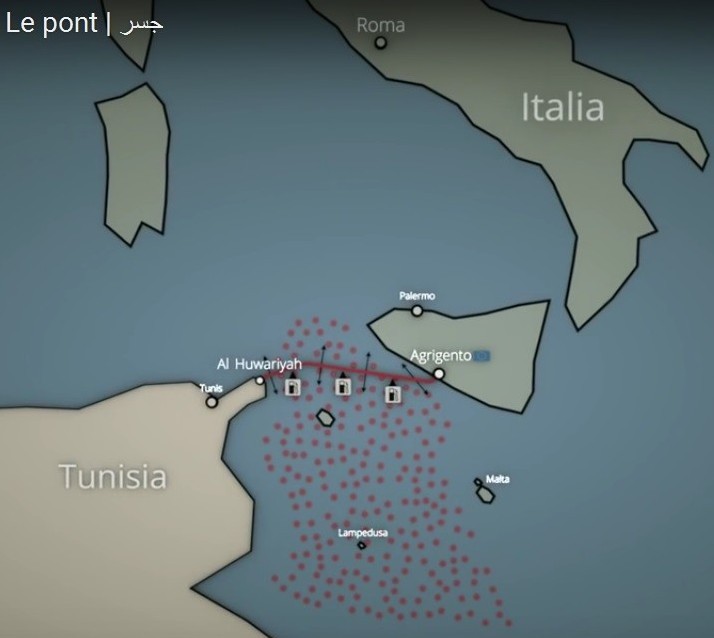
Strabag Corp. is proposing to unleash what amounts to a technologically advanced amphibious attack on native European populations. On October 1rst, a press release inauguration has been set for the first in an exorbitant plan of 1,000 landing platforms to be deployed in the Mediterranean. In light of this, please take note of Kumiko Oumae’s report in the newly established Majorityrights.com News section.
Outreach to exponentially growing African and Middle Eastern populations, with an extravagance of rescue operations to facilitate their migration into Europe - a migratory affliction that would wipe-out native European populations - apparently knows no limits. No expense and detail of concern would be spared while the threat to the very survival of Europeans that these plans augur to aid and abet is ignored.
I would like to take occasion to set out a neglected and important matter for consideration - the hypothesis that “testing” and “lesson giving” are not only underpinnings of liberalism but can be disingenously used and enormously abused as excuses for all manner of trangression. With the false halo of innocence under the rubiric of enlightenment empiricism these ways of looking at the world moved from the laboratories of science to gain vast popularity and practice, not only for the good reasons of solid, verfiable warrant and benign remedies, but also for utility among the populous contra postive traditions and inherited forms - the enlightenment’s prejudice against the superstition of prejudice can serve as powerful and destructive warrant in the wrong hands, giving thoughtless actions, ill-considerd for their ramifications, an ostensible appearance of noble precedent. For decades now, I have been considering the idea that “lesson giving” could provide a convenient excuse for liberalism, viz. as an excuse for those taking liberties by its means and in regard to the effect on those who are more or less violated by the taking of liberties, which is then written-off as “a lesson.” I saw that the idea of “testing” could also be disingenuously used along with “lesson giving” to provide excuses for excessive license and liberal behavior. I suspected thus, that “testing” and “lesson giving” were being used all too conveniently to bypass accountability to social capital and human ecologies. The excess of these ideas, their pervasiveness and popularity are set in motion at the very theoretical underpinnings of liberalism. To begin, these were a liberation from mere tradition, custom, habit, superstition - e.g., from absurd religious requirements. The evangelizing of these values gradually spread through just about all of the world. Liberalism became the water in which we swim - toxic waters for its impervious linearty, promise of limitless progress, pursued as an impervious and deliberately non-discriminatory technology to the destruction of our peoples in their distinct human ecologies. Liberalism which started out as a liberation from tradition became a pervasive tyranny of its own, requiring a second liberation. Nevertheless, to begin, and to some extent always, the empirical project of suspending belief, testing and learning from the results is a positive liberation and compelling for some very good reasons. Even so, testing and lesson giving become overvalued for their material yield, of course, and as a holdover of the enlightenment’s own customs, habits, positive attributes in culture and peoples. There remains a willful naivete of these notions which is very compelling, seductive as it combines a promise of both innocence and powerful warrant; to get there, however, requires theoretical detachment from human agency, subjectivity, social relevativity and with that, a detachment from accountability - leaving adherents susceptible to the disingenous: the perversion of these notions to the point of hyperbolic liberalism is largely a result of Jewish academia, media and political manipulation; but also provides convenient excuses for objectivists to disingenuously accrue power; while the promotion of objectivism at the same time serves as a means of creating a naivete ripe for exploitation as it finds its way down to an intransigence in pop-culture. Left unaccountable, unsophisticated by the post modern turn and in the wrong hands (e.g., popular puerile hands and those who would pander to them), these ideas can provide almost boundless excuses for the most destructive liberal behavior. Just about anything can be written-off as “testing” and “lesson-giving.” Thus, it is an eminently worthy consideration for Majorityrights to engage and focus on these matters which underwrite liberalism. We need to understand where they go too far, what qualitative and quantiative limitations there should perhaps be and by contrast also the proper applications - post modernity does not only evaluate progress but the value of tradition and inherited forms as well. I would call attention to the detriment of the popular application of the empirical view, in its tendency to focus on momentary and episodic units of analysis, while doing violence to relational and cultural/systemic processes and ecology; with that, rupturing historical evolutionary patterns. At this very moment I realize that I have been misunderstood previously as not recognizing that science proper is capable of taking patterns into account. Of course it can. Let me correct that here by noting that it is especially in the popular manifestation of empiricism through enculturation of the enlightenment project, in turn instigated for hyperbolic liberal purposes by YKW, that this “empiricism” is conducted with crass and destructive carte blanche. We call these problems of “modernity” while recognizing that they have been twisted and exaggerated beyond all reason by the YKW. They (the YKW) have done the same to post modernity, to where it is unrecognizable as the postive correction to modernity that it was meant to be (e.g., a liberation from mere facticity and a capacity to reconstruct traditional and inherited forms where good and benign). That is why I have been so vigilant to articulate the post modern remedy for the public project as it is supposed to be - as a means to manage the best and worst of modernity and tradtional/inherited forms. I have called attention to the fact that hermeneutics and social constructionism proper provide a post modern remedy - especially for the public - to help them away from this myopic, scientistic focus and disingenuous bypassing of accountability that filters down from the specialty of the scientist to common, everyday, popular menality and practice. I have called attention to the fact that reconstructing the validity and warrant of social classification (viz., “race”) is necessary to provide delimitation to calibrate, regulate and govern accountability to systemic historical processes and human ecology. I have indicated that the idea of sacrament (monogamy, life-long and or partner-wise) must be introduced for people to have the authentic freedom of choice within and between group relations. Particularly as ritualized, this would re-connect the episode (the empirical) to the broader relational and historic pattern - accountability to its ennobling and caring ensconement. It is a connection of accountbility to the historical systemic group pattern. It provides integrity to the whole group - and a control variable, if you want to look at it scientifically. But these are only the broadest outlines. I have yet to get people to participate in this critique and remedy of modernity and of its Jewish distortions, despite its obvious necessity and importance as it bears upon our experience of runaway liberalism to the detriment of our group’s human ecology. Hence, I pluck-out and focus on the popular abuse of these two enlightenment memes: “testing and lesson giving.” Consider with me, if you will, where the use of these memes are valid and where they become abuse. And what to do in remedial application? How does it work? How can you know things before you test them thoroughly? How do you know if your partner is, or will be appropriate enough unless you “test” them? Can “testing” be relied upon to provide an accurate assessment? Testing can have an episodic bias and focus to the detriment of the relational and protracted cultural/systemic patterns. A lesson may be too costly. The problem and the question is to provide practical means for assessment when trying to correct for the potential reckage of an over-emphasis on “testing” (writing-off caution), “lesson giving” (writing off the damage) and its resultant liberalism. Testing and lesson giving create a problem for accountability. These ideas are all too facile. The “tester” can apparently always justify the test as providing a lesson and postive feedback therefore - even if the consequences were negative in the sense of being destructive to individuals, relationships and the cultural/systemic pattern. Hermeneutics seeks to amend this relation blindness with the inclusion of broader social systemic historical views.
|
|

Existential IssuesDNA NationsCategoriesContributorsEach author's name links to a list of all articles posted by the writer. LinksEndorsement not implied. Immigration
Islamist Threat
Anti-white Media Networks Audio/Video
Crime
Economics
Education General
Historical Re-Evaluation Controlled Opposition
Nationalist Political Parties
Science Europeans in Africa
Of Note MR Central & News— CENTRAL— Ukraine, Israel, Taiwan … defend or desert by Guessedworker on Sunday, 14 April 2024 10:34. (View) Patriotic Alternative given the black spot by Guessedworker on Thursday, 14 March 2024 17:14. (View) On Spengler and the inevitable by Guessedworker on Wednesday, 21 February 2024 17:33. (View) Twilight for the gods of complacency? by Guessedworker on Tuesday, 02 January 2024 10:22. (View) — NEWS — Moscow’s Bataclan by Guessedworker on Friday, 22 March 2024 22:22. (View) Soren Renner Is Dead by James Bowery on Thursday, 21 March 2024 13:50. (View) Collett sets the record straight by Guessedworker on Thursday, 14 March 2024 17:41. (View) CommentsThorn commented in entry 'Soren Renner Is Dead' on Fri, 19 Apr 2024 20:43. (View) James Bowery commented in entry 'Soren Renner Is Dead' on Fri, 19 Apr 2024 19:16. (View) Thorn commented in entry 'Soren Renner Is Dead' on Fri, 19 Apr 2024 15:33. (View) James Bowery commented in entry 'Soren Renner Is Dead' on Fri, 19 Apr 2024 14:42. (View) James Bowery commented in entry 'Soren Renner Is Dead' on Fri, 19 Apr 2024 14:38. (View) Al Ross commented in entry 'On Spengler and the inevitable' on Fri, 19 Apr 2024 06:23. (View) Al Ross commented in entry 'Soren Renner Is Dead' on Fri, 19 Apr 2024 05:55. (View) Al Ross commented in entry 'Soren Renner Is Dead' on Fri, 19 Apr 2024 05:26. (View) Thorn commented in entry 'Soren Renner Is Dead' on Thu, 18 Apr 2024 22:58. (View) Thorn commented in entry 'Soren Renner Is Dead' on Thu, 18 Apr 2024 20:49. (View) Guessedworker commented in entry 'Soren Renner Is Dead' on Thu, 18 Apr 2024 18:00. (View) James Bowery commented in entry 'Soren Renner Is Dead' on Thu, 18 Apr 2024 16:22. (View) James Marr commented in entry 'Soren Renner Is Dead' on Wed, 17 Apr 2024 14:44. (View) James Marr commented in entry 'Soren Renner Is Dead' on Wed, 17 Apr 2024 14:35. (View) Guessedworker commented in entry 'Soren Renner Is Dead' on Wed, 17 Apr 2024 10:33. (View) shoney commented in entry 'Soren Renner Is Dead' on Wed, 17 Apr 2024 06:14. (View) Thorn commented in entry 'Soren Renner Is Dead' on Sat, 13 Apr 2024 18:22. (View) James Marr commented in entry 'Soren Renner Is Dead' on Sat, 13 Apr 2024 15:33. (View) Al Ross commented in entry 'Moscow's Bataclan' on Sat, 13 Apr 2024 07:06. (View) Al Ross commented in entry 'Moscow's Bataclan' on Sat, 13 Apr 2024 05:28. (View) Al Ross commented in entry 'Moscow's Bataclan' on Sat, 13 Apr 2024 05:12. (View) Al Ross commented in entry 'Moscow's Bataclan' on Sat, 13 Apr 2024 05:09. (View) James Bowery commented in entry 'Soren Renner Is Dead' on Fri, 12 Apr 2024 13:15. (View) Thorn commented in entry 'Moscow's Bataclan' on Thu, 11 Apr 2024 14:13. (View) Thorn commented in entry 'Moscow's Bataclan' on Thu, 11 Apr 2024 14:05. (View) Thorn commented in entry 'Moscow's Bataclan' on Thu, 11 Apr 2024 12:28. (View)  
|


 “The FCC’s case against net neutrality rests on a deliberate misrepresentation of how the internet works”,