|
|
|
[Majorityrights Central] Three possible forms of a Ukrainian victory ... and a Russian defeat Posted by Guessedworker on Thursday, 16 April 2026 16:36. [Majorityrights Central] “If America doesn’t learn ...” Posted by Guessedworker on Sunday, 22 March 2026 17:52. [Majorityrights News] Gerdes on the possible sea-change in the Ukraine War? Posted by Guessedworker on Friday, 20 March 2026 21:45. [Majorityrights Central] Some intel on the Islamic Revolutionary Guards Corps Posted by Guessedworker on Thursday, 12 March 2026 23:32. [Majorityrights Central] Defining the borders of the English kin-group Posted by Guessedworker on Wednesday, 11 March 2026 23:51. [Majorityrights News] Jason Jay Smart on the approaching collapse of Putin’s reign Posted by Guessedworker on Wednesday, 11 March 2026 22:42. [Majorityrights Central] Empires, the Chinese Mind, a theoretical nationalism of ethnicity Posted by Guessedworker on Saturday, 14 February 2026 01:54. [Majorityrights Central] Gemini - not an identical twin to ChatGTP Posted by Guessedworker on Friday, 06 February 2026 16:58. [Majorityrights News] Warburg on the impact of Russian forces’ loss of access to Starlink Posted by Guessedworker on Friday, 06 February 2026 10:17. [Majorityrights News] Toast à la Little Saint James Posted by Guessedworker on Wednesday, 04 February 2026 23:48. [Majorityrights News] Southport, migrant hotels, the national flag, and Amelia Posted by Guessedworker on Monday, 02 February 2026 00:14. [Majorityrights Central] Argot Rosetta Stone For GW/Heidegger/Etter Posted by James Bowery on Saturday, 31 January 2026 17:18. [Majorityrights Central] ChatGPT redux Posted by Guessedworker on Thursday, 29 January 2026 01:11. [Majorityrights News] The national revolution in Iran cannot be stopped Posted by Guessedworker on Saturday, 10 January 2026 00:38. [Majorityrights Central] Into the authoritarian world redux Posted by Guessedworker on Saturday, 03 January 2026 17:56. [Majorityrights News] Moscow Times: Valdai residents report no sign of drones attacking Putin residence Posted by Guessedworker on Tuesday, 30 December 2025 11:33. [Majorityrights News] Paul Warburg on America’s self-destructive new strategy Posted by Guessedworker on Tuesday, 16 December 2025 12:32. [Majorityrights Central] Thoughts on Mark Collett’s strategy for nationalism in the British future Posted by Guessedworker on Friday, 24 October 2025 15:01. [Majorityrights Central] Living in the Jewish Mind: Part One Posted by Guessedworker on Monday, 29 September 2025 09:37. [Majorityrights News] Nationalism on the Kramatorsk front. Posted by Guessedworker on Saturday, 20 September 2025 15:55. [Majorityrights Central] And Chat GPT just the same Posted by Guessedworker on Monday, 08 September 2025 15:18. [Majorityrights Central] Grok the modern nationalist Posted by Guessedworker on Sunday, 07 September 2025 19:14. [Majorityrights Central] Principles, parts, processes of ethnic nationalism, Part 1: inflection? Posted by Guessedworker on Thursday, 31 July 2025 12:03. [Majorityrights Central] A window onto a world of Russo-Chinese hegemony Posted by Guessedworker on Tuesday, 08 July 2025 20:47. [Majorityrights Central] The DT takes the first step on the journey Posted by Guessedworker on Thursday, 03 July 2025 05:02. [Majorityrights News] Iranian comment machine switched off by Israeli bombs Posted by Guessedworker on Wednesday, 25 June 2025 09:07. [Majorityrights Central] After Casey and the ensuing child sexual exploitation inquiry Posted by Guessedworker on Tuesday, 17 June 2025 00:21. [Majorityrights News] 4 minutes and 43 seconds of drone warfare history - updated Posted by Guessedworker on Wednesday, 04 June 2025 16:50. [Majorityrights Central] An approaching moment of Russian clarity Posted by Guessedworker on Sunday, 11 May 2025 12:34. [Majorityrights Central] “It’s started. You ignored us. See where it’s going to get you.” Posted by Guessedworker on Sunday, 04 May 2025 00:42. [Majorityrights News] Another dramatic degradation of Russia’s combat capacity Posted by Guessedworker on Wednesday, 23 April 2025 08:49. [Majorityrights Central] A British woman in Ukraine and an observer of Putin’s war Posted by Guessedworker on Monday, 14 April 2025 00:04. [Majorityrights News] France24 puts an end to Moscow’s lie about the attack on Kryvyi Riy Posted by Guessedworker on Monday, 07 April 2025 17:02. [Majorityrights News] If this is an inflection point Posted by Guessedworker on Thursday, 03 April 2025 05:10. Majorityrights Central > Category: The Ontology Projectby Grimoire
The movie premiered eleven years ago, and most of us will have seen it. Many remember our thoughts as we sat to the end and then walked out onto the street and had a minute to think. What made this movie so intriguing was the idea that the oppression imposed by the matrix … ‘The Powers That Be’ … was so enormous, so persuasive, so seamless, that for most people the oppression, the matrix of lies, had become as invisible and unnoticed as the air we breathe.
by Potential Frolic Teleology is the attempt to become an image of greatness, or perfection, or fruition. Previously, we looked at reasons why Palingenesis has negative aspects attaching to its political program, and how these negative aspects mar its positive aspect, which is unification of a people. In moving from a discussion of Palingenesis to a discussion of Teleology, we’re moving from the social level to the individual level. Palingenesis regulates how social entities relate to each other, using politics and philosophy as means. Teleology regulates the relation of men to themselves, within the confines of their own minds, using images and rationalization as means. It is thus more intimate, and much more interesting. Teleology precedes palingenesis. This is because the ideological underpinnings of palingenesis were conceived for the purpose of realizing teleological striving. For example, it was the struggle of individuals to reconnect to historical precedents, a connection to which is only possible in imagination, which begot the political manifestation of same. It was the intelligent individual’s realization of his smallness on the historical stage, and his desire to draw to himself more weight and meaning, that forged the rhetorical connections to ancient Germania and Hellas in germans of the 19th century. This can be seen, for example, in the philological posturing of Friedrich Nietzsche, alledging a special connection to ancient Hellas, discovered uniquely by him in his readings. The actual accuracy of his assertions in The Birth of Tragedy - assertions not less sweeping than those he would make in later books - were demolished in a point-by-point critique by Wilamowitz. Not that this detracts from the philosophical content of his writings. It can be seen however, that the appeal to ancient greek authority is important in 19th century literary personality combat. One finds similar idea content in Evola.
This essay is a wee bit outside of my usual stamping ground, but it is in the nature of lighting the blue touch-paper - just in case anyone wants to address this subject properly! I’m going to begin with a quote from Martin Heidegger’s Being and Time, division 2, section 75 (Blackwell translation), published in 1927:
To my mind, this short passage describes, in Heidegger’s difficult and relentlessly particular terminology, the fractured and scattered state of our ordinary inner life, a scattering effected through the tendency of ordinary waking consciousness to elide into and attach itself to externalities, psychologically speaking. The nett result is a profound absence which many reading this will recognise in their own experience. We still ascribe qualities of self-hood to it, of course. We can never cease doing that. But it is a self-hood with a history rather than a presence in the moment (though that takes us further towards the metaphysical than Heidegger intended - all Dasein is historical in his formulation).
by Potential Frolic I want to explain my struggle with the idea of Palingenesis and what it has taught me about nationalism and myself. The desire to do this flows from frequent encounters here and elsewhere with “the Palingenetic Necessity”, which I define as the conviction that no other model of political action can support white survival in our times. Understanding the problem Seeing the destructive forces working upon our peoples presently, and fearing very much for his own survival and that of his people, the (folkish) nationalist turns his eye to Palingenesis, which presents itself as the opposite to today’s politics of ethnic suicide. The goal of Palingenesis is to renew the values of a supposed heroic and glorious past, these values being assumed to be real and contingent even if the past in question is only a myth, and to venture towards heroism and glory in the present. GW has argued that advocates of Palingenesis are not necessarily good psychologists. They do not take account of the fact that the man is of the time in which he is born, decadent or otherwise, and carries only two possibilities within himself: (i) to belong to that time and have no truck with, or even knowledge of, the truth of his Self, or (ii) to seek out truth even at the cost of turning away - if someone tells him how - from time and place and artifice. There is no special third option for the rebirth of the spirit as heroism and glory, according to GW. Heroism and glory are not characteristics of the true Self but of immersion in violence. They can only appear in time and place, therefore, and cannot be different to or better than the rest of the artifice. They are a beautiful deception - in fact, a bastardization for the purpose of reifying political violence. As psychology, then, Palingenesis as it appears in fascism and revolutionary conservatism is a sham, albeit an alluring one. It answers the following two wholly utilitarian questions in the positive:
Now I am returning to the issue of consciousness and the absence of self with which I began Part 1 of this post. It is only my own view, and it isn’t original. It is also entirely open to challenge by anybody who understands these matters better than I do - and there must be many. It is usual in Western thought for the question of the self to be treated as an epistemological issue. But what I am really setting out to do in this series is to recover from the sloppy psychological models of the past - all that couch-talk about the unconscious, the subconscious, the collective unconscious, and so on, for those workings of the mind which proceed in us quite without our assistance, and over which we presume sovereignty. I’ll begin with a thumbnail sketch of the hardware, so to speak, of the mind. Some observations about the much more interesting and altogether too, too fallible software will follow in the next post. Neurologically, all sentient organisms have one or more systems which project the consciousness of self, insomuch as that hologrammatic thing can be said to exist. These are not coterminous with the divisions in the human brain and nervous systems but, largely excepting thought it seems, are distributed across them. They activate different areas of the brain. They are separate from the visceral nervous system. I contend that they have evolved out of the most nascent awareness of sexual division, selection and self-maintenance. In other words, the survival strategy of sensing, to borrow the old German Idealist term, “the thing that is” beyond the organism itself is the only reason for human self-awareness and self-interest. The “hardware”
OK, I said I wouldn’t do this. But, well … you know. This is the first of two posts on an alternative to the politics of spiritual regeneration - always assuming that the reader understands (a) that some systemic replacement for liberalism is necessary, and (b) that the current American empirical offerings lack motive power. The second part will carry forward some of the arguments here and sketch out a model of Mind as a contribution, I hope, to the search for a new and syncretic founding theory.
With these words Madeleine Bunting, the occasionally sensible but mostly Moslem-mad Guardian Woman, signposts the left’s remaining recourse in a world made hostile by neuroscience. Moslem Maddie’s problem, you see, is that she has heard the rumours that the eponymous self of liberal self-authorship fame does not, in fact, exist. “This”, she says, “is the kind of stuff which challenges almost everything you’re used to thinking about yourself.” And about your politics, if you are a radical individualist as she is. She writes:
That’s a rather dramatic way of putting it, of course. The constant flow of affirmations of self are wholly legitimate from an evolutionary standpoint. The illusion of self exists even if self does not, and it is no less a product of evolution for that. Genes for “self-ishness” and self-preservation are privileged for the fitness gain they offer. So, what now for the left? Cue the decampment, perhaps, from the half of the liberal project that pursues the unfettered will into the egalitarian and social democratic half? Well, that may not be necessary. A strange and unnerving synthesis of the two halves, of a self-authorship and a state-mandated compassion that were never entirely reconciled in the past, may just be coming down the turnpike:
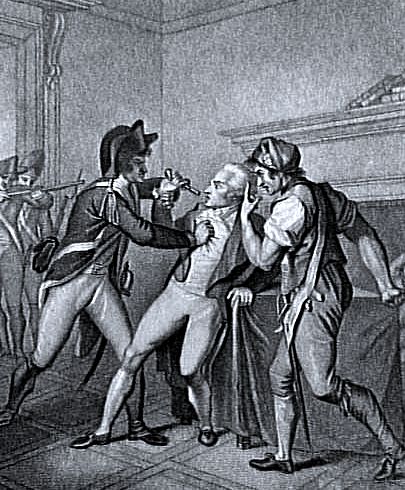
by Happy Cracker Ontology is the study of being, and the reason why such a simple concept is gifted such lofty Greek-derived nomenclature is to underscore the need for sufficient circumspection in this endeavor. We are just now recovering from a period where a flowering of scientific methodology, and the resulting accumulation of knowledge, have lead to a breakdown in our ontological models of the world. The adoption, implementation and breakdown of ontological models due to accumulation of contradictory scientific knowledge, can be visualized as a series of parabolic figures on a coordinate plane. The x-axis represents historical time and the y-axis represents certainty of ontological knowledge. The parabola thus represents the adoption, implementation and breakdown of the ontological model - consistent with a rise, peak and fall in the certainty or belief in this knowledge. Some parabolas are in series, such as Rousseau’s “Natural Man” and Robespierre’s terror-as-virtue Republicanism: “The first man who, having fenced in a piece of land, said “This is mine,” and found people naive enough to believe him, that man was the true founder of civil society. From how many crimes, wars, and murders, from how many horrors and misfortunes might not any one have saved mankind, by pulling up the stakes, or filling up the ditch, and crying to his fellows: “Beware of listening to this impostor; you are undone if you once forget that the fruits of the earth belong to us all, and the earth itself to nobody.” Decades later, the nature of man had changed; Robespierre needed to use the state to enforce terror in order to create a virtuous order:
It appears to be the season for lecture series. BBC Radio 3 has been hosting its Free Thinking 2008 series, involving approximations to wisdom and originality by a colourful variety of folk. One of these is the smooth-mover of the MultiCult, Trevor Phillips, who has discerned six questions, no less, which liberal democracy cannot answer. Sadly, when he last had a proper job is unlikely to be one of them. The BBC has a 7-day storage system for its radio output. So I will listen to Trevor tomorrow and, if he is remotely interesting, I will post accordingly. But now I want to focus on last night’s speech by the only slightly wierd writer, broadcaster and lecturer in psychology, Susan Blackmore. Her subject was one close to my own heart: The myth of Free Will. In my last post on it I explained the significance of an absence of free will in humans thus:-
Susan Blackmore is a lot closer to the action than I am, and these are the significant passages from her lecture:-
Page 7 of 7 | First Page | Previous Page | [ 5 ] [ 6 ] [ 7 ] |
|
Existential IssuesDNA NationsCategoriesContributorsEach author's name links to a list of all articles posted by the writer. LinksEndorsement not implied. Immigration
Islamist Threat
Anti-white Media Networks Audio/Video
Crime
Economics
Education General
Historical Re-Evaluation Controlled Opposition
Nationalist Political Parties
Science Europeans in Africa
Of Note MR Central & NewsCommentsThorn commented in entry 'Trout Mask Replica' on Wed, 04 Feb 2026 00:45. (View) Thorn commented in entry 'Slaying The Dragon' on Tue, 03 Feb 2026 23:41. (View) Guessedworker commented in entry 'Slaying The Dragon' on Sun, 01 Feb 2026 18:47. (View) James Bowery commented in entry 'Slaying The Dragon' on Sun, 01 Feb 2026 17:55. (View)  
|