|
|
|
[Majorityrights Central] Ukraine, Israel, Taiwan … defend or desert Posted by Guessedworker on Sunday, 14 April 2024 10:34. [Majorityrights News] Moscow’s Bataclan Posted by Guessedworker on Friday, 22 March 2024 22:22. [Majorityrights News] Soren Renner Is Dead Posted by James Bowery on Thursday, 21 March 2024 13:50. [Majorityrights News] Collett sets the record straight Posted by Guessedworker on Thursday, 14 March 2024 17:41. [Majorityrights Central] Patriotic Alternative given the black spot Posted by Guessedworker on Thursday, 14 March 2024 17:14. [Majorityrights Central] On Spengler and the inevitable Posted by Guessedworker on Wednesday, 21 February 2024 17:33. [Majorityrights News] Alex Navalny, born 4th June, 1976; died at Yamalo-Nenets penitentiary 16th February, 2024 Posted by Guessedworker on Friday, 16 February 2024 23:43. [Majorityrights News] A Polish analysis of Moscow’s real geopolitical interests and intent Posted by Guessedworker on Tuesday, 06 February 2024 16:36. [Majorityrights Central] Things reactionaries get wrong about geopolitics and globalism Posted by Guessedworker on Wednesday, 24 January 2024 10:49. [Majorityrights News] Savage Sage, a corrective to Moscow’s flood of lies Posted by Guessedworker on Friday, 12 January 2024 14:44. [Majorityrights Central] Twilight for the gods of complacency? Posted by Guessedworker on Tuesday, 02 January 2024 10:22. [Majorityrights Central] Milleniyule 2023 Posted by Guessedworker on Friday, 22 December 2023 13:11. [Majorityrights Central] A Russian Passion Posted by Guessedworker on Friday, 22 December 2023 01:11. [Majorityrights Central] Out of foundation and into the mind-body problem, part four Posted by Guessedworker on Saturday, 02 December 2023 00:39. [Majorityrights News] The legacy of Richard Lynn Posted by Guessedworker on Thursday, 31 August 2023 22:18. [Majorityrights Central] Out of foundation and into the mind-body problem, part three Posted by Guessedworker on Sunday, 27 August 2023 00:25. [Majorityrights Central] A couple of exchanges on the nature and meaning of Christianity’s origin Posted by Guessedworker on Tuesday, 25 July 2023 22:19. [Majorityrights Central] The True Meaning of The Fourth of July Posted by James Bowery on Sunday, 02 July 2023 14:39. [Majorityrights News] Is the Ukrainian counter-offensive for Bakhmut the counter-offensive for Ukraine? Posted by Guessedworker on Thursday, 18 May 2023 18:55. [Majorityrights News] Charles crowned king of anywhere Posted by Guessedworker on Sunday, 07 May 2023 00:05. [Majorityrights News] Lavrov: today the Kinburn Spit, tomorrow the (New) World (Order) Posted by Guessedworker on Friday, 07 April 2023 11:04. [Majorityrights Central] On an image now lost: Part One Posted by Guessedworker on Friday, 07 April 2023 00:33. [Majorityrights News] The Dutch voter giveth, the Dutch voter taketh away Posted by Guessedworker on Saturday, 18 March 2023 11:30. [Majorityrights Central] News of Daniel Posted by Guessedworker on Friday, 03 March 2023 05:18. [Majorityrights Central] A year in the trenches Posted by Guessedworker on Tuesday, 28 February 2023 00:40. [Majorityrights Central] Talking to normies about fascism Posted by Guessedworker on Friday, 10 February 2023 06:33. [Majorityrights News] British Treasury and Bank of England manoeuvre towards CBDC Posted by Guessedworker on Saturday, 04 February 2023 22:44. [Majorityrights Central] What lies at the core Posted by Guessedworker on Tuesday, 24 January 2023 00:01. [Majorityrights Central] Elite contests and contradictions: Part 2 Posted by Guessedworker on Wednesday, 18 January 2023 00:30. [Majorityrights News] At Davos the Chinese change strategy Posted by Guessedworker on Tuesday, 17 January 2023 23:20. [Majorityrights News] Mission creep takes a hit at the Fed Posted by Guessedworker on Wednesday, 11 January 2023 00:39. [Majorityrights Central] Hat-tip to Woes Posted by Guessedworker on Sunday, 01 January 2023 00:11. [Majorityrights Central] Scott Mannion and the being of the English Posted by Guessedworker on Saturday, 10 December 2022 01:12. [Majorityrights Central] Neil Oliver: The Re-Set has already happened Posted by Guessedworker on Saturday, 03 December 2022 22:42. Majorityrights Central > Category: Genetics & Human Bio-DiversityToday the Telegraph reported on an academic paper commending a new lexicography of race and ethnicity in order to combat very, very naughty racist thoughts by white men:
Dr Birney is actually Prof Birney, and as well as holding other positions in the gene biz he is a co-director of the European Bioinfomatics Institute, the “home for big data in biology”. Oddly, this rather large and, no doubt, exceedingly well-funded organisation does know what race is when it needs to:
Along with himself, Prof Birney credits five colleagues with the writing of the paper, which is titled “The language of race, ethnicity, and ancestry in human genetic research”. They set out their case thus:
Prof Birney also has a blog, which he has not used much, it must be said. But his last but one post back in 2019 was titled “Race, genetics, and pseudo-science: an explainer”, and it explains that:
Denying race is a form of professional lying, which is invariably undertaken by otherwise educated people “because racism”. Prof Birney could as easily prove the taxonomic validity of race as disprove it - a fact my good friend John Standing thought he might demonstrate to the anti-racist Prof by way of some emailed questions, as follows:
Over the last couple of weeks the political right in Britain has been making some noise about the English teacher Will Knowland, who was fired some weeks ago for gross misconduct from his post at Eton. His crime was to prepare a lecture, titled The Patriarchy Paradox, to be given to older students in the school as part of a Perspectives course, his object being to present a view of masculinity which they may not otherwise encounter in these “woke” times. Knowland’s mistake was to assume that a balanced perspective is part of the continuing rounded education that the £42,500-a-year boarding school has provided to the sons of the well-to-do for nearly six centuries. Sadly, we no longer live an age when a full-informed and educationally-rounded type is required among the future leaders of society. Eton, under its progressive headmaster Simon Henderson, is right behind the “woke” agenda. James Delingpole at Breitbart takes up the story:
Knowland had prepared the lecture in video form, and when he was prevented by the lock-down from giving it to his students face-to-face he uploaded it to his YouTube page. Henderson demanded that it be taken down. Knowland asked for one good reason, and was summarily dismissed. He is appealing against his dismissal and raising funds for a full tribunal hearing in the event that that appeal fails. Meanwhile, the video has been viewed not by a hundred or so senior Eton students but by nearly 28,000 YouTube viewers. Here it is, in case you are wondering - it’s very good; and it has led to Stephen Pinker, among many others, actually writing to William Waldegrave, the chairman (Provost) of the Board of Governors of the School, asking for him to intervene with Henderson. My point, however, is that today the Telegraph reports that:
Well, it is difficult to imagine these sturdy and still very young men protesting in the same way if the roles were reversed and they were unable to hear the case for toxic masculinity. They demonstrate a distinct interest in the sociobiological facts of being human, and a great appetite for some understanding of their own male being amid the plethora of feminist accounts and claims of gender-fluidity. It is a demonstration of a principle to which I know that, in a wider sense also taking in the race issue and the constraint, indeed forced obsolescence of young white American men, James Bowery subscribes: young men do desire to find value for themselves in this world, and will act against those forces, if they possibly can, which take that value away. They just need a good and thoughtful guide and perhaps a bit of evolutionary psychology.
 Within days I will set up a website to advance the best in White advocacy/nationalism as it is known to be - a place for the resource brought to bear, for its cultivation by those who recognize the crucial value of this resource. I will endeavor to maintain a presence at Majorityrights in order to correct any misrepresentations of my positions and to challenge any perfidy which might make its way back, hoping for my riddance. Some may think that I might be disheartened with the marketing campaign and those beholden to it having held sway over me thus far, but it is not the case. Some will mock me as having spent my time in futility, but I think not; especially as compared to the likes of those who spend $10,000 only to die on the side of Mt. Everest. I have achieved what I set out to do, which is to summit (what I am satisfied to be) the most vital and necessary in theory for the advocacy of European peoples. Similar as those not understood for having undertaken a quest of Mount Everest, it was my objective. Something that I had to do. But unlike their project, mine was not so personal or futile; rather it was in service to my broad understanding and to our people (and, ok, if I am to be most honest, perhaps as much against antagonists and those who do not care - their practices which are objectionable for the destructive impact they are having upon us), and against those who time and again mislead the theoretical trail; by contrast, I have left clear maps on trail for the sovereignty of European peoples: I know that I have brought the best in truth and in depth; while some may be determined to deny this truth out of custom, habit, tradition, their prejudices or vanity - or in red caped misdirection, as I have particularly shown - all one has to do is take a look honestly at my efforts which I will carry over to the new site to be disabused of pseudo justification for antagonism to the platform which I bring to bear. Whether the new site achieves popularity or not right away is not an issue; any more than popular approval might not be first in mind for the guy who dies on the side of Mt. Everest, singularly focused in his aim, irrespective of how futile and impractical popular opinion may deem his quest to be; however, by contrast, the objective of the new site is not vain nor impractical, nor destined to be unpopular or out of the mainstream as those who do take a look will see; as the perspicuous overview from this summit has shown what is most relevant; a manifestation of the most necessary resource for our people.
Attack on our group/genus is clear, so is need for our defense: Euro-DNA Nations back front & center In brief:  The DNA Nation concept is a means to coordinate people of European extraction - i.e., on the basis of genetics: genus and species (European race and national kinds) worldwide; thereby facilitating organization of 1) our European genus and species in diaspora together with 2) our native European people to maintain their distinct native genetic kinds and national interests; including the aim to secure their national borders; and to 3) coordinate our European diaspora and native Europeans together in genus and species to establish sufficient economic base, power base, organizational boundaries and territories worldwide to defend and advance our kind. .......
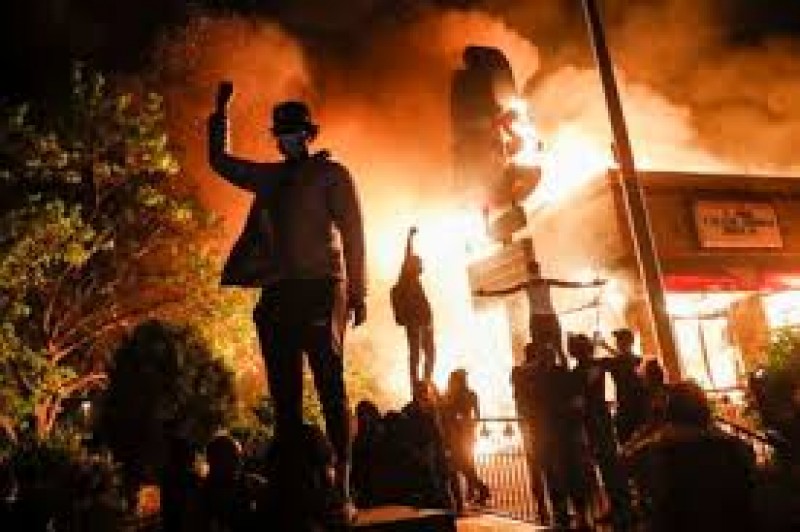
 With race riots having broken out in cities all over the United States (and elsewhere), it should now be clear to even the normiest boomer-civnat that Whites are under attack as a race, i.e., as a group - we (White men, in particular) are low man on the totem of the progressive stack of intersectional victim groups. We obviously have to look after our own.  Dallas man tried to assert himself and defend his property alone against the hyper-assertive black element. Dallas man tried to assert himself and defend his property alone against the hyper-assertive black element.While the more sensible among us have observed the destruction to our precious Ethnic Genetic Interests for decades as a result of liberalization of our national borders and group boundaries, the Covid-19 pandemic signaled a paradigmatic shift to broad consciousness that malign factors may cross national borders and interpersonal boundaries; and the state response of closing borders and requiring social distancing revealed that border and boundary maintenance can be done, even if this permutation was not done expressly for the protection of our European genetic kinds.
But we have a more flexible means for protecting our kinds, where the state and those in power are antagonistic and block the means to secure our European kind, sicking aliens and out-groups upon us to no end, and that is the perennial form in which a people fight off oppressive, exploitative and destructive elites: We may unionize our people for the sake of the aforementioned three purposes - otherwise scattered diaspora, our discrete species of native nations and the over-arching power of our genus. The time is ripe to promote this organization in defense of our interests; the need should be clear to all. Take advantage of C-19 lockdown to squeeze-out the middle class as they might, as they would, what is the proper response to elite oppression? It is unionization (or some analogous means of organizing our people). Then we can begin the course of marshaling our nations and economy to serve our interests as opposed to elite parasites. Yes, unionization, social organization, is traditionally considered to be a leftist concern (about a broad union of people, with power largely managed by accountability to deliberately delimited boundaries as opposed a “magic hand” wielded acutely, narrowly against the group, supposedly warranted as “purely” and as much without debt to their people as you’ll let them get away with asserting), but unionization of the group is not necessarily an anti-nationalist concern at all. On the contrary, social responsibility, accountability through unionization of national boundaries fit together like a hand and glove - unionization equaling delimitation of group border, providing accountability, providing correctability, which is practically synonymous with group systemic maintenance - corresponding with homeostasis, self corrective systems, autonomy, self governance, sovereignty (what we want and what our enemies try to destroy).
It should dawn on people why our enemies are pushing the anti-left narrative so heavily - they don’t want us to organize against their elite hegemony, the right wing sell outs and licentious liberals that they enlist to their side. And why they altercast “third positionism” as a means of backdoor infiltration and/or destabilization; as opposed to allowing us to define left ethnonationalism for ourselves, to include private property, individual liberties, free enterprise within reason and other means of integrity that Europeans expect within a basis of social accountability.
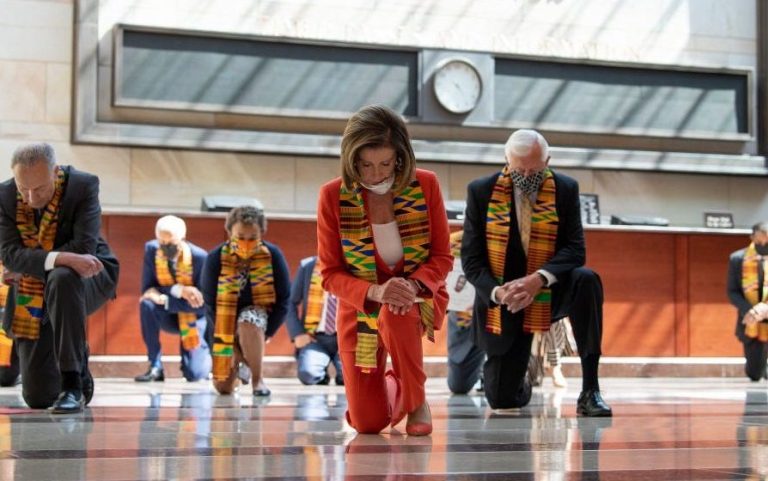
A generation of boomers are still in power, not only holding position (bending the knee in deferential acquiescence to blacks and their backers!) presiding over our liberal destruction but also in power over the reactionaries to liberal destruction; particularly represented by STEM types in intransigence for the relative success afforded by their STEM predilection (marketable skills) and the fortune of post war boom years, where the anti-social story of individual human potential could allow them to burn the social capital stored by the conservatism of prior generations, to remain rationally blinded to their indebtedness to their social capital; and they will tend to think that we simply need to get back to their liberal/objectivist, anti-social ways - it just needs to be applied harder. They are all too ready to believe that the very correction to their over-grazing and irresponsibility is the problem: those “lefties” who seek to create a unionized system of social accountability. But STEM types are notorious dupes to manichean devils.  STEM types, markedly Europeans evolved mostly in response to natural challenges, Augustinian devils, are famously great scientists and engineers and notorious dupes to the Manichean devils coming out of the Middle East, those whose primary challenge was other groups, who thus evolved accordingly, wielding Manichean trickery and deception. Now, science and empirically rigorous, close readings of our peoples deep, emergent nature, requirements for the maintenance of our being, is indispensable. There are several invaluable concepts that GW and Bowery have put forth from that rigorous end of inquiry; e.g., GW’s “being-of” is a great idea, an important centralizing position in hermeneutic process (and not mutually exclusive to the platform that I set out).  However, if the end of rigorous verification is to have orientation and relevant account, it must function within working hypotheses. I like to go with Shotter’s idea of calling these “specificicatory structures”, partly finished concepts which may be elaborated, acted-into and corrected with others. Our borders and boundaries can’t be taken for granted and don’t fall into place in a seemingly perfectly natural way that borders and bounds do for the Japanese, because we have been subject to an array of manichean tricks, for millennia now, to rupture our borders and bounds. Furthermore, as the STEM predilection is attuned to precision, binary either/ors and to look for “the one little sublime thing” that might make the circuit go or not and at same time might eliminate redundancy as inefficient, it can be a good habit for engineering, but a vast disservice to the complexity of praxis, the social world, rupturing its organic holisms and multiple agentive interfaces, such that slightly ambiguous concepts, specificatory structures, serve better for their flexible interfacing capacity. Comfortable thus with working hypotheses and not over-valuing precision so much as to misapply it, one is not liable to make a bewilderingly retarded mistake such as hearing that Gregory Bateson “is Jungian” (not true) and therefore that he can be dismissed entirely as otherwise redundant for that one thing (which isn’t even true!). And as I’ve pointed-out before, STEM types have had a leg up in advancing their perspective in the internet age, thus delaying corrections to anti-social perspectives that may tend to adhere to their predilections. It is the other end of orientation - calibration and unionization of our group to provide relevant accountability to our ancient social capital and its future trajectory - that the manichean adversaries of European interests have been assiduously at work against. The concept of the group, particularly as unionized, is the opposite of liberalism (the no-account, toxic ocean in which we swim) because you are conserving what is within and providing, through its “union” structuring, the means of accountability to our group system, which corresponds to correctivity, which is approximately synonymous to group systemic homeostasis (self corrective systems) - which is what we (should) want as a people - functional borders, boundaries to provide autonomy, sovereignty. This structures consciousness as deliberate; you have to love the departure from objectivist, no account liberal whateverism - it is deliberate.  Black daycare worker suffocates 8 month old, CCTV shows dying child thrashing her legs to escape Black daycare worker suffocates 8 month old, CCTV shows dying child thrashing her legs to escapeSpecifically, Europeans are under attack as a group (a race is a group). Generally, the humanities, not harder sciences, are the disciplines which develop means to analyse human groups. Psychology generally focuses on the individual, and as such it is limited in its utility to our group concerns in interaction. While sociology takes the group as its unit of analysis and communicology takes interaction as its unit of analysis. As instruments thus, sociology and communicology are better suited to our concerns - we are under attack as a group in interaction by characteristically antagonistic and manichean (trickster/deceptive) peoples. And as sociology is being weaponized against us, that is all the more reason to take control of it for our interests, not to abandon the group unit of analysis as “Jewish.” That’s ridiculous. Talk about an ostrich putting its head in the sand. Now then, there are many necessary means for understanding and organizing our people that I call White Post Modern in order to distinguished these resources/means from what has been put across by the YKW and their liberal minions as “post modernity” - the many red cape misrepresentations and distortions of the concepts to wield against White interests and to turn White people off to the underlying concepts altogether, crucial though they would be to understand and deploy in White interests.
Black Lives Matter is just one of many anti-White organizations sponsored by (((YKW))) 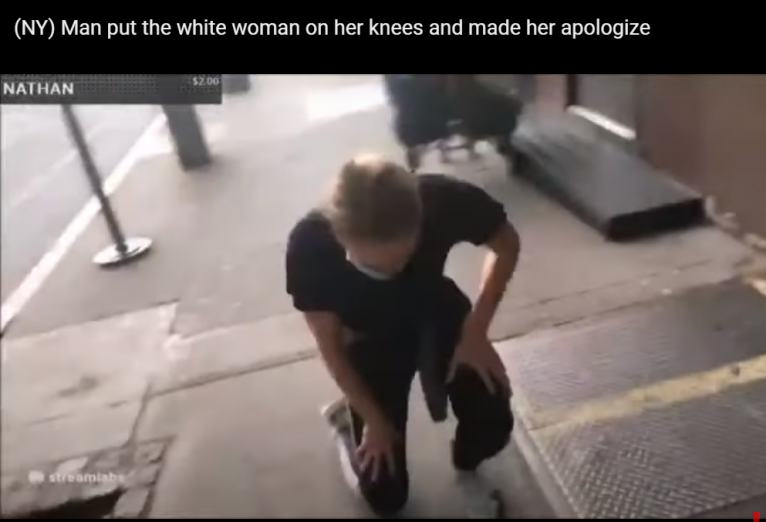 Particularly as they attained greater hegemony than ever in 2008, Jewish power and influence has been determined to maintain those distortions of the humanities weaponized against Whites as representing “THE Left” and “THE Problem” to be solved primarily by Whites joining them on the Cartesian end of pure science, universal truth, facts, Abrahamic god beyond nature, etc. Rationally blinded to what the YKW are doing, in pseudo objectivity, detached from the disingenuousness of our own elite sell-outs, the naivete of the masses who go along with this (((Madison ave))) marketing campaign against “The Left”. Anything but the social accountability and social justice, anything but left ethnonationalism, as its concept of unionization facilitates - no, can’t have that. It’s a threat to Jewish power and influence; a threat to right wing sell outs who take their pay off; a threat to liberals who take anti-social license.
The abuse of the humanities has been so profound in its deployment against Whites that you can hear particularly STEM type Whites in reaction proclaim “Sociology” a false religion. Well, the abuse of sociology into an anti-White religion can be. But to criticize sociology as a discipline as a “false religion” would be like calling a telescope, “bad.”  Again, the social group, which is the focus of sociology, is as relevant as any neutral unit of analysis can be given that we are under attack as a group - a race, attacked by anti-racism. Thus, if sociology is being abused against us, that is all the more reason to take control of the instrument for our interests. Our enemies have devised red capes of social organization throughout the years, Marxism (international a-racial unionization), Cultural Marxism (anti-White unionization), and recently since 2008 have cultivated a characterology of “the left” which they would try to attribute to anybody who tries to apply salutary concepts of the left to White interests, viz, to the ethnonation, saying that you are trying to take away private property, trying to take away unequal outcomes according to merit, that you seek centralized planning etc.. What you really want is to be right wing, because that would suit Jews in their hegemony, don’t want any union of the masses seeking social justice; at least you could show your theoretical sophistication by being neither right nor left? then you could stay obligingly disorganized; failing that, be third position along with knucklehead Keith Woods, so you can introduce Hitler and natural fallacy to help rid the Jews of their mischling problem and put the White unionists to death in war, oblige Jewish provocation as such, for the introduction of that destabilizing element, courtesy the knucklehead. Rather than organizing, unionizing White interests against Jewish power and influence, you can keep on with the program of diverting reaction to the right wing sell-outs the YKW enlist, the liberals the YKW enlist with increasing license.
(((Curtis Yarvin (mencius moldbug)))‘s whole “Dark Enlightenment” was effectively an op against STEM types to further misdirect them from the proper findings and deployment of the humanities. Worse, to dismiss the humanities, the more hypothetical end of inquiry in balance to harder scientific rigor, is to dismiss the most relevant units of analysis for the challenge that we are up against, for anti-racism is anti group classification and (likely necessary) discrimination thereof; while communicology is the study of interactions, e.g., group interactions which may break down group systemic maintenance (a human ecology) or serve to maintain it. And it is to dismiss resource from the humanities unnecessarily, as they should not be looked upon as in conflict but complementary to the more rigorous end, equally indispensable.
However, while I make perfect sense to myself, I have been up against Jewish/Abrahamic interests, the right wing reactionaries they enlist and buy off with low account stories of their independent objective merit, while the liberals, with the same line of independent, objective merit, are bought off more cheaply, i.e., provided more straight forward license (licentiousness) to indulge. Those who react in indignation while not being willing to act against our people’s interests (at least not intentionally), take the right wing altercasting into purity spirals - a wish for “that’s just the way it isnness” to find relief from Jewish rhetorical deception and other manicheanism in the social world (praxis) - but at the serious cost to group organization, accountability and agency. That would be “leftist’ ..can’t do that.” And so when I, an early and quintessential Gen-Xer, seek to correct the rational blindness of Boomers, particularly of the STEM kind, with necessary concepts of social unionization to facilitate accountability to our historic and future genetic capital, given the hideous abuse they have witnessed by means of the red capes of the humanities, given that the Jews want them to continue in their misunderstanding and to identify as right wingers, easily maneuvered, or self destructive, stigmatizing, dividing and disorganizing as such, given the mean and insane anti social reaction that many have gotten into as right wingers, I have been up against far more resistance than I would have expected and far more than I should have gotten.  Now, this has been a bit of digression but I needed to take it on because I haven’t gotten the help that I should have from the boomer STEM types; in fact, I have gotten horrible resistance. The general strawmanning that I’ve been subject to has been absurd, while the platform that I offer is coherent and equipped with important concepts. The idea of unionization as I advocate it should never have met with the kind of resistance it has; and this resistance is likely to be an expression of reaction to abuses of the concept deployed as anti-White or indifferent to White EGI, as with other social concepts organized against Whites; mis-perceived as being inherently anti-White and unusable by Whites therefore, which is absurd; but in truth, the anti-Whitism has been laid-on thick; people’s reacting against “the left” is understandable - it was my reaction until I began to make inferences along with some founding WN fathers turned against the right; and if I had not been privy to the source of inner theoretical workings, i might not be able to penetrate the ostensible either. DNA Nations functions something like a union of unions; coalition of unions; federation. This is not superficial philosophy. It is not mere politics which requires to be put aside indefinitely for some “deeper” science or philosophy. Aristotle takes praxis as the first order of business and Aristotle is the most respected single figure among European peoples for reasons of outstanding judgment in regard to human nature and our requirements. If Praxis, group organization, is out of whack, all other endeavors are liable to be futile. And crucially, in line with Aristotle’s advice, to over apply science and physics (pleroma) to the biological and social world (creatura) of praxis is the classic epistemological blunder which has precipitated some of our worst historical catastrophes.
 Nor do we need to distrust all words, as we are not trying to persuade our enemies but rather seek to make things clear for our people. That is the essence of the post modern project, to call back our people from Cartesian estrangement into a centralization of our group of people (praxis), a unionization delimitation facilitating accountability to ours and coordination with other groups of people and environment that Cartesianism’s objective estrangement can be oblivious-to.
 Richard looking down unironically on the post modernists. In truth, where pomo is not otherwise misrepresented by (((red caping))), Richard is assisting the disinformation through his customary misdirection, now misleading White interests by characterizing the erstwhile eminently necessary concepts of post modernity with one of the few concepts associated with it that should be left behind - Rorty’s shallow concept of “irony” and the ironic stance. Richard looking down unironically on the post modernists. In truth, where pomo is not otherwise misrepresented by (((red caping))), Richard is assisting the disinformation through his customary misdirection, now misleading White interests by characterizing the erstwhile eminently necessary concepts of post modernity with one of the few concepts associated with it that should be left behind - Rorty’s shallow concept of “irony” and the ironic stance.The astute in concern of White interests will observe and understand that Jewish interests are generating and marketing misdirection of concepts that would be essential to White group defense, and Whites continue to fall for it. The basic strategy of Jewish group antagonism is to take a good idea, necessary to group defense, advocacy, homeostasis, and deploy it in the interest of non-Whites or anti-Whites; then exaggerate or reverse these advocacy concepts to the point of utter misrepresentation, absurdity, to where they are perceived as alien and repulsive to the common sensibilities of Whites, causing them to react even against the concept underlying this red caping and against thus, the very concepts that Whites need to understand and organize their group defense. Since their assent to greater hegemony than ever with the 2008 financial bail-out, Jewish interests have been confronted with an intersectionality where their prior advocacy of social justice positions now threaten them in their elite power, and hence they have sought to align and co-opt White right wing reaction, elitists in particular, though any sort of no account liberal (notably, “conservatives” conserving liberalism unbeknownst: US Constitution’s “civil rights” weaponized against conservation of White group interests; Christianity’s individual souls irrespective of group interests; scientism’s liberal conserving of animal drives as opposed to the “artifice” of human group organization) to their cause against “the left” which might otherwise provoke awareness suggesting the unionization of White ethnonationalism to hold to account those who are fucking our race over - Jewish interests along with the naive or disingenuous complicity of White right wing elitists, who are fine with selling-out our people, and other no account liberals, happy to take the license offered in the disordered, no account fallout of modernity - the wake of “objective superiority” taken for granted. 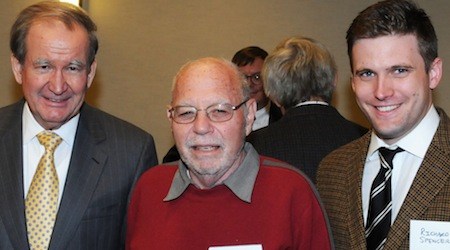 While Pat Buchanan was disgusted by “the sewer of multiculturalism” (all Americans should be Judeo/ Christian, speak English), (((Gottfried))) and he took up the response of integration by carrying forward the mantle of (((Frank Meyer’s))) paleoconservative “fusionism” of Abrahamism and enlightenment values; handing it off to Richard Spencer for a paleocon 2.0 big tent called the “alt right”, until Richard’s “Faustian imperialism” blew that up. The paleoconcon false opposition has now been handed from Gottfried to Nick Fuentes’ court. While Pat Buchanan was disgusted by “the sewer of multiculturalism” (all Americans should be Judeo/ Christian, speak English), (((Gottfried))) and he took up the response of integration by carrying forward the mantle of (((Frank Meyer’s))) paleoconservative “fusionism” of Abrahamism and enlightenment values; handing it off to Richard Spencer for a paleocon 2.0 big tent called the “alt right”, until Richard’s “Faustian imperialism” blew that up. The paleoconcon false opposition has now been handed from Gottfried to Nick Fuentes’ court.And since WN continue to fuck things up, reacting against (((red caped/ i.e. misrepresented))) “post modernity” as so much “left wing, da-da nonsense”; acting into the reactionary right wing positions altercast them by Jewry, supposedly on behalf of pure truth and morality, somehow transcending human interests, while chasing misrepresentations (((red capes))) of the erstwhile necessary concept of Post Modernity on the whole, along with (((red capes))) of its ancillary concepts, I must repeat, hopefully in a more clear and compelling way, things that I’ve said before but for some flourishes. However, it is a great advance of Post Modernity properly understood, to emphasize the fact that an idea does not have to be “new” in order to be understood as good, useful, important. The essential move of the Post Modern turn is to call attention back from Cartesian estrangement, to re-centralize and provide means to sustain our world view in praxis - our social group – through an engaged process to protect inherited forms and helpful traditions of our people from the ravages of modernity’s linear “progress”; while allowing modernist change where salutary, and leaving behind tradition where unhelpful in sustaining praxis; but the post modern turn from modernity’s linear notion of progress would not take praxis so far in ethnocentrism as to be supremacist and imperialist, unable to respect and coordinate with other groups of people, let alone go so far as to revert to a more primitive form yet, Monoculturalism, to where the humanity of non-members is not recognized: Just as the Monocultural worldview of cannibals might view a White interloper as non-human, rather as something good for the communal stew pot, so tribal monoculturalism would perhaps view we “racists” as less than human, not worthy of life. As Modernity has been on a trajectory for the reflexive effect of Monoculturalism in its globalizing pursuit of universal progress, particularly as its rule structure, performance requirements, narcissism and rational blindness are (((weaponized))), many of our right wing dupes have dutifully reacted against Post Modern responses to Modernity, which are also (((weaponized))) - (((red capes))) of concepts such as “multiculturalism” and “diversity” - and they double down against them in Cartesian reaction, in Modernity’s quest for pure universal warrant with objective detachment and its abiding rational blindness that opens the way for subversive infiltration and monocultural integration. Liberals, operating on the same “objective” Cartesian premises taken for granted as currency by right wingers, have long found a way to prove their objectivity - by means of “color blindness” - “not seeing” the most obvious differences, such as black and White. That’s been an easy way to establish one’s legitimacy in the world’s liberal hegemony, the fallout and disorder of the enlightenment. But a reflexive effect of objectivity over-stressed is hyper-relativism, as corrections of Praxis and its means (means of social systemic homeostasis by way of human agency/correction in interaction) are thwarted. Perhaps European Nations and all White Nations, markedly led by The U.S., its Constitution being the beacon of Enlightenment philosophy, had to reach the present level of destruction to White genetics for our advocates to look more critically at our own philosophy - observing vulnerabilities to our genetic patterns; notably on the empirical side of Cartesianism, in Locke’s conception of individual civil rights (so integral to the American way) as a technology to supersede the “empirical fiction” of social classifications. The US Constitution and Civil Rights, held to be sacrosanct - the “ultimate warrant in defense” for a modernist, liberating them, so they believed, from the influence of suprafactual narratives and superstitious traditions - came into doubt. Indeed, the vulnerability of that Cartesian purity spiral was exploited against Whites, Alinsky style, making us “live up to our rules” in “Civil Rights”, 1964, which prohibited White people, anyway, from making group classifications and discrimination thereupon. In subsequent decades, the prohibition was stepped-up with Anti-Racism - basically anti-group classification and discrimination thereupon, for Whites, anyway. Were it not for the (((red caping))) of the post modern turn and its attendant concepts, as our philosophers properly conceived them, our people could have recognized the countervailing significance to us. Following a clear trajectory from the apex of Modernity in Descartes, to its empirical side in Locke, to Vico, the first major critic of Cartesianism, to Kant’s failed (still Cartesian) attempt to rescue our moral order from Lockeatine arbitrariness, then on to Nietzsche’s criticism of Modernity and through to Heidegger and his student, Gadamer, we can make the inference that: Anti-Racism is Cartesian, anti-group classification and discrimination thereupon; it is not innocent, it is prejudiced. It is prejudice against prejudice (Gadamer), and as such, it is hurting and it is killing people. As opposed to the Cartesian estrangement from praxis - which is a typical reaction to disingenuousness and the arbitrariness within our primordial human condition - Heidegger recognized that a second liberation was necessary, from mere facticity and into the hermeneutic turn. Heidegger also called attention to the need to hold fast to emergent qualities, individual and group, within this otherwise arbitrary condition that he called the thrownness. GW deserves much credit for holding fast to Heidegger’s concern for the emergent (basically, our inborn qualities, following a kind of teleology but in the end of which, the whole is greater than the sum of its parts). While holding fast to Being in one’s land, place and amidst one’s people is characterized by dwelling. Hermeneutics is not anti-science. It is even necessary for non-fiction accounts. Despite the fact that there is inborn capacity for agency, it is much more like animal reaction until it participates in narrative capacity to sustain a plan, make choices, and verify success. While the emergent provides an important, deep guide to an authentic path of our telos - and though indeed, hermeneutic capacity is part of the multifarious emergent qualities - our biological foundation is not foolproof for its occurrence in our arbitrary circumstance (wherein it is still possible, for example, to breed with other peoples), particularly absent the corrective capacity of narrative facility shared of the social realm beyond our personal biology. Following a natural concern to maintain our species, it is necessary to have that second liberation from mere facticity, as narrative is necessary to maintain even non-fiction accounts - such as holding fast in coherence to one’s individual and group kind in overall homeostasis. Post Modern coherence is not to be misunderstood as linear and impervious, as with the modernist tendency; it is rather knowingly interactive and coherent in overall trajectory. This coherence is the first requirement of authentic human existence. With necessary concession made to a modicum of arbitrariness in our primordial condition, we may partake of that second liberation into narrative coherence, and with it, achieve accountability, agency, correctability and warrant to hold up deliberately - necessary for our homeostasis given that individuals of our group can rather decide that they find it healthy to betray us. And there are antagonists willing to tell stories about how our emergent qualities are evil, misdirecting people against our social systemic maintenance. More, narrative form is necessary to transcend paradoxes, contradictions, confusions, tangles, strange loops, etc. (which can be weaponized against us). We require thus, sufficient hermeneutic, rhetorical capacity to maintain our individual and group coherence. The post modern concept of hermeneutics has been (((red caped))) as “anti-science”, as if it is conceived to facilitate narrative flights of fancy in which one can make just whatever they like of themselves - 57th gender etc.. But this is a red cape misrepresentation of hermeneutics anti-Cartesian mandate. Yes, hermeneutics is critical of and liberating from scientism - bad science or bad application of science - but as hermeneutics is engaged in circulating process of inquiry which facilitates movement from broad perspective, the imagination of hypotheses largely detached from myopia of the episode, and back to rigorous verification that may yield warranted assertability as need be, it is absolutely necessary to the scientific endeavor - facilitating it, not opposed to it. Disordering Effects of Modernity Complicate Gender Relations The rupturing of group classificatory bounds as a result of their “fictional status” yielding to individual civil rights, particularly as (((weaponized))) in “Civil Rights” and “anti-racism” instigates the disordering effect of modernity, particularly for Whites as they are prohibited from classification and discrimination thereupon. As people have an inborn need to classify in order to make sense, despite the prohibition, the general classification of gender will remain as too fundamental to disregard, and classifications too highly contrasting such as black and White will remain as default classification by tropism. That is to say, these classifications will become heightened while others are diffused. The naturally one-up position of females for their precious child bearing capacity will be increased within the disorder of modernity as they are solicited and pandered to from all sides given the rupture of group discriminatory bounds. Even while puerile and unsocialized into maternal concern for her people, she may become a more powerful selective gate-keeper than ever and incentivized to as such to maintain the liberal status quo - pandered-to incessantly, markedly by (((YKW))), her selective predilections - what is merely confident, strong, impervious, undaunted no matter what will become dubiously maximized, as will her base, atavistic female inclination to incite genetic competition be without sufficient correction in socialization. Her gains may be short term and the grounds of comfort diminishing, but she can usually call in thugs to white knight for her, while the reason to hold out for broader pattern reward becomes more and more unclear. Indeed, it is harder to be a female from the standpoint of traditional morals as more and happier opportunities exist for her to make mistakes within the disorder of modernity. Moreover, in the disordered circumstance, it isn’t only Feminists who are problematic to White men, but also Traditional women as they may not appreciate that the different circumstances of post modernity entail some different performance requirements in gender relations as compared to tradition - the disorder of modernity may not provide sufficient structure and support necessary for males to act into the traditional role, at least not quite as directly as convention might have her expect; and they get shunned aside unjustly for the circumspection. Marginals Even if social/political group classifications are prohibited, marginals would function something like systemic empirical border markers of sorts, irrespective. However, Gadamer’s hermeneutic concept of marginals has been (((red caped))). Respect for marginals as sentinels of the systems’ bounds, having perspective on the system and knowing where the shoe pinches, to provide corrective feedback on systemic calibration, is an excellent idea. And clearly, a marginal for us, is someone just inside, near the edges of the system, maybe down on their luck, they can even be marginalized because they are better in important respects, but they are marginal members within and well disposed to our group maintenance - their participation probably should be shown compassion if not respect and integrated a little better. We’re all marginals from time to time.
Now, what YKW have done is (((red cape))) the concept of marginals by representing them as aliens, those originating outside and antagonistic to Whites or those Whites who are anti-White and destructive to the system, advocating that they should be included and integrated into our system. Thus, repulsing Whites to this concept which would be invaluable to our social systemic homeostasis. The drag queen story hour (((red caping))) of marginals prompts occasion to discuss difficulties in post modern gender relations. There are interesting points to be made on behalf of Whites (not exactly for liberal purposes). While there are excellent criticisms of homosexuality that should be ready at hand (won’t go into it here) and it should be discouraged, especially for males, we should not lose site that below its (((red caped))) politicization, queers should not occupy a priority concern generally speaking (you may have particular circumstances, that’s different). Over reaction to this (((red caping))) can have negative effects for Whites; the vast exaggeration and distortion of advocacy of this relatively minor issue - e.g., homosexual defense transitioning into drag queen story hour - can place enormous pressure on young White boys to do stupid things in order to prove that they are not gay. With ‘the universal maturity©’ of Modernity upheld, people might not discern the different performance requirements of post modernity and White boys may be compelled to emulate non-White patterns of masculinity, which fail to manifest our best, most authentic nature. There’s too much of this “White boys need to man-up” shit, not enough ‘White girls need to woman down’ happening in reaction to the red capes. “Manning up” under the circumstance is even more a matter of border and bounds creating than it is a matter of allowing one’s self to be incited into direct competition with arbitrary males. As Bowery and Renner note: if you try to impose involuntarily contract with others upon us then you are a would-be slave master and supremacist; be loyal or be gone; don’t impose the consequences for your liberalism upon us. There is an apparent inverse relation between confidence and intellectualism. Especially under the disordered circumstance, a modicum of intellectual wherewithal is necessary. But as the predilections of puerile White girls are overly favored within the disorder of Modernity, increasingly one up as they are - pandered-to from all sides given the rupture of discriminatory out-group classifications - puerile females are empowered (don’t like it? she’ll call in the universal thugs/white knights) and incentivized to maintain this powerful one up position as gate keepers of liberalism for its short term gains, their base (sub praxis) female inclination to incite genetic competition exacerbated, their penchant to over value confidence exacerbated to the detriment of Whites. Black boys, e.g., over-weening with confidence may win the day with momentary and episodic displays for their shorter evolutionary time horizons; their long pre-evolution which has quantified and maxed-out masculinity, creating an aggressive, presumptuous, hyper-assertive sort; their R selection vs K selection strategy suited to the atavistic episodic evaluative fall out within the disorder of modernity. While the value to be ascertained of the more sublimated, protracted cultural and relational patterns of White boys is obfuscated. Besides the ill-fit of “universal maturity”, there’s another problem with the “traditional solution” to the universal disorder of modernity. In addition to distracting urgent attention from the much more important issue of race replacement - given relative non-correctability - chasing a (((red cape))) of post modernity such as drag queen story hour suggests a (((red caped))) “Traditional solution” (((Judeo-Christianity))) to a “Traditional problem”, (((“Sodom and Gomorrah”))). Social Constructionism That’s what social constuctionism proper, does. It is another post modern project to bring our people back from Cartesian estrangement into Praxis. And yet social constructionism has been (((red caped))) as if race is a mere social construct - as if you can make anything that you want of it, if it exists at all. But that rendition of “social constructionism” would be solipsism - not many people of the social world are going to agree with you that racial species have no biological, empirical bearing. Rather, to say that race - or, you know what we mean, profoundly different markers, well on the way to speciation among humans - doesn’t exist. That would be a transgression of its anti-Cartesian purpose as well. Social Constructionism is conceived to call attention where European peoples need it: attention to the FACT of our social indebtedness and of praxis being the preliminary world view of any human merit; delimited as calibration, it provides for accountability and coherence; next, and as important, it works hand in hand with hermeneutics to call attention to the fact that there is always at least a modicum of agency while we’re alive. Social Constructionism and its underscoring of agency takes three forms: 1) a more literal kind of social construction, as in constructing a building with others, in all facets of the process. 2) a more metaphoric kind, as in a couple getting together and “constructing” a child together, with all the social involvements necessary to bring about the conception and the raising of the child; and 3) Post hoc attribution as to how more brute facts come to count. In these cases, that much closer to sheer physics, one still has some agency and can come up with even far fetched interpretations of the event, though upwards of 95% of the human population will be forced (by dint of the will to survive, and thus beware laws of physics and biology) to look upon you as crazy. But narrative difference from empirical fact will not necessarily be ridiculous and may in fact be helpful to individual and group, distinguishing for example, hero from fool or villain in the brute case of death: “Good riddance to bad garbage” or “his virtuous sacrifice facilitated the living on of his children and people.” The brute fact can be “instructive” - what can we learn from this accident/ tragedy to avoid its happening again? The point and the reward remain in recognizing some capacity for agency - even if only as to how facts come to count, post hoc. Even as we look back to discuss days of our pre verbal, pre mammalian evolution, if we are not here to discuss it, it is a moot point. Hence, the eminent validity of centralizing Praxis in our worldview. If a tree falls in the woods… you want truth and morals, for what? How can we let White children come into this without trying to deal with this mess? With one example from disingenuous antagonists using modernist language - “there will be immigration flows” - as if these “flows” are “caused” like a brute force of nature, you can begin to glean the superiority of the post modernist, hermeneuticist turn and its attendant social constructionist concept as it invokes the means of agency to reverse these “flows”. You can see how it would benefit our enemies to invoke such a strictly deterministic, Cartesian notion of necessity - “that’s just the way it is, no account, no arguments need apply” - in circumstances such as migration ‘flows’ auguring our race replacement. You begin to sense how retarded it’s been for huWhites to argue against the red caping of post modernity, social constructionism and hermeneutics. You begin to sense why our enemies have misrepresented post modernism, because they don’t want us to have proper understanding of post modernity and its attendant concepts of hermeneutics and social constructionism - precisely as it would give us that coherence, accountability, agency, correctability and warrant of our social systemic homeostasis. Hopefully that’s enough of an interest arouser. I’ll provide more background then work through some other examples distinguishing White Post Modernity Proper from its (((Red Caping))). Background:Modernity’s roots The deepest, most direct root of Modernism in European philosophy goes back to the ancients, to the Epicureans specifically. The Epicureans were committed to overcoming mere superstition, custom, habit and traditions which did not facilitate the good life; they sought instead to trace all experience to positive source and sensible apprehension to establish solid grounds to the good life. They were the ones to coin the term ‘the atom’ to designate the smallest physical unit of which the universe is composed. From there, they would propose a hierarchical ordering for the use of pleasure, with contemplation occupying top place. The Epicureans being direct forebears of Modernist philosophy are thus seen in clear line to the Enlightenment, especially the empiricists, Locke, Thomas Jefferson, later philosophers of science and the Logical Positivists. Traditional European Society Traditional European societies were ethnocentric, particularly in the south, as exemplified by Plato and Aristotle, Aristotle in particular with his Praxis (one’s ethnocentric bio-social-political group) providing a sound Traditional starting point for this analysis; i.e., aligning tradition and natural concern for species homeostasis. Aristotle did place praxis at the center of his world view as evidenced by his position that politics is the first philosophical priority - if politics are out of whack, all else is for naught. And he did believe there were outsiders who were to be treated in a different manner. A democracy limited to the philosophically capable, and those committed to group protection, is probably consonant with authentic European tradition as it provides means for correctability (systemic homeostasis). The way of government that a particular ethnostate chooses is beyond the scope of this essay and needless to say, the democratic franchise can and has been (((red caped))) as well. Nevertheless, Aristotle is the most esteemed figure of Europeans (even more than Jesus) and understandably so, as his philosophy was profound enough to keep social systemics aligned with natural laws that would preserve our species. Thus, a tradition authentic to our nature, not an affectation. If northerners complain, it should be said that inasmuch as they survived as distinct species, they would either be deliberately, accidentally or naturally in accord with Aristotle’s philosophy. Aristotle observed that people are biological creatures requiring optimal, not maximal need satisfaction (his golden mean applied across the board politically), as advanced mammals, they are engaged in the social world with relative concern for relationships, they have agency, reflexive effects, can learn, etc; thus Praxis does not have quite the linear predictability of the hard sciences and therefore requires a different epistemology, i.e., practical judgement, in order to maintain coherence and homeostasis. The North of Europe probably forged a less ethnocentric evolution due to the fact that nature was often the greater challenge than other tribes; protracted spans of time passing when the differences of neighbors were not quite so threatening; but clearly they were ethnocentric nevertheless, having different rules for “outsiders” - e.g., Viking invasions did plunder others nations; and they worked out their politics in accordance with the predilections of their nature and circumstance as sustained their species. Whether tribe, city state or nation, there was enough ethnocentrism for distinct European groups to maintain themselves. Red caping praxis as political through and through. One may argue that Aristotle is stretching the political metaphor, but his observations of human nature would argue otherwise. It is more likely that one would be reacting to (((red caping))) of the idea, to where everything is political and a challenge to White hegemony; and true to the (((red caping))) strategy, Whites wind up fighting against the correct underlying idea - centralization of praxis. Maxwell’s demons Clerk Maxwell draws a useful heuristic distinction here between “Augustinian Devils” and “Manichean Devils.” Augustinian Devils are challenges of nature, which characteristically do not tend to have the concsciousness to change in order to foil solutions. An evolution in penchant and predilection to take on Augustinian devils can be anticipated in northern circumstances - and this would correspond with lower ethnocentism, objectivity and scientific solutions being more favored in natural selection. Manichean Devils are trickster challenges. Given our agency, humans have capacity to change in order to foil solutions to their challenge. This capacity would be more favored in the natural selection of the South and the Middle East to sustain their ethnocentrism where the challenge was, on balance, more a matter of other people and tribes than brute nature and resource. With this traditional background, the stage was set for Europeans to be taken as naive, to be duped by the Middle Easterners - most poignantly by YKW. Red Caping European Moral Order The first and probably most important (((red cape))) imposed was an affectation to become our “Traditional European moral order” - Christianity. Its tangled, dread inspiring and self destructive rule structures which, among other terrible misdirection, compel a sacrifice of concern for the lived life in favor of some ‘hereafter’ beyond our biological legacy even. Suffice it to say, they’ve got Christians worshiping the same Abrahamic god as Jews, except that the Jews are “chosen” as a special group by that god, whereas others are not special as groups, they are, as GW observes, cast as an ever undifferentiating other from “the chosen.” Moreover, as Bowery observes, the Bible functioned as the Jewish media control even before the advent of Modern technology. With threat of losing what semblance of belonging, if not penalty of death and hell, a fundamental strategy of Jewish (((red caping))) - to disrupt the ethnocentrism of Europeans and other non-Jews - was cast a central component of ‘our’ most fundamental ‘Tradition.’ Its almost like a tradition of non-tradition, as honoring “your parents” hardly constitutes a commandment to obey a long historical tradition of forebears held in high regard. Indeed, we have barely begun to be roused in indignation over the Christian church having buried our most sacred day of ancestor remembrance and replacing it with “All Saints Day.” Another key function of (((red caping))) is established, in that it allows for Jewish infiltration, misdirection and subversion of the group - by means of conversion in the case of the Christianity. Anyone can become a member, including YKW, who are particularly disposed to our dissolution according to the red cape strategy. Finally, as the Jewish (((red cape))) functions, overcompensating reaction can be even worse than compliance, as even the important underlying idea for group homeostasis - in this case, a moral order - is rejected in favor of a-moral concerns of Modernity - e.g “nature”, adherence to “survival of the fittest” to the point of natural fallacy, “might makes right” to the point of utterly immoral destruction. Indeed, there is reason to believe that the compulsion to overcome these (((red cape))) guilt trips, divorced from nature, was an instigating factor in the purity spiral of Cartesianism, hence Modernity. ModernityPhilosophers take Descartes to represent the sine qua non of Modernity, setting forth an ‘Enlightenment’ that unfolded into the epoch of Modernity. Cartesianism is looked upon as a quest for unassailably warranted knowledge, whether above and beyond nature and human interaction or on the other side of the Cartesian divide, within nature and below human interaction. This would come to be seen as problematic as the pursuit of these ” that’s just the way it is” warrants, whether above or within nature, where not utterly impervious to social concern and negotiation, tended to pay short shrift to social accountability. The trajectory of Modernity did, indeed, make important contributions to overcoming backward traditions, customs and superstitions. Moreover, given the remarkable advances in science and technology that it provided for, it is understandable how a valuation of experimentalism and what is new could be derived as chractaristic of necessary progress. The first major critic of Descartes was Vico, who anticipated the propensity of this impervious technology to run destructive rough-shod over what should be philosophy’s central concern and world view - praxis - and thus he seeded the post modern turn with its neo-Aristotlian project of retreiving philosophical inquiry from Cartesian estrangement and back into praxis. Even so, John Locke, who represents the empirical side of the Cartesian divide, cannot be faulted for wanting to remedy an exploitative and intransigent class system divide WITHIN England. In opportunistic conception of his empirical philosophy, he proposed that social classifications were a fiction of the mind, as each individual has the same perceptions and discrimination on the basis of these fictional classifications - such as British aristocracy obstructing equal access to advanced education for ‘lower classes’ - should give way to his concept of individual civil rights. But the weakening if not disruption of social classificatory organization and discrimination thereupon as an abstraction that can be applied, on principle, to any classification in favor of civil individual rights, is risky business. Kant anticipated the danger in Locke’s world view of myopic empiricism running arbitrary rough-shod over praxis, viz,, its moral order. Therefore, he tried to rescue the integrity of the moral order by establishing its principles on “categorical” (unassailably warranted) universal principles. Kant’s rescuing project failed, as the Post Modern philosopher, Martin Heidegger, would observe, because it was “still Cartesian.” Digression I’m typically greeted with strong negative reactions on this topic, especially from STEM types. Their misunderstanding me as ‘doing something bad by using the term Cartesianism’ stems from a few places. Being outside the fray of academic humanities, they see negative use of the term Cartesianism as a sign of pseudo intellectualism, if not the down-right (((red caping))) which is all they tend to see of “post modern philosophy” in relation to science (including some useful bits of Cartesianism) and THE ‘truth’ they see as the means for combating whatever problems that we are confronted with. Of an Augustinian nature, they may not apprehend the Manichean (((red caping))) of what is otherwise a legitimate and important underlying Post Modern critique of Cartesianism and Modernity. STEM. people, focused on Augustinian devils, are notorious dupes. White Post Modernity would not tell you to abandon Cartesianism entirely, especially not in its utility, say, to algebra or microwave engineering. The WPM project would try to call you back from runaway of Cartesian anxiety, and encourage you instead to look upon these quests for truth and precision as characteristic of a right wing component, indispensable, but nevertheless provisional and functioning as feedback to be subsumed within its utility to yourself in tandem with the group calibration - praxis - social systemic homeostasis. However, resistance to proper understanding - both from our people and because (((they))) don’t want us to understand - has been an intense challenge: Firstly, you’re confronted by our high I.Q. STEM boomer pioneers of the internet, who had hegemonic presence, and who have known enough success by their way of doing things to want to see it as tried and true, and not, say, somewhat contingent upon the luck of their generation or the value of their skills in the Modern milieu. They hadn’t yet had enough holes poked in their world view to feel the need to examine its vulnerabilities with up-to-date philosophical vigor. Their misapprehension is not entirely of their own making. There has been the (((red caping))) of Post Modern ideas that they are reacting-to. When I tried to discuss hermeneutics with Prof. MacDonald, because of its (((red caping))) he INSISTED that hermeneutics is anti-science. But I need to mention that seeing through the torrents of (((red capes))) is not easy. I understand his thinking ’ hermeneutics is anti science’ for all its Jewish red caping waved through college Sophomores. Academia is, after all, in the big business of selling talk - and the paying customers, 18 -24 year old undergraduates with Guaranteed Student Loans, are perfect consumers for self serving, anti-scientific, Jewish advanced, anti-White, liberal hermeneutic distortion peddled by tenured professors in perpetuity. I even mistakenly presumed Gadamer to be Jewish for his association with the term. Greg Johnson embarrassed me by pointing out that Gadamer was German. Our own Guessedworker has fought me tooth and nail on every important post modern term and concept that I’ve used, so offensive has been their hyperbolic (((red caping))) to his S.T.E.M. predilection and ethnonationalist concern. When I began explaining WPM Proper at The VOR back in 2011, I invited Bowery, thinking that he’d be on board. Instead he proceeded obliviously to say that we needed to “reboot the enlightenment.” Afterward, when I came to Majority Rights, James tried to forbid me from using the critical philosophical term/concept “Cartesianism” - “stay far away from it!” ... “You are demoralizing our people!” ...and when I criticized The Empirical Philosophers (meaning Locke, Berkeley and Hume), he reacted as if I was denouncing science and its method. Finally, in indignation, he tried to tell me to not characterize Modernity as a big problem. This wasn’t an easy challenge. They’re all very smart and have made important contributions. However, their misapprehension may also be attributed to (((red capes))) targeted directly at their S.T.E.M. type, such as “The Dark Enlightenment” and “Neo-Reaction.” These (((red capes))) in the hands of a (((mencius moldbug))) would portray Modernity and things like Cartesianism/or its misunderstanding as THE problem, rather than vulnerabilities in our system that (((they))), along with our traitors/dupes, can exploit/can be exploited by. There is also an apparent problem in the habit of STEM analysis that looks for the ONE problem that interrupts a circuit; a habit that can have them not see the holistic overview of what is being said here. For a combination of reasons, our ensconced STEM boomers and right wingers aligned in a reactionary purity spiral, haven’t quickly recognized that I wasn’t myself fooled by the (((red capes))) if not spitefully wielding them myself, against our people’s interests. Pardon the digression, but I won’t be dissuaded from using these post modern terms and concepts - not even by geniuses who’ve done as much great work for our people as those three. These terms and concepts are simply too important for our people to allow them to be confused and misdirected. ... The better starting point for analyzing the unraveling of our social systemic homeostasis - The French Revolution or The American Revolution and Locke? Most people start with the French Revolution, and it is highly relevant to Modernity. There are useful inferences to be made. Among those I’ve heard, Keith Preston observing that the European Aristocracies were often not as much loyal to their own nation as to the Aristocracies of other nations. That lines-up generally with the concept of the right that I am finding to hold up cross contextually. I wouldn’t put too much concrete emphasis on this, however. Literal mindedness in this argument takes you into the Marxian-Hegelian (((red cape))) where the Aristocratic classes all stand together and therefore the “workers of the world should unite” across national bounds; while the Hegelian dialectic works its way out historically, in accordance to its own inherent logic to bring about the withering away of the state, which is presumed an ideal result. Marx’s internationalizing of class and revolution, as well as the slogan of equality, became huge (((red capes))) for reactionaries to chase after. Marxism and Cultural Marxism became more and more a (((red cape))) for “the left.” There may be merit to the critique that recognized a disordering of society by the revolution that was new, yes, but bad in a different way, as it was financed largely by the Jewish (or White for that matter) merchant class to overthrow a better ordering of societal rule [e.g., priest, philosopher, warrior, artisan], other than by mercantile. However, rather than so much the who question that occupies top place in our society, I would tend to favor the ‘what’ - i.e., protection of our borders and the protection of our population - whereas ‘who’ occupies governing position would then be contingent upon their adherence to the ‘what.’ Left and Right The French Revolution is where the traditional Right vs Left dichotomy began, with those representing the King and his leadership being on the right side of the court, while those representing the populace - who would rise up in revolution - sitting to the left of the King. It’s of worms that I’ll open in more detail later. I will argue that the dichotomy remains useful, that “the left” has been (((red caped))) in representation as Marxist, internationalist, liberalist, equalitarian and anti-White, when it is better represented as a union of the ethnonational populace - Paris for Parisians. The slogan, “Liberty, Fraternity and Equality”, especially Equality, has been a terrible (((red cape))) that right wing reactionaries chase after. I will argue that red cape and other semiotics that can guide a White ethnonational revolution are sorted out in the depth grammar of ordinary language patterns - necessary as currency in connection with logics of meaning and action which, in turn, direct behavior. Language as currency and depth grammar being those connotations which hold up cross contextually over time. For the moment, I’ll sketch a few things, and suggest that Whites should ask: Why does Jewry want White identity associated with “the right” or “neither left nor right” and against “the left”? And what are they doing with the connotations of the terms by compelling these identifications? Has not the left been associated with social justice, social accountability, compassion for the ordinary, marginals and group unionization in defense against elite abuse of power? While the right associated with purported objectivity, truth, brute nature below human accountability, or principles, elite individual or narrow group interests if not a god beyond human nature and also beyond accountability? When the audience looks with me at the reasons why Jewry has always wanted White identity to be attributed to “the right” and “far right” if not “alt right” or “dissident right” “against equality” and why they do NOT want Whites to identify as an ethnonational left, but as of late, especially, against “the left”, the audience will begin to understand my argument… it begins with the recognition of the original premise of the (((red cape))), i.e., to take a concept that is good for organizing the group and then to deploy it against Whites and make it obnoxiously didactic to Whites in order to weaken if not break up their social systemic homeostasis. Indeed, compelling Whites to identify with repugnant anti-social reactions that effectively preclude popular groundswell to our ethnonational cause. Those of us a bit older, remembering the 80s and 90s, will recall that conservative arguments were not anywhere nearly so typically pitted against “the left.” Conservatism was pitted more against Liberalism and Political Correctness in the 90s. It was only following the 2008 financial (((bail out))) that suddenly for fear of intersectionality of Cultural Marxism with Jewish interests, that the underlying connotations of “the left” would be discovered as useful for Whites against Jewish oppression that a (((mass marketing campaign))) was initiated with a whole pathological characterology of “the left” and what it does: it is anti-nature, does not deal with reality, wants equality, internationalism, wants unrealistic, international social justice, liberalism, sexual deviance, etc. Whites have been shockingly on board with this characterology so convenient to the current interests of elite Jewry and so clearly indicating that this is not necessarily what “the left” has to mean as this characterology called “the left” was not the in-vogue bogey man 30 years ago. In fact, if the left is characterized by a broad based “fraternity” of the people in unionized interests against elite betrayal, then it conforms perfectly to a left nationalism and ethnonationalism as well. As a union, it would conserve the interests within, focus our accountability, compassion and concerns of social justice for our people, not liberalizing concerns internationally. You can see how the red cape of “the left” as “international” and oxymoronically as liberal was used to have Whites arguing against their own organizing function through these misleading connotations. With the heavy marketing of “the left” as Marxist international, oxymoronically liberal for Whites, as it became cultural Marxist, to where White unionization was prohibited while non and anti White scabbing/border and bounds transgressing was sponsored as a part of “the international fraternity” (marketing the idea that that’s what “the left” necessarily means), Whites felt compelled to identify as some form of Right, Neither Left nor Right or Third Position as a function of the (((red caping))) to rupture our systemic homeostasis, leaving us susceptible to infiltration and misdirection in headlong Right wing reaction. Unionization closes off that vulnerability and the neo-logism, White Left EthnoNationalism, allows us to make accountability and the definition of its aspects in our interests explicit. The depth grammar of the right is not accountable to our ethnonational union of people: it is accountable to god, to “truth”, to principles, to the great man or small group of elites, to “nature”...but not particularly to praxis, to the broad systemic union of our ethnonationals, our people. The neologism, White EthnoNational Left, can make it clear in a way that “Neither Left Nor Right” or “Third Position” can, that praxis, the union of our people is our central concern and is where accountability is due and not in any Marxist sense precluding reasonable individual liberty, private property, free enough enterprise, abundant resource or ethnonationalism! This ambiguous result of the red cape reaction, disrupting organization, is why they will settle for an identity of neither left nor right, or third position, failing identification as some sort of right if not liberal. But for all the attention given the French Revolution as “the source of our problems”, I’ve found following the Lockeatine line making more coherent sense of our predicament in Modernity’s disorder, since that is where the taboo against classification (a term corresponding with unionization) for White men was set forth and ripened for weaponized (((red caping))). This has created a mystification, disingenuously wielded or naively adhered to by those who identify as right wing as they criticize the left for wanting more state regulation of social justice, while at the same time allowing the red cape of internationalism to extend over whom the nation is comprised. Our right wingers and other liberals are disingenuously or naively being encouraged to believe that they are objectively if not divinely entitled to be unaccountable and disloyal to the broad group of our own people and creating vulnerabilities, allowing for the rupturing of our social systemic homeostasis as such because individual rights are held sacrosanct while social classification (by Whites, anyway) is considered evil. Locke’s anti-classification notion of civil individual rights creates systemic pattern vulnerability John Locke was aggrieved by the Aristocratic Class’s discrimination against lower classes in Britain. His grievance dove-tailed with his concept of empirical philosophy, maintaining that all individuals have the same perceptions while social classifications are a fiction of the mind; therefore these fictitious classifications should give way to civil individual rights. This concept suited the ‘enlightened’ Epicurean predilections of Jefferson, along with his wish to throw off British upper class and British rule all together, and thus he made Locke’s anti-social classification notion of Civil Individual Rights into a central component of the American way. Jefferson missed the bus on Kant’s noble but failed attempt to rescue principles from the arbitrary empiricism of Locke, let alone Vico’s correct placing of group praxis at center of the world view. And the fairly arbitrary notion of civic individualism over classificatory patterns, this ‘liberation’ from traditional patterns, became characteristic of an America that would grow more and more powerful until it was the world’s hegemon, wielding power and influence over all, for better and worse. Jewish (((red cape))) weaponization of “Civil Rights” was still way in the future when blacks and women were given the franchise. While Jews could be said to be influential, even if only indirectly through Christianity and their part in the slave trade, it is certain that some Whites were engaging a Cartesian purity spiral on the notion of civil rights. As America’s ship sailed further into the abyss of Modernity’s disorder, Nietzsche, a critic of modernity, chided those who thought that they were merely describing reality and proper course of progress: “they are only drawing maps of maps”... Nietzsche would be very influential on Heidegger and his Post Modern/ Hermeneutic turn. Over in England, Russell and Whitehead wanted to tackle the problem of classification presented by the classic liar’s paradox, “I am a Cretan, all Cretan’s are liars.” In response, they came up with Theory of Logical Types, that class and membership were on different levels, and therefore, “a class could not be a member of itself.” Russell would confide that he considered this “the most arbitrary thing he ever had to do.” Arbitrary perhaps, but their focus on classification is interesting, and they were generating useful thoughts, indeed schools of thought in coming to terms with Post Modernity. Whitehead would say that “even a false or inadequate working hypothesis is better than no working hypothesis.”...adding, “one cannot continually investigate everything, but must take for granted a given state of partial knowledge from time to time.” Note: the legitimate existence of our race is beyond a false or inadequate working hypothesis - even if Post Modern (((red caping))) would try take advantage and exaggerate greatly the significance of our capacity to interbreed with other races. White ethnonationalists should take heed that the working hypothesis of our classification is sufficient to devote a large measure of our efforts to its advocacy. Certainly Bateson made worthwhile use of logical types in his theory of schizophrenia; and the whole school of thought generated from there made important contributions to solid Post Modern philosophy. It dovetailed well with his Post Modern, neo-Aristotlean concerns. Class functions on a level of relational patterns. Humans are mammals and therefore care about relationships. It causes them confusion, pain and destruction when they cannot invoke this level to order their lives. Of Locke’s anti-classification program, he admonished that “it could only produce dark, Satanic mills”... From his centralization of praxis (in a necessary, non Cartesian relation to environment and others) and communication in reflexive interaction, communications scholars would develop the very useful communications perspective, that we live in communication. From his more social and biological position on praxis, Bateson was also able to offer some corrections to the deficiencies and toxicties of Heidegger (e.g., “nature rarely works within lethal variables”); it is significant to offer corrections to Heidegger as he was, on the whole, not just a great and important philosopher for Europeans, but rather prominently manifesting the Post Modern/Hermeneutic turn. While Heidegger was beginning to wrestle with the Post Modern/ Hermeneutic turn, Wittgenstein was doubling down on Modernity, trying to map an unassailable correspondence of language to world in his Tractatus Logico Philosophicus. Bateson would chide those who would engage in this scientistic wish to get away from any ambiguity of the language, social classification and its invocation of meta-communication what-so-ever, as having an apparent wish to “get back to the innocence of mood signs”... Wittgenstein expressed his embarrassment in belatedly catching the post modern turn. However, there were adherents to the Tractatus at The Vienna School of Logical Positivism, who never did catch on. And they extended the invisible hand to the Austrian school of economics, including Wittgenstein’s cousin, Hayek, and von Mises, Ayn Rand, Alan Greenspan, Thatcher, Reagan, on to the guys behind H.U.D., fannie mae, ginnie mae, freddie mac and fangled Wall Street instruments, finally Bernanke, Paulson etc. to the 2008 financial melt-down. The Vienna School of Logical Positivism held a mandate to follow through on the Tractatus to establish a language that mapped and mirrored reality perfectly - free of any ambiguity and metaphor. But a few different aspects to words (e.g., referent, signifier, context) are always found to make some metaphor and thus human judgment and convention unavoidable and indispensable. Language as currency and semiotics While Heidegger is clearly the more useful and important philosopher to us, the 1/4 White Wittgenstein does have a few concepts that are useful to us in his later philosophy. For example, his borrowing of the concept of internal relation - a co-evolutionary concept - from continental philosophers, operating much like fractal technology, provides a useful alleviation from the Cartesian anxiety: how does one think? All kinds of ways. Where does one start? Anywhere. You want orientation? Look at an episode - where perhaps a practice may have begun; look at what people are doing and consider the use involved. You want to penetrate deeper? Look at the depth grammar. As language is the currency of convention, the ordinary language philosophy that is derived of Wittgenstein is turning out to be useful - more on that when we finish the historical background ..the Heideggerian school, its off-shoots and advances in post modern thought since; before we detail our thesis of the (((red caping))) of these concepts and rectification in White Post Modernity. This attention to language isn’t superficially caught up in Jewish language games. Heidegger was also keen to follow “the wisdom of the language” for what its roots and sources would offer as suggestions. And as we exist in the arbitrary thrownness, as Heidegger calls the contingent nature of our classification at its most radical level, post modern philosophy steps back from a suffocating quest for a perfect Kantian architectonic or Hegelian dialectic; recognizing that we have to be pragmatists to some extent, it retrieves us from mechanistic quest of Theoria and takes us back into Praxis, going the way of the Pragmatists, looking more to the development of working hypotheses and specificatory structures in its pursuit of operational verifiability and warranted assertability. I was chided for using the metaphor of “conceptual tools”, or a tool kit, ready to hand to bring to bear to our problems, as if we should just za zen manifest emergent ethnonationalism every moment. When GW insists that we need a complete, unshakable “foundation” to the project of universal ethnonationalism, I would ask why he thinks that we do not already have “foundation” enough to begin - a working hypothesis of our people’s existence and need for advocacy enough to warrantably assert? He and other more scientifically oriented people might help greatly by shoring up our “foundation”, behavioral tendencies, etc. but the idea that we don’t know enough to proceed in our defense is absurd…as is the idea that it is not bespeaking deeply considered philosophy, but merely political advocacy. It fits my working hypothesis that he’s reacting to Jewish red capes of and among praxis, along with other liberal rhetorical abuse that instill Cartesian anxiety, compelling the belief that we do not already have grounds to warrantably assert our advocacy, but need to have some pure, universal warrant beyond praxis; as if we don’t know enough about our people, the value of our different European kinds that merit homelands of our own and a means to survive as distinct kinds in diaspora…not that we can’t do better, find better popular inspiration, some key fundamental connections, but enough to begin. Genetic evidence accumulated in recent decades bolsters our concern for human and pervasive ecology - that would certainly include concern for our own kinds. Though we can infer many working hypotheses from experience, e.g., that Asians, Africans and Europeans have different rates of maturity with different advantages that can tangle each other up when brought together in interaction, operational verification of science does contribute to warranted assertability of the fact - R and K strategy, testosterone levels, lesser impulse control and sublimation, warrior gene, etc. - the point is that concerns of praxis and science are not mutually exclusive and should not be antagonistic. There are many occasions when science uncovers issues not at all apparent to ordinary sense (e.g. Jewish crypsis) and that sort of excellent yield of science is not discouraged, unappreciated and mutually exclusive to hermeneutics either. The antagonism that I’ve experienced from Bowery and GW - GW’s wish to “sweep aside” everything bespeaks a failure to see the underlying importance of Post Modern Concepts to Whites, to trust that application for Whites is very different from the red caping they perceive; failing to appreciate its function to protect the good in what is and has been, the value of agency and correctability in its outlook to stave off their worst fears (e.g., in Bowery’s case, a concern of “eusociality” and the loss of distinct European self sufficiency) and to create, in fact, the grounds of homeostasis, group and individual. GW sees a susceptibility among academics to top down wish to impose concepts over what should be concern to describe what nature will do irrespective. This imposition upon nature has come to the utility of Jewry as a characterization of what “the left does.” This characterology of “the left” is a red cape. He hasn’t been ready to accurately grasp what I’m saying, nor its significance due to his own vigilance to slay academic pretense and misdirection as it over motivates misconception that I’ve been the mere passive receptacle for Marxist indoctrination and not one making original inferences, weighing concepts for their utility to European people, leaving some things behind, willing to have what I’m taking for granted constructively questioned, but not constantly and with deconstruction being the only “input.” GW and Bowery are not appreciating that hermeneutics is a circulating process - and no, GW, its not “back and forth back and forth” in some trivial, plodding manner - it is inquiry that can gracefully and as a matter of utility take starting points from wherever necessary and engage utility (including the utility of ideals). Where GW and Bowery make well placed, rigorous observations about sub praxis natural underpinnings, they should only contribute to refinement of our working hypotheses, specificatory structures, perhaps adding operational verifiability to the already warranted assertability: the eminent validity of ethnonationalism and the working hypothesis that the White/European race and its subspecies does, in fact, exist - and well it should - at least it is natural for species to defend themselves, even if you believe that we should not survive (as a Hitler might not, in his scienstism). A more rigorous, scientific focus, a closer reading as it were, shouldn’t be considered mutually exclusive to what I’m saying. It can be a problem if they veer into scientism - try to say that what I’m saying should be swept aside - probably as they perceive and react to red capes or are stuck in a STEM habit of trying to isolate “the problem” in a circuit while making all else redundant (e.g. me and what I’m adding) by comparison to their “new model”...not realizing that they are attempting to sweep aside things that are far more important than their straw man contentions. They are habituated to issue straw men as they are not prepared to see friendly concepts coming from the humanities and therefore interject straw men in place of working to complement what I am actually saying with their valuable input. I over reacted to GW’s reaction to non-foundationalism, when saying there “can be no unassailable foundations” - technically true philosophically, but stretching hermeneutics to the point of absurdity to ignore laws of biology and physics; call them foundational if you will. Our biological species is, after all, what we’re about; not some alternative narrative to that, possible though it may be. Its frustrating to be confronted with misreadings of post modernity as being absurd. In its proper understanding neither I, nor any scholar that I’ve ever talked to, deny evolution, laws of biology and physics, facts…we take these matters for granted while someone reacting to the (((red cape))) misrepresentations would try to characterize us as absurd - or, rather, going along with the (((red cape))) characterology of “the left” as not dealing with nature (as opposed to one who deals in verifiable and specifiable hypotheses). Concluding the history and moving on to specifics should help people to see this as a collaborative enterprise, not mutually exclusive to their reasoned concerns. Specificatory Stuctures - are suited for Praxis. Aristotle observed that people: are biological creatures evolved for optimal need satisfaction; registering reflexive systemic effects of excess, deficiency and actions of others - as mammals in particular who have relative concern for relationships, have agency, can learn to learn, can reframe agendas hermeneutically. Social science thus differs from hard sciences, especially from physics but even from biology in our human capacity for agency and reflexive effects in interaction. To make sense of this requires what Aristotle called phronesis (practical judgment), or what Shotter calls specificatory structures: largely or partly finished general frameworks, slightly ambiguous, but having ready understanding to act as participatory currency by the public - frames that can be shaped and crafted for broad perspective, not suffocating necessary imagination to transcend moment and episode into broader patterns as need be, nor precluding re-specification in precision, down to genetic or molecular levels, as need be. This hermeneutic capacity in liberation from mere facticity to transcend stray moment and episode, paradoxes, strange loops, tangles, defeats, is necessary not only for individual coherence, accountability, agency and warrant, but also for groups.
State of the Fart Right: why the bum steers from Jonathan Pohl, STFU James, et. al? Lately, I have been making the rounds on some of the prominent racialist hangouts and podcasts, trying to get attention to the ethnonationalist platform that would make most sense, be the most viable and with that, to cultivate means for its coordination. As always, I am motivated to take theoretical/epistemic misdirection and help re-direct it to solid theoretical premises for the defense and advocacy of our European peoples. I have been lured into some hangouts in order to defend myself and this platform against misrepresentations that were happening in real time. That’s what this post is about - to defend this platform as the prominent voices presenting themselves as experts or worthy common sense critics on behalf of European/White interests continue to receive and give terrible misdirection. Recently, I was lured onto a hangout hosted by ‘Babylonian Hebrew’, a young Jewish fellow living in New York but advocating Zionism for Jews and honest, hard criticism of diasporic Jewry. I joined the hangout in order to correct an egregiuos strawman committed against me/this platform by one of those disingenuous diasporic Jews - Kyle Rowland, an obnoxious kid made infamous in the current racialist conversation by his slathering dissimulations on Luke Ford’s weasil streams - aimed to provide ways out of responsibility for Jews. Anyway, the world should know by now that I advocate a platform of European/White Left ethnonationalism in order to garner the underlying social organization, accountability and conscientiousness that the concept of unionization provides for, along with other White post modern means to manage our population and stave off infiltration, misdirection into runaway and betrayal - of key importance, the perspective of the union is intent on holding elites to account to our group (union) interests. Now, Kyle Rowland has been busy peddling the Luke Fraud line that de-emphasizes the hyperbolic ethnocentrism and nepotism of Jewry in its assent to disproportionate if not hegemonic representation in niches of power and influence; at the same time emphasizing argumentation that Jews have achieved this according to objective merit; while Whites have suffered where they have suffered for lack of objective merit. Predictably, Kyle had tried to strawman me/this platform with stereotypes of this platform being anti-elite so that he could discourage those Whites of powerful resource from taking our side. I was happy to disabuse the world of this strawman. It is one of the benefits of defining the left for ourselves, viz., a White ethnonational left is not equalitarian, not against private property, relatively free enterprise and people having more according to their merit. It is not against elites, it is about holding all union members, especially including elites, to account - they will not betraý our unionized interests. Kyle responded that ‘‘your kind always says that’ ...‘you are an anti-social right winger.” Ah, I rejoined, in truth, that I am not anti-social - you want White advocates to be anti-social and that’s why you want them to identify as right wing, paying short shrift to social accountability in futile quest for pure warrant beyond or within nature, below relative human group interests. At this point Ecce Lux joined-in against Kyle, wanting him to steel-man his argument that race replacement is immoral. Ecce did well, and I pointed out as well that Kyle was making an egregious buyer beware argument - if White people are hoodwinked into accepting race replacement it’s their fault. But I also pointed out to Ecce that anti race replacement is not the strongest angle in America, because Kyle could just hit you, as he already had, with the displacement of native Americans by Whites. A better tack is to argue carrying capacity and from there segue into human ecology ... well, we’re sorry about the history but it is history and we’ve got to manage carrying capacity and human ecology now… This was when Jonathan Pohl’s cohort, STFU James was encouraged by him and other half wits of the fart right to start attacking ...ME…
Both are necessary for coordination of interests between people, but incommensurabilty is the more important idea - White Post Modern idea - to have people understand now in order to overcome the ravages of modernity’s emphasis as it instigates narcissistic comparison.
Like so many disputes, however, this one occurs as a result of misunderstandings on a taken-for-granted level. That is, I took for granted my understanding that there is a level of comparison which is universal and necessary to coordination, but did not emphasize it; so the taken for granted of others, that “post modernity” admits of no standards of comparison was probably being presumed of my discussion of White post modernity as well. To protect the discreetness of peoples and cultures against the universalizing ravages of modernity - of which anti-racism and the prejudice against prejudice are instrumental - I have drawn attention to the fact that people and cultures may be qualitatively different, evolved for niche functions that are quite adequate within their niche, the “paradigm” that is their human ecology within human and pervasive ecology more broadly. White Post Modernity is drawing on Thomas Khun’s* Structure of Scientific Revolutions to sensitize our people to differences that make a difference because overcoming modernity’s universalizing blender, particularly as it is weaponized against us by YKW, is by far our most urgent need. Particularly when they’ve got Whites reacting to the abuses of “post modernity” by rendering of false, obnoxious and insulting quantifying comparisons, “against equality”, between niches and groups of people, which can unnecessarily generate conflict and disorganization, not only against non-Whites but also among Whites, it’s been important to emphasize the concept of commensurability/ incommensurability: That is, you aren’t especially asking whether a person or group is universally and quantifiably better or worse, but rather whether their rule structures mesh and harmonize in a systemic position or whether they conflict; whether they qualitatively fit somewhere within a group system; and if not in your group system, which group system? (by inference, if they do not fit in any group system, but destroy them all, you begin looking at them as a threat of ecological runaway - potential cataclysm, a universalizing cataclysm that does not respect important differences). However, in the emphasis of this important point to facilitate the advocacy of the difference of our distinction by its best, most broadly acceptable means, I may have not emphasized enough the idea that the concept of White Post Modernity draws a distinction between incommensurability and incomparability. Just because systems are incommensurable does not necessarily mean that you cannot compare them on at least some primitive levels. Comparability and InComrability would be the universal paradigm by which we could discern and compare interests that would be moral concerns legitimate to any people. This is very important because this universal language would allow us to coordinate our differences and our interests in maintaining our human species, i.e., between those people who are not so egregious as to advocate the destruction of our species, our differences. However, when talking about “depth and shallowness”, we must not get caught in modernist linearity of comparability being “the” deepest philosophical concern. Our similarities are a less critical matter at this point whereas the concern of our differences is crucial. Incommensurabilty and commensurability are the differences that make a profound difference among groups and between them on a level of human and pervasive ecology. This is at least as deep a philosophical concern, perhaps deeper, but certainly it is a criteria that we must emphasize now - not just our universal similarities. Comparabilities can be arrived-at fairly easily as a result of the internal relation of our co-evolutions (plural, deliberate). However, the differences may be more difficult to discern (and uphold for the broad system they are a part of being beyond ready purview) and where not difficult to discern, may be stigmatic to articulate and act upon as a result of anti-racism, the weaponization of modernity’s universalizing, objectivist prejudice against prejudice. And to overcome the universalizing narcissism of modernity and the destruction that may result for its blindness or oblivion to important differences between people, its disregard of differences that can result in their destruction, their using similar universalizing disregard of our differences (“deep down we’re all the same”) resulting in our destruction, or blow back against us for our naive/narcissistic oblivion to important differences which will not simply be put asunder, coordination between groups also requires that we promulgate the concept of commensurability/incommensurability, not only comparability/incomparability.
 Over valuation of objectivity and its attendant rational blindness. Over valuation of objectivity and its attendant rational blindness.
@daniel.sienkiewicz (Majorityrights): I don’t quite agree with Matt either. While the quest for objectivity, valuation of impartiality for the solid warrant of findings based on tests irrespective of prejudice and aversion does not really exist apart from people (and their interests, thus it does not exist purely) and Whites are evolved to value it more than others (evolved more to take on Augustinian, i.e., natural, non-human challenges), and it does yield science and tech marvels, the power that goes along with it, it is a predilection that leaves us somewhat naive for the rational blindness it requires, thus susceptible to systemic dissolution (not necessarily superior then), as the quest of objectivity is virtually the opposite of prejudice against peoples and aversion (to creatures, things, physical, systemic consequences) - to people who perhaps warrant prejudicial treatment; creatures, things, physical and systemic consequences that may warrant aversion.  If objectivity is part and parcel of White supremacy as it is according to Matt, he might observe that it is also part and parcel of White degeneracy and systemic dissolution. If objectivity is part and parcel of White supremacy as it is according to Matt, he might observe that it is also part and parcel of White degeneracy and systemic dissolution.White supremacy is certainly not an objective claim. But to be at our best and reconstruct our social systemic homeostasis against those groups more unabashedly self interested (evolved more in conflict with other peoples rather than nature), thus willing to take advantage of us, as e.g., Africans might, to the point of manichean trickery even, as e.g., Muslims and YKW might, Whites must sufficiently overcome this prejudice against prejudice. That, in order to be accountable to our own group, human ecology, which will allow us in turn to coordinate accountability with other groups, e.g. African and Middle Eastern, and pervasive ecology. Rather, quest for objectivity is virtually the opposite of prejudice - it is prejudice against prejudice. Quest for objectivity - pure warrants above or within nature, below human nature - is virtually the opposite of social accountability, a “that’s-just-the-way-it-isness” as such, which paves the way for war. Objectivity is a tool the findings of which are to provide feedback to be gauged against the calibration of our relative interests as a group system and that of other group systems and systems broadly.
|
|

Existential IssuesDNA NationsCategoriesContributorsEach author's name links to a list of all articles posted by the writer. LinksEndorsement not implied. Immigration
Islamist Threat
Anti-white Media Networks Audio/Video
Crime
Economics
Education General
Historical Re-Evaluation Controlled Opposition
Nationalist Political Parties
Science Europeans in Africa
Of Note MR Central & News— CENTRAL— Ukraine, Israel, Taiwan … defend or desert by Guessedworker on Sunday, 14 April 2024 10:34. (View) Patriotic Alternative given the black spot by Guessedworker on Thursday, 14 March 2024 17:14. (View) On Spengler and the inevitable by Guessedworker on Wednesday, 21 February 2024 17:33. (View) Twilight for the gods of complacency? by Guessedworker on Tuesday, 02 January 2024 10:22. (View) — NEWS — Moscow’s Bataclan by Guessedworker on Friday, 22 March 2024 22:22. (View) Soren Renner Is Dead by James Bowery on Thursday, 21 March 2024 13:50. (View) Collett sets the record straight by Guessedworker on Thursday, 14 March 2024 17:41. (View) CommentsThorn commented in entry 'Soren Renner Is Dead' on Thu, 25 Apr 2024 15:19. (View) James Marr commented in entry 'Soren Renner Is Dead' on Thu, 25 Apr 2024 11:53. (View) Thorn commented in entry 'Soren Renner Is Dead' on Wed, 24 Apr 2024 22:36. (View) James Marr commented in entry 'Soren Renner Is Dead' on Wed, 24 Apr 2024 14:20. (View) weremight commented in entry 'Soren Renner Is Dead' on Tue, 23 Apr 2024 04:24. (View) Thorn commented in entry 'Soren Renner Is Dead' on Mon, 22 Apr 2024 22:54. (View) James Marr commented in entry 'Soren Renner Is Dead' on Mon, 22 Apr 2024 16:12. (View) James Bowery commented in entry 'Soren Renner Is Dead' on Mon, 22 Apr 2024 14:44. (View) Thorn commented in entry 'Soren Renner Is Dead' on Mon, 22 Apr 2024 12:34. (View) weremight commented in entry 'Soren Renner Is Dead' on Mon, 22 Apr 2024 06:42. (View) James Marr commented in entry 'Soren Renner Is Dead' on Sun, 21 Apr 2024 23:27. (View) Thorn commented in entry 'Soren Renner Is Dead' on Sun, 21 Apr 2024 23:01. (View) James Marr commented in entry 'Soren Renner Is Dead' on Sun, 21 Apr 2024 22:52. (View) Thorn commented in entry 'Soren Renner Is Dead' on Sun, 21 Apr 2024 22:23. (View) Anon commented in entry 'Soren Renner Is Dead' on Sun, 21 Apr 2024 20:07. (View) Thorn commented in entry 'Soren Renner Is Dead' on Sun, 21 Apr 2024 19:39. (View) James Bowery commented in entry 'Soren Renner Is Dead' on Sun, 21 Apr 2024 17:38. (View) Thorn commented in entry 'Soren Renner Is Dead' on Sun, 21 Apr 2024 15:20. (View) James Bowery commented in entry 'Soren Renner Is Dead' on Sun, 21 Apr 2024 15:01. (View) Anon commented in entry 'Soren Renner Is Dead' on Sun, 21 Apr 2024 13:31. (View) Thorn commented in entry 'Soren Renner Is Dead' on Sun, 21 Apr 2024 12:52. (View) James Marr commented in entry 'Soren Renner Is Dead' on Sun, 21 Apr 2024 09:21. (View) Al Ross commented in entry 'Soren Renner Is Dead' on Sun, 21 Apr 2024 05:25. (View) Thorn commented in entry 'Soren Renner Is Dead' on Sat, 20 Apr 2024 23:49. (View)  
|