
|
|
|
Some intel on the Islamic Revolutionary Guards Corps
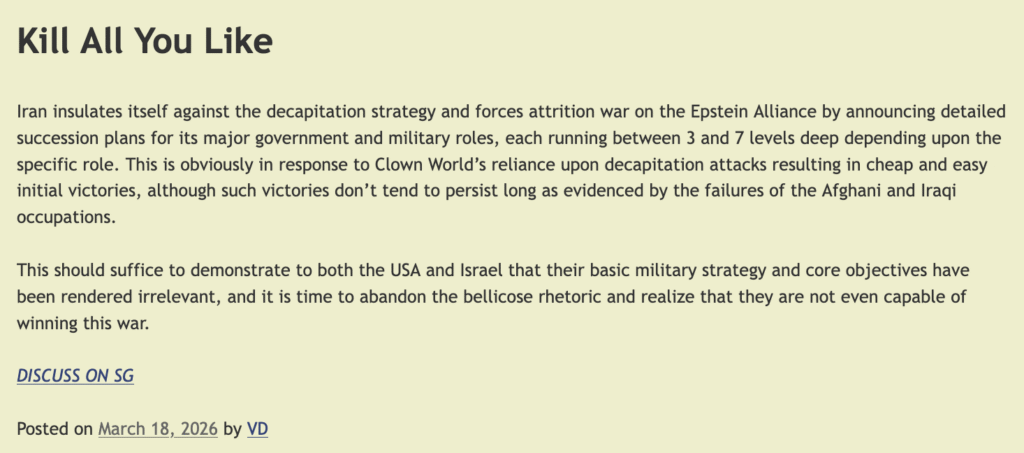
Now and again something interesting comes one’s way in the most unexpected of places. The Conservative Woman ran a distinctly uninteresting piece yesterday titled “Conspiracy theorists can’t see that the West is already at war”. It did not add a great deal to the sum of my knowledge. But in the thread to it there was one 700-word comment on the 125,000 strong mafia group which is the Islamic Revolutionary Giuards Corps posted by someone going under the handle of “True Conservative”. This guy (or girl) evidently reads some worthwhile sources, and took the following text wholesale from one of them. I haven’t tried to check who, but the spelling suggests American. Anyway, this is how it goes:
I think this is a better reading than, for example, the one at the site of the Council on Foreign Relations. In any case, the obvious questions which now flow are: a) What did the Trump administration expect to achieve by its decapitation project, and what has it actually achieved? b) If the administration’s foreign adventurism is, as it seems, entirely driven by gaining control of China’s oil supply, does it want to stay the course and resolve the problem of the IRGC or will it cut and run, lose its strategic gambit, and give the win to these characters and to Beijing? Would seeing American failure in Iran only embolden Beijing to move on Taiwan? c) If the Trump administration decides it has to stay the course in Iran what can it do now to bring down or at least gain control over the IRGC? Comments:2
Posted by Thorn on Tue, 17 Mar 2026 13:06 | # “The only way this [Iran clusterfuck] can be solved is with a regime change in the USA and Israel” - Nick Fuentes IRAN WAR DAY 17: Trump BEGS NATO Allies To Open Hormuz Show starts at: https://rumble.com/v777sds-america-first-ep.-1658.html?e9s=src_v1_ucp_a 4
Posted by Guessedworker on Fri, 20 Mar 2026 22:00 | # As with any mafiosi - and the Islamic Republic is precisely that - it is the money-flow that holds the enterprise together. Cut that an the parasite will die. It has been obvious for at least a fortnight that the Americans have to take Kharg, and the rest will follow. 5
Posted by Thorn on Fri, 20 Mar 2026 22:31 | # As long as the Iranians have ballistic missiles and drones to keep the Strait of Hormuz closed and target the GCC, the war will continue. Taking Kharg would just make the U.S. soldiers stationed there easy targets for drones and missiles. 6
Posted by Thorn on Sat, 21 Mar 2026 11:44 | # Even if Trump tries to declare victory and make a quick exit, the Iranians won’t let him. As long as the Iranians have a stockpile of drones and missiles, they will keep the war going. This video adds a touch of humor to an otherwise very dark topic: https://www.youtube.com/watch?v=ZqiiAvzgrfE Post a comment:
Next entry: “If America doesn’t learn ...”
|
|

Existential IssuesDNA NationsCategoriesContributorsEach author's name links to a list of all articles posted by the writer. LinksEndorsement not implied. Immigration
Islamist Threat
Anti-white Media Networks Audio/Video
Crime
Economics
Education General
Historical Re-Evaluation Controlled Opposition
Nationalist Political Parties
Science Europeans in Africa
Of Note MR Central & NewsCommentsGuessedworker commented in entry '"If America doesn't learn ..."' on Sun, 26 Apr 2026 12:11. (View) Guessedworker commented in entry '"If America doesn't learn ..."' on Sat, 18 Apr 2026 16:23. (View) Thorn commented in entry '"If America doesn't learn ..."' on Sun, 12 Apr 2026 20:35. (View) Thorn commented in entry '"If America doesn't learn ..."' on Sun, 05 Apr 2026 23:35. (View) Thorn commented in entry '"If America doesn't learn ..."' on Mon, 30 Mar 2026 15:40. (View) Thorn commented in entry '"If America doesn't learn ..."' on Mon, 30 Mar 2026 11:43. (View) Guessedworker commented in entry '"If America doesn't learn ..."' on Mon, 30 Mar 2026 07:08. (View) Thorn commented in entry '"If America doesn't learn ..."' on Sun, 29 Mar 2026 11:56. (View) |

Posted by Thorn on Sat, 14 Mar 2026 10:44 | #
This—> IRAN WAR DAY 14: Kharg Island ATTACK, INVASION IMMINENT??? https://rumble.com/v7733do-america-first-ep.-1657.html?e9s=src_v1_ucp_f
Show starts at 2:22:22