
|
|
|
Argot Rosetta Stone For GW/Heidegger/Etter Philosophical discourse is largely about disentangling what we are talking about vs the words used to talk about what we are talking about. This can go on for millennia in the absence of, shall we say, “shared perspectives” regarding that to which words we use refer. This, of course, is where multiculturalism deprives us of the tools we need to avoid force and fraud as a primary in social relations: No one can tell what anyone else is really pointing to with their verbal constructions. So consider an “identity” as that which “identifies” what things there are “out there” about which we palaver toward some sort of shared viewpoint. Etter, for the uninitiated, was the attendee of the 1956 Dartmouth Summer AI Workshop that Our Desi Betters thought I should not hire and instead hire a team of fellow Desis on H-1b visas to assist in my part in HP’s the $500M Internet Chapter II project. I wanted to hire Etter, not be because of his prominence in our modern age (although utterly unrecognized by so much as a Wikipedia page); I had no idea at the time he had played such a central if invisible role. He was merely the only person I’d been able to find over the course of 20 years since my participation in the VIEWTRON project, that seemed to have the right ideas to address a project with the high aims of an “Internet Chapter II”. My insistence resulted in the termination of my career which had already been seriously damaged by the 1992 papers I posted following on my 1991 testimony before Congress at the START hearings meant to reorient the West away from a military stance toward a positive sum future. Unfortunately, there was simply no way but “Through The Jew” as I saw it, to that positive future. But that’s another tragic story we’re all finally coming to face now.
Comments:2
Posted by James Bowery on Sun, 01 Feb 2026 19:02 | # I do not see the parallels as clearly as I may have led you to believe. In particular, when you say the last two windows are sloppy, I question my understanding of your argot. So let’s start with the last of the two slop windows and talk only of your misportrayed argot vs Etter’s: NOT your argot: Ground’s Action (final/singular incorporation into ontic totality, inhering impulsion/directionality in being) Etter’s Argot (as best I comprehend it as its purveyor in his absence): Ontological Origin (x as null-viewpoint/background, from which existence derives as non-self-identity, open-ended for ZFC) Leaving aside the technical comment about ZFC, the “Ontological Origin” is that to which the paper’s section “6.1 Identity Precedes Existence” addresses itself as part of section 6’s portrayal of 3 place identity’s “Philosophical Significance”:
Here’s another way of viewing this meta-viewpoint: You do not exist to yourself. You do not “stand out” from yourself to yourself. The notion of identity at this promordial level is simply between that which “stands out” from you and that which does not stand out from you. Everything that stands out from you can be said to exist but at this primordial level that is all that can be said about “things”: they are all identical in that you have identified them as existing. That this might be relevant to “ontology” is satisfied by definition of the very term “ontology”. To get to ontological refinements beyond this requires additional structure which is what the side comment about ZFC set theory is alluding to. Etter’s primordial structure allows for further refinement, but we must originate in the primordial act of creation, “something is not me”, stripped to its essential nature. I suppose in this sense, “ontology” isn’t precisely correct given the notion that “ology” may elide the active participation of the subject in discerning any object.
3
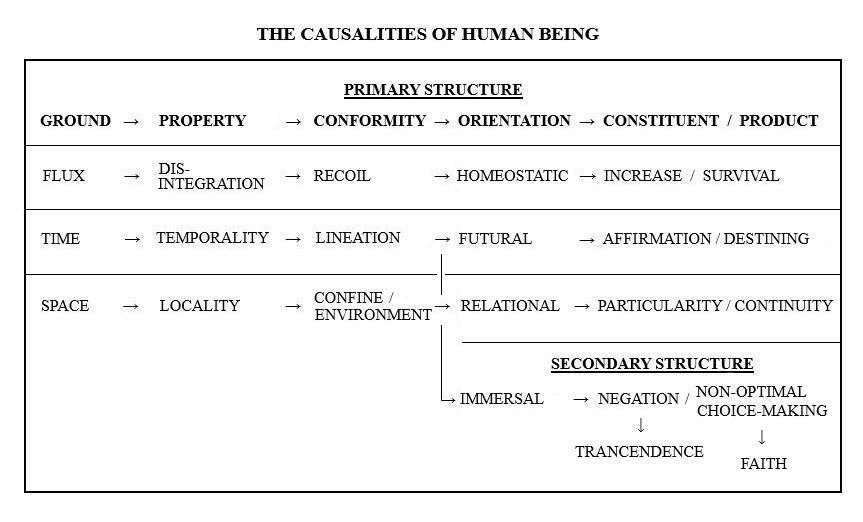
Posted by Guessedworker on Sun, 01 Feb 2026 23:18 | # James, Thanks for the reply. The two more sloppy windows become such by crushing too much together into the content. It is understandable. There is oft-times a degree of conceptual overlap. Absolute, hard lines between specific ontologies tend not to be drawn, and should not. From different perceptual points relational distances and perspectives change, which I think your Etter argument proves mathematically (correct me if I am wrong) Also, if you cast your mind back to the Causalities chart:
...you will see that Particularity, along with Confine and Relation, is in the line of development from Space but ... there are two other lines. We have a trinity here, three parts of one, which I suppose to be in the classical creative relation of affirming, denying and reconciling. So while the product of Particularity is the continuity of primordial difference it is only really clearly delineated in its relation to, and from the perspective of, the others. From a random perspective the lines are likely to be much more blurred. Certainly, I thought that Gemini 3’s “opening into distinct particulars with antecedents, absence of global relation or relation of difference” was quite blurry! I am not at all sure what it actually says. While seemingly clear enough, the last window:
... focusses on the beginning and end of the lines. One has to do that, of course, to dramatise the meaning of it all. But crush it together too much and the gift of difference gets dropped entirely, as happened here. Crushing together actually makes invisible the one aspect of the chart which I feel has some elegance, namely the four stages between Ground and Product, which articulate according to their material content as both creating and receiving entities. I admit I don’t know how, for the Rosetta’s shorthand purposes, one can reduce the articulations without being reductive. Across all three lines, too. But, hey, exacting formulae are produced in Etter’s column. So maybe maths is the answer! On the perennial question of identity and existence, I have found at various times that the logical order of existence’s priorness does not accord with practical experience. This was an early conclusion in the Ontology Project. I half expect that some quantum world explanation will eventually be forthcoming. But in the absence of that one just has to note the inconsistency. Post a comment:
Next entry: Gemini - not an identical twin to ChatGTP
|
||||||||||||||||||||||||||||||||||

Existential IssuesDNA NationsCategoriesContributorsEach author's name links to a list of all articles posted by the writer. LinksEndorsement not implied. Immigration
Islamist Threat
Anti-white Media Networks Audio/Video
Crime
Economics
Education General
Historical Re-Evaluation Controlled Opposition
Nationalist Political Parties
Science Europeans in Africa
Of Note MR Central & NewsComments |
Posted by Guessedworker on Sun, 01 Feb 2026 00:49 | #
Well, first off, James, I really don’t merit a place in the same comparison table as such giants, certainly not on the basis of a couple of essays or whatever it is. But since you have been kind enough to inveigle some innocent LLM engine into mistaking me for a philosopher, I must honour you with a reply.
So, I do recognise the objects of my argot in the list, notwithstanding the higher slop content in the final two windows. I do feel that there is truth to the general structure at which I’ve arrived, and so it is not surprising that other builders of structure who went this way before should have some commonality with it. The work which I began in 2008, following three failed attempts to bring into being a gathering of thinking nationalists, is nowhere near finished; but I will get to the end. Whether anyone will notice is another question.
As for Heidegger’s argot, it is of course, famous for its slipperiness, and that is not only because of his abstruse subject matter or his novel terminology. It’s in the canonical scale of his project. He is always reaching, or affecting to reach, beyond everybody else. Even so, Heideggerian thought has the advantage of very nearly a century of exposure, and thousands of detailed and expert expositions and insightful interpretations and re-interpretations. If he’s not accessible now he never will be.
Etter I know nothing at all about, except what you wrote on the preceding thread yesterday. Perusing his column in the table I can only catch glimpses of the parallels you obviously see very clearly. But I’m prepared to believe that he is a profound thinker worthy of our attention. It would, though, be helpful to non-mathematicians to have a “plain language” translation. What are the points of agreement, and of disagreement with my schtick? What additional insight is in his positions?