|
|
|
[Majorityrights Central] Three possible forms of a Ukrainian victory ... and a Russian defeat Posted by Guessedworker on Thursday, 16 April 2026 16:36. [Majorityrights Central] “If America doesn’t learn ...” Posted by Guessedworker on Sunday, 22 March 2026 17:52. [Majorityrights News] Gerdes on the possible sea-change in the Ukraine War? Posted by Guessedworker on Friday, 20 March 2026 21:45. [Majorityrights Central] Some intel on the Islamic Revolutionary Guards Corps Posted by Guessedworker on Thursday, 12 March 2026 23:32. [Majorityrights Central] Defining the borders of the English kin-group Posted by Guessedworker on Wednesday, 11 March 2026 23:51. [Majorityrights News] Jason Jay Smart on the approaching collapse of Putin’s reign Posted by Guessedworker on Wednesday, 11 March 2026 22:42. [Majorityrights Central] Empires, the Chinese Mind, a theoretical nationalism of ethnicity Posted by Guessedworker on Saturday, 14 February 2026 01:54. [Majorityrights Central] Gemini - not an identical twin to ChatGTP Posted by Guessedworker on Friday, 06 February 2026 16:58. [Majorityrights News] Warburg on the impact of Russian forces’ loss of access to Starlink Posted by Guessedworker on Friday, 06 February 2026 10:17. [Majorityrights News] Toast à la Little Saint James Posted by Guessedworker on Wednesday, 04 February 2026 23:48. [Majorityrights News] Southport, migrant hotels, the national flag, and Amelia Posted by Guessedworker on Monday, 02 February 2026 00:14. [Majorityrights Central] Argot Rosetta Stone For GW/Heidegger/Etter Posted by James Bowery on Saturday, 31 January 2026 17:18. [Majorityrights Central] ChatGPT redux Posted by Guessedworker on Thursday, 29 January 2026 01:11. [Majorityrights News] The national revolution in Iran cannot be stopped Posted by Guessedworker on Saturday, 10 January 2026 00:38. [Majorityrights Central] Into the authoritarian world redux Posted by Guessedworker on Saturday, 03 January 2026 17:56. [Majorityrights News] Moscow Times: Valdai residents report no sign of drones attacking Putin residence Posted by Guessedworker on Tuesday, 30 December 2025 11:33. [Majorityrights News] Paul Warburg on America’s self-destructive new strategy Posted by Guessedworker on Tuesday, 16 December 2025 12:32. [Majorityrights Central] Thoughts on Mark Collett’s strategy for nationalism in the British future Posted by Guessedworker on Friday, 24 October 2025 15:01. [Majorityrights Central] Living in the Jewish Mind: Part One Posted by Guessedworker on Monday, 29 September 2025 09:37. [Majorityrights News] Nationalism on the Kramatorsk front. Posted by Guessedworker on Saturday, 20 September 2025 15:55. [Majorityrights Central] And Chat GPT just the same Posted by Guessedworker on Monday, 08 September 2025 15:18. [Majorityrights Central] Grok the modern nationalist Posted by Guessedworker on Sunday, 07 September 2025 19:14. [Majorityrights Central] Principles, parts, processes of ethnic nationalism, Part 1: inflection? Posted by Guessedworker on Thursday, 31 July 2025 12:03. [Majorityrights Central] A window onto a world of Russo-Chinese hegemony Posted by Guessedworker on Tuesday, 08 July 2025 20:47. [Majorityrights Central] The DT takes the first step on the journey Posted by Guessedworker on Thursday, 03 July 2025 05:02. [Majorityrights News] Iranian comment machine switched off by Israeli bombs Posted by Guessedworker on Wednesday, 25 June 2025 09:07. [Majorityrights Central] After Casey and the ensuing child sexual exploitation inquiry Posted by Guessedworker on Tuesday, 17 June 2025 00:21. [Majorityrights News] 4 minutes and 43 seconds of drone warfare history - updated Posted by Guessedworker on Wednesday, 04 June 2025 16:50. [Majorityrights Central] An approaching moment of Russian clarity Posted by Guessedworker on Sunday, 11 May 2025 12:34. [Majorityrights Central] “It’s started. You ignored us. See where it’s going to get you.” Posted by Guessedworker on Sunday, 04 May 2025 00:42. [Majorityrights News] Another dramatic degradation of Russia’s combat capacity Posted by Guessedworker on Wednesday, 23 April 2025 08:49. [Majorityrights Central] A British woman in Ukraine and an observer of Putin’s war Posted by Guessedworker on Monday, 14 April 2025 00:04. [Majorityrights News] France24 puts an end to Moscow’s lie about the attack on Kryvyi Riy Posted by Guessedworker on Monday, 07 April 2025 17:02. [Majorityrights News] If this is an inflection point Posted by Guessedworker on Thursday, 03 April 2025 05:10. Majorityrights Central > Category: The Ontology Projectby PF There is an interesting paradox involved in human responsibility. On the one hand, asking someone to be responsible is asking them to do something that is nearly impossible in our unconscious waking state. On the other hand, holding people to responsibility is what we do, and it is not entirely clear how an alternative mechanism could take the place of it. When judging someone, it is very interesting which perspective set you choose to view them through. Take Hitler, for example. There are sympathetic perspectives from which to view every action taken by the Nazis in WWII. You could call to mind their awareness of the Soviet threat, the threat of Communism. You could note the various examples of British malfeasance and provocation - or rather those actions of the British which, you would then note, would necessarily have to be seen this way in the eyes of Germans. You could note the intense humiliation at Versailles and the high jinx of the Weimar governments, and get a good feel for why German man wanted to lash out in various directions at that time period. Putting yourself into other peoples shoes isn’t a new game for me, so I am utterly underwhelmed when, after going on an Easter egg hunt for all the sympathetic perspectives that can be wielded to reflect favorably on Nazism, they turn out looking quite vindicated. Their position actually makes a great deal of sense, once you adjust your own view for how they were viewing it.
Petrarch, from Africa, written in 1343. The European mind is, in my view, better viewed from the very Anglo-American standpoint of its natural endowment than as a culturally and historically revealed phenomenon, though it is certainly our habit to favour the latter. I confess that I don’t like the light that culture and history throw on the mind. I instinctively want to withdraw out of that light, and withhold my agreement to the descriptions and images that appear in it. What, after all, should we say about the European mind now, in the light of its debilitations in our postmodern age? Perhaps no more than Petrarch said at the close of his epic poem about the great Roman general Scipio Africanus. I don’t expect anyone else reading this to be burdened by this argument with temporality. I don’t expect anyone else to seek a revelation of mind in its consistencies at all times rather than its saliencies in some - its great cathedrals, its epic poetry, its symphonies, its devotion to freedom and charity, and so forth. I quite expect that my search for consistency went unsuspected by anyone who read this question, addressed to Notus Wind on his latest Ontology of Mind thread:
This was an attempt to turn the historical narrative inside out in a few words, and find the mind humming away smoothly inside. Here is Notus’s reply which I thought too good to be left to gather dust on a mature thread that perhaps not everyone will trouble to keep up with.
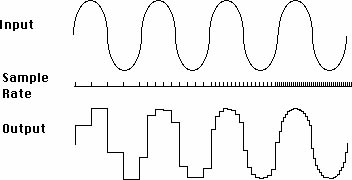
by PF “Being, in order to be true, has to be spontaneous.” - GW Imagine there is an analog signal that contains frequencies between 100,000 Hz and 25,000 Hz. In this analogy this is our Being. Practical metaphysics aims at an experience of this wave, and ontological philosophy aims at the intellectualization of it. However each organ of human perception has a sampling rate below these frequencies. The body might have a sampling rate of 20,000 Hz, in this example. The emotions might have a sampling rate of 10,000 Hz. The mind, which operates by habituation most of the time, has a sampling rate of 5,000 Hz. The original signal has to be reconstructed from what is picked up by these organs of perception. Needless to say its impossible for a 100,000 Hz wave to be reconstructed from samples taken at 5,000 Hz
In order to do this, it will focus primarily on external things, which register merely as impressions on the eye and models in the memory. We could say that these are very low frequency, very superficial modulations in the high frequency carrier wave that is our Being … things like social appearances, the meaning of words, the possible ramifications of an action for self and group, who is mating with whom, threats from outside, possible sources of food and shelter, and ways of keeping oneself alive. Not because these things are important in any deeper sense, but they lead to survival.
by PF Reality, it turns out, is multi-dimensional. For now that term should be understood loosely, without regard to the precise delineation or number of these ‘dimensions’. As quickly as we can generate tools, thinking, and mental hardware to analyze reality, its observable facets and ‘dimensions’ appear to multiply in front of us: with each newly ground lens we discover that there is more to be discovered. As human beings, we used to be quite content with the assembling of historical narratives which described a progression of facts: (1) Caesar crossed the Rubicon, (2) this initiated a civil war, (3) in which Caesar was ultimately victorious, until (4) he was assassinated. In creating these narratives it was possible, utilizing a method of ratiocination which Thucydides elucidated, to arrive at a physical description of facts which had incontestably happened. This is still possible. However as we refine the lens through which we view our lives, more dimensions of experience emerge into view, for which it is not nearly so easy to arrive at any kind of overarching consensus. These include the emotional and probabilistic aspects of reality, which are in some sense even more important to the internal experience of reality than observable facts, yet which we cannot reach a discursive consensus on because our description of these areas cannot approximate the complexity of the things we wish to describe.
by PF This is the first part of a primer on PFian perspectivism and theory of mind. Thanks to Rod who provided the impetus to clarify these ideas. Modality is a fancy word for mood, and it aims to describe the emotional constellation that is attached to specific things. A verb can have different modalities: ‘could’ and ‘should’ and ‘would’ each represent a different mood-relation of the actor to the action. Not limited entirely to emotion, modality also bleeds over into probabilistic concepts: how likely is something? For us, modalities can be seen as representing states of the human nervous system as it reasons - minds frozen in a moment of time. Was he contemplating the future and what is possible? Then he ‘could’ dance the flamenco. Was he contemplating his duties and obligations to others? Then he ‘should’ dance the flamenco. etc. etc. Incidentally modality is also a musical term, and the different scales it refers to also bring forth or convey different moods. Man’s intellectual efforts are roughly divisible into three ‘modalities’: ‘is’, ‘am’ and ‘should’. These correspond to the state of his mind as he completes whatever mental task he is working at. Most importantly they describe the mood-relation (emotional tenor?), probabilistic aspect, and the method of verification which the process is subject to. The probabilistic aspect is how much imaginative conjecture is required by the thought process. There are two methods of verification which human beings have access to, and the modalities divide among them. What has become the default position is social verification. This is the verification which takes place in our minds when our symbol system appreciates a consonance between its read-out and observed reality, thus ‘verifying’ the truth content of whatever symbol set is being looked at. At first glance it seems surprising to call this verification method ‘social verification’, but not when one considers that the mind evolved essentially as a social phenomenon and remains that way in spite of its internalization within the individual. In other words, the thought process as it first evolved, was naturally a ‘distributed system’, in terms of control theory. People learned things, and verbally became able to compare notes. The man who is able to synthesize perspectives inside his own mind, and thus carry out this process internally, is performing in his own mind what would have heretofore been the work of all our ancestors sitting together around a fire.
by PF The following are quotes from the 1998 Harvard edition of Rüdiger Safranski’s intellectual biographical work, Martin Heidegger: Between Good and Evil, originally published in German in 1994.
We already know one moment when “disguises” break up and authentic Being discloses itself - the moment of anxiety. The world loses its significance, it appears as a naked “that” against the background of nothingness, and Dasein experiences itself as homeless, unguarded and unguided by any objective Being. The breakthrough to authentic Being thus takes place as a contingency shock, as the experience of “there is nothing behind it.” Even more clearly than in Being and Time, Heidegger formulated this initiation experience for a philosophy of authenticity in his Frieburg inaugural lecture of 1929. Philosophy, he then said, only begins when we have the courage to “let nothingness encounter us.” Eye to eye with nothing, we then observe not only that we are “something” real, but also that we are creative creatures, capable of letting something emerge from nothing. The decisive point is that man can experience himself as the place where nothing becomes something and something becomes nothing. Anxiety leads us to this turning point. It confronts us with the “being possible” that we are ourselves. Heidegger’s analysis of anxiety expressly does not have fear of death as its subject. It would be more correct to say that its subject is fear of life, of a life that one suddenly becomes aware of in its whole contingency. Anxiety reveals that everyday life is fleeing from its contigency. That is the meaning of all attempts to firmly root oneself in life. One might assume that ‘They’ are only Everyman, [had previously spoken of the fact of self-loss into the ‘World of They’], but ‘They’ are also the philosophers. Because these, as Heidegger remarks critically, firmly root themselves in their grand constructs, their worlds of values and metaphysical backworlds. Philosophy, too, is for the most part busy removing the contingency shock or, better still, not admitting it in the first place.
Ever since this blog launched I seem to have become a serial conversationist. At present, one of my on-going conversations is with a writer and friend in New Zealand, Rod Cameron. Rod is talking to me about his ideas and I am talking back, a little unfairly, about mine. I suppose we shall eventually discover all our areas of agreement and difference. I know these latter include Jungianism, of which Rod is an advocate. But they seem also to include the question of an ontological nationalism. This post is actually a reply to a long email from Rod which arrived yesterday morning, and which was itself a response to a much longer exchange over Skype Chat. I apologise to everyone who is already tiring fast of angels and pinheads. But I think this stuff is quite important. Rod, Obviously, there are scores of very fine commentaries on Heidegger on the net. They will tell you much more than I can about the man and his thought, and I urge you to search them out if you are seriously intending to incorporate even a passing reference to “the existential” in Chapter Five. What I will do here is to reply to two issues you raised about my own very callow observations on same in the (possibly forlorn) hope that we can move towards a shared understanding. You quoted my observation that “Everything begins with being. There is nothing prior, and only diffusion of thought after.” You ask, “Can I take this as an Absolute statement?” Yes, if you recognise that being is a practical experience, a state in Nature we are capable of achieving - indeed, equipped by Nature to achieve. It is not simple this thing called Life, or some particular way of looking at our general experience of living. Being is not general. It is particular. It is the existential exclusive. It is a state that is difficult to reach and hard to hold on to, and like all things that take hard human endeavour, it has a high psychological value. Nevertheless, everything really solid that we can talk about as students of the human begins with it, yes. All the rest, all that we generally know and understand, and think, feel and do, and all that we are, suffers by comparison to the extent that it might be called unreal or a form of absence or exile. Or, in the context of our collective European life, it might be called the postmodern life or simply our collective estrangement from ourselves and from one another. The individual experience in being differs from the collective qualitatively only because of the scale on which the individual life differs from that of the collective. The alcohol has a higher proof, for sure. But they are not different in the moment that they reveal. Being is unity in temporality. Then you write:
According to a Telegraph article today there is a suicide cluster at the vast Shenzhen plant of electronics sub-contractor, Foxconn:
The journalist goes to the trouble of quoting Marx on alienation. But the existence of a cluster suggests memetic activity, not the individually-driven rationalisations of the depressed and damaged. There are three ways the will to suicide, as a group-confined memetic, can be internalised by susceptible individuals, one for each general type of human mind. The mind in which physicality and sensation predominate requires some pretty blunt instruction. “Go jump, loser!” would do it, providing the psychological state was one of sufficiently profound absence of the subject. That is quite conceivable, given a fifteen hour day of the narrow-range, physically repetitive motions of station activity in Far East electronics production. In quoting an intern who went undercover at Foxconn, the Telegraph journalist describes an employee of just this type:-
Page 6 of 7 | First Page | Previous Page | [ 4 ] [ 5 ] [ 6 ] [ 7 ] | Next Page |
|

Existential IssuesDNA NationsCategoriesContributorsEach author's name links to a list of all articles posted by the writer. LinksEndorsement not implied. Immigration
Islamist Threat
Anti-white Media Networks Audio/Video
Crime
Economics
Education General
Historical Re-Evaluation Controlled Opposition
Nationalist Political Parties
Science Europeans in Africa
Of Note MR Central & News |