|
|
|
[Majorityrights News] Congressional Research Service reports on Epic Fury aircraft losses Posted by Guessedworker on Wednesday, 20 May 2026 08:42. [Majorityrights Central] Explaining about life and the Reductio ad Hitlerum at The Restorationist Posted by Guessedworker on Wednesday, 13 May 2026 23:04. [Majorityrights Central] Three possible forms of a Ukrainian victory ... and a Russian defeat Posted by Guessedworker on Thursday, 16 April 2026 16:36. [Majorityrights Central] “If America doesn’t learn ...” Posted by Guessedworker on Sunday, 22 March 2026 17:52. [Majorityrights News] Gerdes on the possible sea-change in the Ukraine War? Posted by Guessedworker on Friday, 20 March 2026 21:45. [Majorityrights Central] Some intel on the Islamic Revolutionary Guards Corps Posted by Guessedworker on Thursday, 12 March 2026 23:32. [Majorityrights Central] Defining the borders of the English kin-group Posted by Guessedworker on Wednesday, 11 March 2026 23:51. [Majorityrights News] Jason Jay Smart on the approaching collapse of Putin’s reign Posted by Guessedworker on Wednesday, 11 March 2026 22:42. [Majorityrights Central] Empires, the Chinese Mind, a theoretical nationalism of ethnicity Posted by Guessedworker on Saturday, 14 February 2026 01:54. [Majorityrights Central] Gemini - not an identical twin to ChatGTP Posted by Guessedworker on Friday, 06 February 2026 16:58. [Majorityrights News] Warburg on the impact of Russian forces’ loss of access to Starlink Posted by Guessedworker on Friday, 06 February 2026 10:17. [Majorityrights News] Toast à la Little Saint James Posted by Guessedworker on Wednesday, 04 February 2026 23:48. [Majorityrights News] Southport, migrant hotels, the national flag, and Amelia Posted by Guessedworker on Monday, 02 February 2026 00:14. [Majorityrights Central] Argot Rosetta Stone For GW/Heidegger/Etter Posted by James Bowery on Saturday, 31 January 2026 17:18. [Majorityrights Central] ChatGPT redux Posted by Guessedworker on Thursday, 29 January 2026 01:11. [Majorityrights News] The national revolution in Iran cannot be stopped Posted by Guessedworker on Saturday, 10 January 2026 00:38. [Majorityrights Central] Into the authoritarian world redux Posted by Guessedworker on Saturday, 03 January 2026 17:56. [Majorityrights News] Moscow Times: Valdai residents report no sign of drones attacking Putin residence Posted by Guessedworker on Tuesday, 30 December 2025 11:33. [Majorityrights News] Paul Warburg on America’s self-destructive new strategy Posted by Guessedworker on Tuesday, 16 December 2025 12:32. [Majorityrights Central] Thoughts on Mark Collett’s strategy for nationalism in the British future Posted by Guessedworker on Friday, 24 October 2025 15:01. [Majorityrights Central] Living in the Jewish Mind: Part One Posted by Guessedworker on Monday, 29 September 2025 09:37. [Majorityrights News] Nationalism on the Kramatorsk front. Posted by Guessedworker on Saturday, 20 September 2025 15:55. [Majorityrights Central] And Chat GPT just the same Posted by Guessedworker on Monday, 08 September 2025 15:18. [Majorityrights Central] Grok the modern nationalist Posted by Guessedworker on Sunday, 07 September 2025 19:14. [Majorityrights Central] Principles, parts, processes of ethnic nationalism, Part 1: inflection? Posted by Guessedworker on Thursday, 31 July 2025 12:03. [Majorityrights Central] A window onto a world of Russo-Chinese hegemony Posted by Guessedworker on Tuesday, 08 July 2025 20:47. [Majorityrights Central] The DT takes the first step on the journey Posted by Guessedworker on Thursday, 03 July 2025 05:02. [Majorityrights News] Iranian comment machine switched off by Israeli bombs Posted by Guessedworker on Wednesday, 25 June 2025 09:07. [Majorityrights Central] After Casey and the ensuing child sexual exploitation inquiry Posted by Guessedworker on Tuesday, 17 June 2025 00:21. [Majorityrights News] 4 minutes and 43 seconds of drone warfare history - updated Posted by Guessedworker on Wednesday, 04 June 2025 16:50. [Majorityrights Central] An approaching moment of Russian clarity Posted by Guessedworker on Sunday, 11 May 2025 12:34. [Majorityrights Central] “It’s started. You ignored us. See where it’s going to get you.” Posted by Guessedworker on Sunday, 04 May 2025 00:42. [Majorityrights News] Another dramatic degradation of Russia’s combat capacity Posted by Guessedworker on Wednesday, 23 April 2025 08:49. [Majorityrights Central] A British woman in Ukraine and an observer of Putin’s war Posted by Guessedworker on Monday, 14 April 2025 00:04. Majorityrights Central > Category: Psychology
John Shotter’s “Social Accountability and the Social Construction of ‘You”
The most fundamental questions of who we are and how we might organize in our defense has a cogent, preliminary answer outlined by the Euro-DNA Nation
The very act of participating in the Euro-DNA Nation establishes a degree of merit to individuals as worthy members from the onset: This person is willing to undertake a minimal act in essential distinction of themselves and their group in flight or fight for the defense of European types. There are additional qualities that need to be drawn-out by means of criteria other than genetics, of course. For example, Bowery might seek demonstrations of particular skills to confirm the type that he is looking for in his particular community. Lister would be correct to look for additional criteria beyond genetics and so on. These particular qualitative concerns are provided for in the Euro-DNA Nation as well. We may hypothesize and verify that we do have a definition of White/European Nationalisms which can move easily in consensus, neither yielding to slobs or snobs. Although there is some confusion over what constitutes White/European Nationalism by way of slobs and snobs, there is a de facto consensus that all people of indigenous European parentage, including Russians, are valid members. With that, there is a normal provision that the various kinds of Europeans ought to be able to maintain their distinct demographics and not have them blended away, not even with other European types. This normal provision protects against the slobs, those who cannot see the depth and importance of European differences from one another and in some of their slovenly cases, not even seeing difference from non-Europeans. It also protects against snobbish definitions of White, which would deny the overwhelming Europeanness or the value of some European kinds; in this case again, they are not seeing or acknowledging a difference that makes a difference from non-Europeans. Their concerns that some patterns among those others which are unlike theirs and not distinctly European might damage their kind if integrated, are alleviated by the human ecological accountability of the particular national and subnational bounds. Thus, by maintaining national, regional and communal differences and values we may handle concerns of the snobs and the slobs. The snobs, those who do not really care for certain native Europeans, not recognizing them as a part of “us”, may be placated by the fact that borders with these groups that they do not particularly care for are maintained. They have the means to stem limitless blending away. Therefore, they do not need to throw these people overboard along with the non-Europeans. On the other hand, the slobs, people who have a tendency to be lax in recognizing the differences between Europeans or even worse, from non-Europeans, are, by the means of these national, regional and communal accountabilities, also prevented from going too far. This framework allows for more and less pure alike, it maintains both genus and species of Europeans and thus provides a crucial basis that in theory might serve organizational grounds for our identity, its defense and expanse, even, into new territories.
GW has expressed the constraint:
DanielS has expressed the constraint:
An approach offered by John Harland is to admit the historicity of Jesus in His essential mythic image as descendant of God evidenced in his own over-ruling of texts with direct bodily connection with God as Father, but to deny the historicity of the extant texts—deny them as yet another means by which dastards attempt to interpose themselves between the God-heritage of individuals and their Father, in spirit and flesh. Ridicule of Harland’s own editing of the texts to suit his view may be conducted only at the sacrifice of the two constraints establishing the context of this presentation. Offer a superior approach if you don’t like Harland’s—either that or declare folly the entire effort to connect with the spiritual force of Christianity. Click this link for a pdf document containing part of Harland’s account starting with “The Germans” (in the anthropological sense meaning what many identify as Celtic and Nordic pagans of the pre-Christian era), “The Catholic Church Promotes Judeo-Christianity”, “The First Breaking Apart of the Church Serpent” (regarding Henry VIII and Martin Luther), “A Further Break From the Serpent” (regarding the establishment of America), “The Strange Phenomenon of ‘Money-Mad’ Americans” (regarding the closing of the frontier and replacement of Nature and Nature’s God with money-based “culture”), “The American Dream” (the commodification, by conspirators, of the American spiritual renaissance), “The German Reich” (the parallel processes occurring in what became the nation state known as “Germany” during the 1800s leading up to WW I), “The World Picture After WW I” (the situation leading up to WW II) and the concluding section of this pdf document is “The Second World War”. The entire book is “Word Controlled Humans” by John Harland, ISBN 0-914752-12-X available from Sovereign Press, 326 Harris Road, Rochester, WA 98579 (with which I have no business or personal relationship).
Another speech from the London Forum earlier this month - Mike Thwait, described as “perhaps the most promising rising British star of the Nationalist Cause”, on how we might use the mass psychology techniques that are used against us. Video in 4 parts. Part One
More or less all my “thinking life” I have wondered at the third component in that little phrase in the American Bill of Rights, “Life, Liberty and the pursuit of Happiness.” How, I asked myself, could serious people raise happiness (the pursuit of), a product of many factors and passing circumstances, most of them not within the gift of politicians, to the status of an existential absolute? If one needed an explanation of how we children of the liberal age, when given the choice of wealth or goodness, choose wealth, choose materialism, hedonism, nihilism, it is pretty much enshined in those four words. To my mind, happiness as an abstracted and singularised human purpose leads away from itself. It does it by creating in the mind of the subject a cheap and cheapening, easily met standard for itself. For example, civic nationalists are satisfied with the lowest-hanging of political fruit - a few gestures in the direction of la patria, a flag, some symbols of military power, a bit of back-slapping with perfect strangers over some feigned shared value ... It means nothing. It is nothing compared to the sum at which the true nationalist prices the human meaning and worth found in the familial and in kind, in brotherhood, rootedness, belonging, trust, love, and the good of his people. These are, in reality, the psychological essentials. But, politically, they belong to another universe, a nationalist universe too discreet for non-nationalists to penetrate. Even ones who are psychologists. From a study published earlier this month in the Association of Psychological Science:
From Nature Neuroscience:
James mailed me a link to Dienekes Pontikos’s copy and paste of this study by researchers in the psychology department at Northwestern university. The study is interesting for two reasons. First, it is pleasing to see the emergence of gene studies into the racial phenotypes of individualism and collectivism. This, of course, is a live issue for us but as always much depends on its handling - which brings us to the second reason. The two lady researchers have linked causal pathogens to the pressures producing collectivism, which has the effect of rather neatly pathologising the individualism of Europeans as anxiety-ridden and presenting Asiatic indifference as calm! The ladies concerned are: Dr Joan Chiao, an assistant Professor of Psychology working in the Brain, Behaviour, Cognition and Social Psychology programmes. She is also affiliated with the Asian American Studies programme, among others; Kate Blizinsky, a grad student interested in - wouldn’t you know it - the neurology of stress and well-being. Speaking purely as a know-nothing racist white man, I find the dynamic opposites used in this study misleading from the European perspective. To my cavalier mind, the individualism of Europeans is not polarised in that evolutionary human way against the collectivism of East Asians, but against the Europeans’ own weak cooperative nature. We Europeans cannot and do not seek to collectivise, and lose ourselves therein. That is an affront to our nature. I strongly contend that if Europeans ever “slough off their anxiety” and so evolve away from individualism, it would not be towards indifference. I am reminded from long ago of a couple of television programmes on military confrontations with East Asians, one being Slim’s campaign in Burma and the other the forced retreat from Gloucester Hill in Korea. What those two programmes left me with was the negligible (not to say pathological) value which, respectively, the Japanese and Chinese soldiers attached to life. In both programmes, the British ex-soldiers described them as vermin throwing themselves into the fire of the enemy. These were not men, for they did not behave in any way the Brits knew men to behave, and killing them was not difficult or a cause for regret. We Europeans can cooperate on the basis of our natural values, but it takes a certain effort. It is not our default position. We definitely cannot “do” blind collectivism like the East Asians, and I don’t accept that the polar opposite to East Asian collectivism is our innate individualism. It might be something closer to the chaotic assertiveness endemic among Sub-Saharan Africans. Perhaps a third leg to Africa - ending no doubt in West Africa - would make the research more complete and enlightening. It certainly seems to me that more racial space and a greater degree of subtle thinking is required of anyone seeking to split this psychological log. But what we have in this study is a Chinese woman who probably doesn’t comprehend very much about us, and a Jew whose “interest” would, in some hands, lend itself well to the tribal delights of pathologisation. So with that (perhaps unfair) caveat, here are the money quotes:
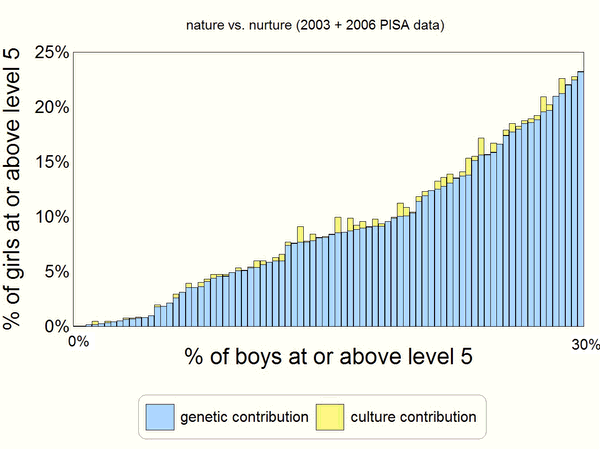
An email arrived in my inbox today from that indefatigable chercheur de la vérité, he of the lion’s claw. It announced a new addition to his website, titled The Math Sex Gap revisited: a Theory of Everyone. It features Prodigy eviscerating two papers that have appeared in 2008, both of which found cultural bias to be the cause of the gap, then introducing his own Theory of Everyone which accounts for race, culture and geography. Culture, you ask? Only this much:-
We should all be grateful for the thought of La Griffe and all his like. Without their contribution there would be no counter-argument besides commonsense to those who do their best to undermine intellectual salience for no better reason than it is white and male. Or as Prodigy says to his feminist audience, “I always enjoy visiting La La Land where a gap-free society defines the goal of human striving.”
Page 6 of 8 | First Page | Previous Page | [ 4 ] [ 5 ] [ 6 ] [ 7 ] [ 8 ] | Next Page |
|

Existential IssuesDNA NationsCategoriesContributorsEach author's name links to a list of all articles posted by the writer. LinksEndorsement not implied. Immigration
Islamist Threat
Anti-white Media Networks Audio/Video
Crime
Economics
Education General
Historical Re-Evaluation Controlled Opposition
Nationalist Political Parties
Science Europeans in Africa
Of Note MR Central & NewsCommentsGuessedworker commented in entry '"If America doesn't learn ..."' on Sun, 26 Apr 2026 12:11. (View) Guessedworker commented in entry '"If America doesn't learn ..."' on Sat, 18 Apr 2026 16:23. (View) Thorn commented in entry '"If America doesn't learn ..."' on Sun, 12 Apr 2026 20:35. (View) Thorn commented in entry '"If America doesn't learn ..."' on Sun, 05 Apr 2026 23:35. (View) Thorn commented in entry '"If America doesn't learn ..."' on Mon, 30 Mar 2026 15:40. (View) Thorn commented in entry '"If America doesn't learn ..."' on Mon, 30 Mar 2026 11:43. (View) Guessedworker commented in entry '"If America doesn't learn ..."' on Mon, 30 Mar 2026 07:08. (View) Thorn commented in entry '"If America doesn't learn ..."' on Sun, 29 Mar 2026 11:56. (View) Guessedworker commented in entry '"If America doesn't learn ..."' on Sat, 28 Mar 2026 23:31. (View) Thorn commented in entry '"If America doesn't learn ..."' on Mon, 23 Mar 2026 22:55. (View)  
|