[Majorityrights Central] Explaining about life and the Reduction ad Hitlerum at The Restorationist Posted by Guessedworker on Wednesday, 13 May 2026 23:04.
[Majorityrights Central] Three possible forms of a Ukrainian victory ... and a Russian defeat Posted by Guessedworker on Thursday, 16 April 2026 16:36.
[Majorityrights Central] Empires, the Chinese Mind, a theoretical nationalism of ethnicity Posted by Guessedworker on Saturday, 14 February 2026 01:54.
[Majorityrights News] Moscow Times: Valdai residents report no sign of drones attacking Putin residence Posted by Guessedworker on Tuesday, 30 December 2025 11:33.
[Majorityrights Central] Thoughts on Mark Collett’s strategy for nationalism in the British future Posted by Guessedworker on Friday, 24 October 2025 15:01.
[Majorityrights Central] Principles, parts, processes of ethnic nationalism, Part 1: inflection? Posted by Guessedworker on Thursday, 31 July 2025 12:03.
Does the presumptive Republican nominee see African Americans and Hispanics as part of the American “we”?
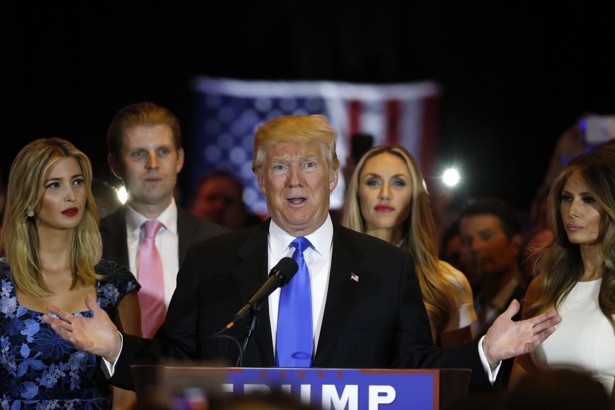
Lucas Jackson / Reuters
Celebrating his big win in Indiana—and his elevation to presumptive nominee of the Republican Party—Tuesday night, Donald Trump spoke at Trump Tower in New York City, where he delivered a promise to heal the deep fractures in his party.
“We want to bring unity to the Republican Party,” he said. “We have to bring unity. It’s so much easier if we have it.”
Do Black Votes Matter to Donald Trump?
That will be a tall order. But as a general-election candidate, Trump will need to win over more than just Republicans. In his inimitable way, he pledged to bring together the rest of the nation as well.
“We’re going to bring back our jobs, and we’re going to save our jobs, and people are going to have great jobs again, and this country, which is very, very divided in so many different ways, is going to become one beautiful loving country, and we’re going to love each other, we’re going to cherish each other and take care of each other, and we’re going to have great economic development and we’re not going to let other countries take it away from us, because that’s what’s been happening for far too many years and we’re not going to do it anymore,” he said. (That’s a single sentence, if you’re keeping track at home.)
Trump faces significant obstacles to achieving that unity, particular with blocs that are not white men. Seven in 10 women view him unfavorably. It’s even worse with minorities. A recent Gallup poll found that 77 of Hispanics view Trump unfavorably. A Washington Post poll pegged that number at eight in 10, seven of them “very unfavorable.” An NBC News/Survey Monkey poll found an astonishing 86 percent of African Americans had a negative view of Trump.
One reason for those atrocious ratings is the way Trump speaks to and about minorities, which was on display during his victory speech Tuesday.
“We’re going to have great relationships with the Hispanics,” he said. “The Hispanics have been so incredible to me. They want jobs. Everybody wants jobs. The African Americans want jobs. If you look at what’s going on, they want jobs.”
Part of Trump’s rhetorical power is his supercharged used of “we,” a method that persuades people across the country that they are part of a larger movement, and somehow share with Trump his aura of wealthy and luxury. (It’s the same technique he’s used to sell real estate for years.) In the midst of his spiel about all the ways “we” would make America great again, Trump tossed in this passage about minorities.
His phrasing is telling. First, it suggests that for Trump, blacks and Hispanics aren’t part of “we”—“they” constitute separate groups. Perhaps that’s an accidental, unthinking division, but subconscious racial division is no less dangerous. Second, it shows him assuming that minority concerns can be reduced to economics. That view is perhaps unsurprising for a man who has spent his career trying to accumulate wealth, but it is a two-dimensional view of black and Hispanic Americans.
The fact that his policies simply don’t line up with what most African Americans want in a president is one reason his numbers with black voters are so bad. Another factor is a presidential campaign driven in large parts by divisive appeals to racism and bigotry against Hispanics, Muslims, and other groups. Trump also has a long history of racially charged incidents, from alleged tenant discrimination to his strident reaction to the Central Park Five.
The entertainer has long spoken about minority groups with the outdated formulation involving a definite article: “I have a great relationship with the blacks. I’ve always had a great relationship with the blacks,” he said in 2011, using language that undermined his claim. He’s said similar things about “the Hispanics.”
Changing the way Trump speaks about African Americans and Hispanics won’t solve his problems with those groups, but if he wishes to unify the country, beginning to speak about them as though they are part of the American populace would be a good place to start.
Way to go right-wingers. As usual, the real Republican men are too rational to see race…these men are color blind, love everybody.
This loving domestic unity is going to be good for European EGI, going to be good for the economy - Asia is going to buy its products.
An article about Malia Obama’s choice of college garnered racially charged reader comments on Fox News.
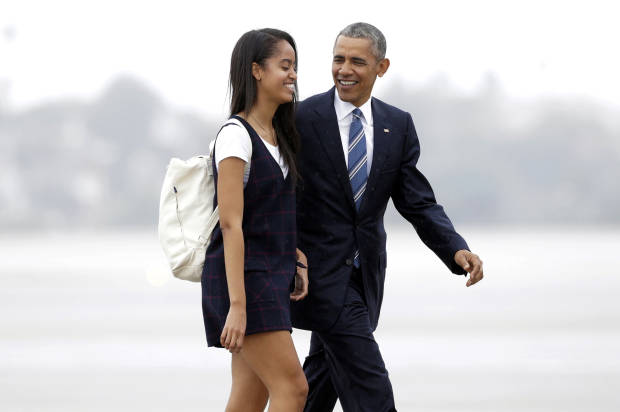
FILE- In this April 8, 2016, file photo, President Barack Obama and his daughter Malia walk from Marine One toward Air Force One at Los Angeles International Airport. Malia is taking a year off after graduating from high school before attending Harvard University as part of an expanding program for students known as a “gap year.” (AP Photo/Nick Ut, File)(Credit: AP)
After posting a news story about Malia Obama’s decision to take a gap year before beginning Harvard, Fox News was forced to remove the comment section from the article, after an avalanche of racism by readers, according to reverbpress.
Although the comments are now hidden, Addicting Info managed to take several screenshots of the hatefulness posted some on the news site. Typos and grammatical errors have been included as per the original:
I wonder if she applied as a muDslime..or a foreign student..or just a N—–
According to the screenshot, this comment garnered the most likes from other users, managing to combine three different groups of people into one racist sentence.
A new study which locates the origin of Yiddish and in fact, the Ashkenazim, in Eastern Turkey is interesting not only for the implications it has for Jewish origins and behavior, but because it has correspondence with the origin of the parent haplogroup of Jews.
However, the hypothesis that Jews have origins other than the Middle East presents problems and opportunities when looking at ways to deal with conflicts with them. When and how did Jews take on attributes that cause us problems? What to do about it based on the facts?
Fausette’s “niche theory” of the development of Jewish virulence traces the origin of their infamous rootless and parasitic behavior to the Babylonian captivity - thereafter, they returned to Palestine/Israel and occupied managerial niches over the sedentary populations; thus evolving a parasitic relation to native peoples.
If we take a look back further along their genetic line, to the origin of J1 in Eastern Turkey, however, their characteristic rootless and mercantile nature might predate and indicate that that Jewish evolution may have imposed itself on the Middle East having already mutated the characteristic form prior to the Babylonian captivity.
Another well known hypothesis of non-Middle East origin of characteristic Jewish peoplehood is The Khazar hypothesis made popular by Arthur Koestler. While Khazaria was much later than the Babylonian captivity and a bit to the east of eastern Turkey, the temperament that the Caucus mutations have given rise-to do have family resemblance to Jewish behavior. Inasmuch as the theory holds true, it could throw some predictive light on them.
Being of pragmatic disposition, I tend to be averse to the hypothesis that Jews are of Khazarian origin. The practical reasons to reject the hypothesis that I have in mind are firstly, to go along with the preponderance of genetic evidence which currently organizes them as Middle Eastern peoples. That goes to the second reason to be averse to theories of alternative, e.g., Khazar origins: the purpose to locate Jews both genetically and geographically in order to hold them to account, curb the shenanigans of their sundry diaspora - what Bowery has referred to as their horizontal transmission - which is the idea based on the niche hypothesis that their exiles and border crossings only select for their non-sedentary, parasitic characteristics. The solution that he proposes is that they be compelled to stay in one place and develop “vertical transmission”, a non-parasitic, viz., symbiotic relation with a particular land. Nevertheless, we certainly do not want to propose that their rightful place is among European lands and to allow them to continue their exploits among us; nor would it necessarily do us any particular good to see them return to the lands of ancient Khazaria or somewhere else in the near east, even if that is where they are from.
Even so, while it may not be convenient for those of us who’d like to see them all forced to go to Israel, stay there and perhaps develop some vertical transmission, we might need to have a deeper understanding of their motives and their place (or non-place, as it were) in order to come to a better concept of how to deal with them as they are, and as the facts are, whether in Israel or in diaspora.
I suppose that those who find the Khazar hypothesis appealing might be motivated from the opposite direction - that we might be able to put an end to the trouble that they are causing in the Middle East by denying their warrant to be there; and eventually perhaps diffuse their virulence by its assimilation or dying-off.
Whatever we might want, however, facts won’t necessarily bear it out. Nevertheless, there are important matters of historical punctuation, viz., when and where Jews begin as a people; and there is our capacity to determine how the facts count surrounding any such assertions: Jewish claims are assailable indeed; their claims are within our negotiative control and subject to our agentive preference. Operational verifiability will only assist us to warrantably assert our preferences.
First, let’s take a quick look at the kind of argument that is being made against the Khazar hypothesis:
And indeed, Kevin MacDonald et al. argue persuasively for the genetic and geographical location of the origin of Jews in the Middle East. KM and Duke argue that there’re only one or two (unreliable, they say), genetic studies that endorse the Khazar hypothesis, while scores, they say, verify ME origins.
Patrick Slattery argues that there are two massively difficult conversions that would have to have been made to underpin the Khazar hypothesis: first, a mass of people held to become the Ashkenazi would have had to convert to Judaism. Next and an even greater challenge, is to explain why people who are held to have originated in Khazaria spoke Yiddish - a largely Germanic language
Now, GW has raised very valid points about characteristic temperament and other kinds of special relation that Jews have to the area.
He has responded:
Posted by Guessedworker on Fri, 03 Apr 2015 16:18 | #
1. The Mosaic faith developed specifically as a survival mechanism in captivity, and developed through the Babylonian and Roman periods as such. For any people which has lost its guarantor of group survival - its land - and faces a permanent exile, with a future holding no more than an inevitable process of persecution and genetic dissolution, a mass conversion to Judaism is a perfectly logical choice.
Groups are capable, under stress, of taking immense decisions, including to suicide en masse. We should not regard mass conversion to a foreign faith as simply impossible.
2. Yiddish is an artificially-constructed language rooted in the languages of the host, particularly in the east, but containing influences from Hebrew and Aramaic which may simply originate in the oral faith tradition.
Again, while it isn’t quite Khazaria, it isn’t far from it either, and looking at this new GPS hypothesis, Eastern Turkey and surrounds show relevance to Ashkenazi origins and behavior after and perhaps before the Babylonian captivity. Interesting also is the fact that this study contradicts Slattery’s understanding of Yiddish as a mostly German derived language. The study below asserts that German words were merely added to an underlying language, the fundamental grammatical structure of which came from the East.
If we are willing to go to more ancient times, well prior to Khazaria, the fountain head of J1 does indicate an origin in Eastern Turkey (neither far nor very different climes from Khazaria) - viz., “the greatest genetic diversity of J1 haplotypes was found in eastern Anatolia, near Lake Van in central Kurdistan.”
The only problem with arguing non-ME origins for Jews is that it seems more helpful to middle-easterners than to Europeans. On the contrary, it could spread them around more and amongst us (e.g., from Turkey up into Eastern Ukraine!) - that is the last thing we might want when we need to quarantine them.
Want or not, however, it might even have some explanatory value for their influence on the margins of the Near East: In the Ukrainian - Russian war, for example; and their predictable role on both sides. Both Ukraine and ancient Khazaria would be appealing targets as a strategic and valuable real estate for them with some historical affinity as well as by being a place to put the products of Jewish men’s whore-mongering - prostitution is legal in Israel but the bastard products are not legally entitled by Israel to citizenship - they are not born of a Jewish mother. Where better to put them? Many of their mothers are Ukrainian or Russian, from these areas.
However, if we can pinpoint some of their characteristics virulence to mutations having occurred along the Silk Road in Eastern Turkey, that might help us to identify other anti-bodies to their virulence.
The origin of the Yiddish language (spoken at least since the 9th century A.D.), and consequently Yiddish speakers, has been debated for the past several centuries, mainly between linguists. While the Rhineland hypothesis suggests a German origin, the Irano-Turko-Slavic hypothesis, proposed by Paul Wexler, suggests a more complex origin starting with Slavic lands in Khazaria, followed by Ukraine, and finally Germany where the language was relexified, i.e., adopted a German vocabulary, but retained its Slavic grammar, which is why Yiddish was oftentimes called “Bad German.”
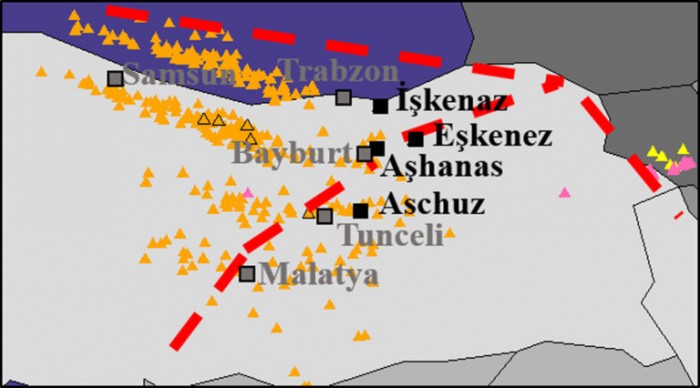
GPS predictions for the DNA of Ashkenazic Jews (orange triangles) overlap villages whose name may be derived from the word “Ashkenaz” that reside along the Silk Roads and other trade routes. GPS predictions for the DNA of Iranian (yellow triangles) and Mountain (pink triangles) Jews are also shown.
To evaluate these two hypotheses we applied the Geographic Population Structure (GPS) tool to the genomes of over 360 sole Yiddish and non-Yiddish speaking Ashkenazic Jews. This is the largest study of Ashkenazic Jews and the first one to study Yiddish speakers. Surprisingly, GPS honed in an obscure region in northeast Turkey. There we found four primeval villages (one was abandoned in the mid-7th century A.D.) whose name may be derived from the word “Ashkenaz,” suggesting that this was the central location of ancient Ashkenaz.
The search for ancient Ashkenaz has been one of the longest quests in human history lasting at least 1000 years (perhaps second only to Noah’s Ark that has been searched at least since the 3rd century A.D.). This is the only place in the world with these placenames and they cluster within a hub of atrade routes, as can be expected from a nation of traders where linguistic, genomic, historic, and geographic evidence converge.
Evidently, the ancient Ashkenazic Jews were merchants who, together with Iranian Jews, plied land and maritime trade routes and invented Yiddish as a secret language with 251 words for “buy” and “sell” to maintain their monopoly. They were known to trade in everything from fur to slaves. These findings are consistent with historical records depicting Jews as merchants. Indeed, by the 8th century the words “Jew” and “merchant” were practically synonymous. Around that time, Ashkenazic Jews began relocating to the Khazar Empire to expand their mercantile operations. Consequently, some of the Turkic Khazar rulers and the numerous Eastern Slavs in the Khazar Empire converted to Judaism to participate in the lucrative Silk Road trade between Germany and China.
After the fall of Khazaria (10-13th ce) Ashkenazic Jews split into two groups. Some remained in the Caucasus and others migrated into Eastern Europe and Germany that has been incorrectly proposed to be the original land of Ashkenaz. The two groups still call themselves Ashkenazic Jews, however the name became more strongly associated with the latter group. After their separation Yiddish became the primary language among European Jews and underwent relexification by adopting a new vocabulary that consists of a minority of German and Hebrew and a majority of newly coined Germanoid and Hebroid elements that replaced most of the original E. Slavic and Sorbian vocabularies, while keeping the original grammars intact.
Further evidence to the origin of AJs can be found in the many customs and their names concerning the Jewish religion, which were probably introduced by Slavic converts to Judaism, like the breaking of a glass at a wedding ceremony and placing stones over tombstones.
Our study demonstrate the potential of the GPS technology combined with citizen Science to shed light on the forgotten chapters of our history.
Eran Elhaik
University of Sheffield, Department of Animal and Plant Sciences
Sheffield, UK
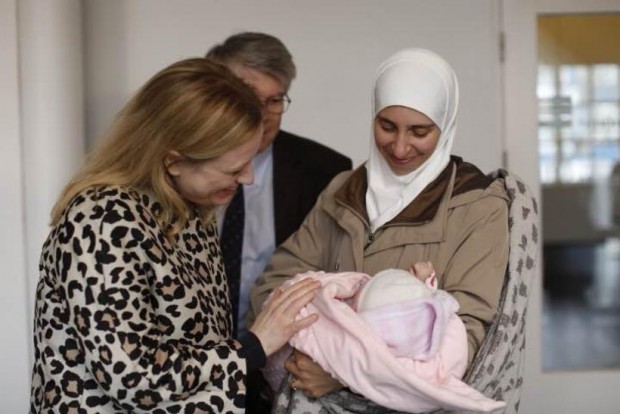
Eygló Harðardóttir welcomes a Syrian mother and baby. Iceland Monitor/Styrmir Kári
Four Syrian families arrived in Iceland yesterday and were welcomed by the Minister of Social Affairs and Housing, Eygló Harðardóttir.
“We care about your wellbeing in Iceland, and wish for you to take part in our society,” said Harðardóttir, warmly welcoming the people. One family will be moving to Kópavogur and the other three to Hafnarfjörður.
They have all stayed at refugee camps in Lebanon and were flown from there via Paris.
Representatives of the Icelandic Red Cross also welcomed the families and gave them gifts.
“Without a doubt many things will come as a surprise to you over the next few days, weeks and months, whether its our customs or habits, the weather or our nature, but hopefully soon you will feel like Icelanders and find out that we’re probably very similar to you. “
Posted by DanielS on Saturday, 09 April 2016 09:21.
Pardon the source, but this article not only well explains the draconian anti-abortion law that Poland’s PiS party is set to pass, but also prompts the question as to what other insane laws the new Polish government will institute.
An additional danger for White Nationalists is to be anticipated by Jewish commandeering of the inevitable popular backlash.
Poland’s Catholic Church and conservative government may have figured a draconian new “pro-life” law would have general acceptance. They were wrong.
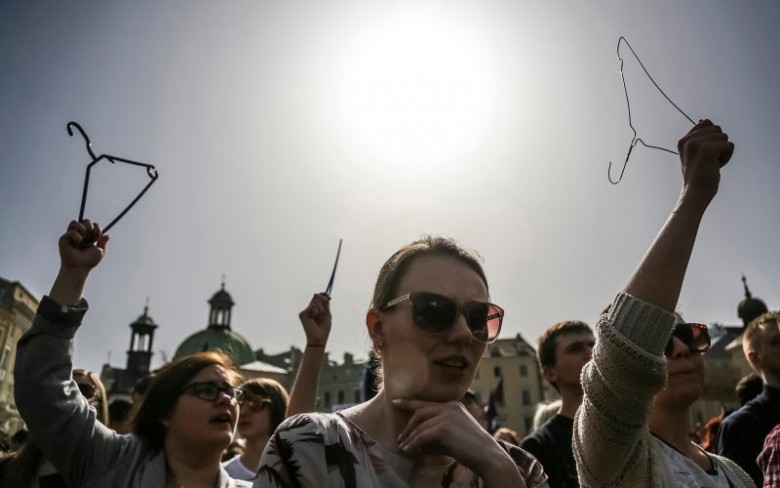
When Catholic priests issued decrees during morning mass last Sunday calling for the country to institute a complete ban on abortions, Poland erupted in protests. The initiative was not unexpected, but the surge of opposition caught many by surprise as men and women took to the streets waving wire coat hangers, symbols of the deadly “back room” abortions that take place when all legal means to terminate a pregnancy are exhausted.
The purpose of the priests’ coordinated speeches was to launch a petition and gather churchgoers’ signatures that could then be used to begin a legislative campaign in the country’s parliament, the Sejm. A “pro-life” organization called Fundacja Pro quickly gathered the required 1,000 signatures. But when the group made its intentions known during the course of the previous week, many Poles started organizing opposition on Facebook.
In just two days, they drew together over 65,000 concerned activists and laid the groundwork for Sunday’s protests, but stopping the momentum of the draconian legislation is going to be a long, tough fight.
Current law in Poland allows abortions only in three drastic situations: when the pregnancy is a result of rape or incest; when the life of the pregnant woman is in danger; or when the fetus is severely damaged. This is already one of the most restrictive abortion laws in all of Europe, forcing many women to seek out underground abortions or travel outside of Poland to countries like Slovakia. But in the eyes of Poland’s Catholic Church, this policy is too lackadaisical.
The draft of the new legislation was written by an organization called Ordo Iuris (Rule of Law), whose stated aim is to “promote a legal culture based on respect for human dignity and rights.” The draft was promptly endorsed by the Polish Episcopal Conference, which acts as the central organ of the Catholic Church in Poland. The conference’s widely disseminated notice on the new law explained that it supports it because the 5th Commandment specifically states “Thou shalt not kill,” and thus life must be protected from beginning—from the moment the sperm fertilizes the egg—to its natural end.
The wording of the law itself is simple but the implications are sweeping: “Every human being has the inherent right to life from the moment of conception,” reads its article I. “The life and health of the child from conception remain under protection of the law.”
On April 4, the Polish television network TVN reported that the law would lead to prison terms of up to three years for causing the death of a child once conceived. The same would apply to anyone who assists with or encourages the termination.
Critics looking at the possible legal ramifications were appalled. Pawel Kalisz of the Polish website Natemat wrote that the wording of the law could include as accomplices the woman or girl’s doctor; the friend driving her to the clinic; the dad who wrote her the sick note for the day off from school; the friend who brought her medication from abroad. Everyone.
Others noted that, in theory at least, rape survivors and children will be forced to give birth; women who might die due to their pregnancy will have no way to terminate it legally; a miscarriage might be punished with a sentence, as fetal murder will enter the criminal code;
Also, the state will have the right to bypass a person’s constitutional rights in order to protect unborn children; since prenatal testing is connected to a very small risk of miscarriage, it will be banned and doctors performing it might face criminal charges; and the morning-after pill will be categorized as an early abortion tool and thus completely banned (as will IUDs).
As one protester pointed out as well, women who discovered early on that their fetus had zero chance of surviving the pregnancy would be forced to live with the misery of carrying the baby for months and months until the inevitable conclusion.
The punishment would escalate to up to eight years of jail time for abortions undertaken without the consent of the woman. Furthermore, prison sentences of up to 10 years would be on the table for abortions undertaken while the fetus has the capacity for life outside the womb.
There are some loopholes, but they are narrow and unreliable. The draft law would not make it a crime for a doctor to end the life of a conceived child during the course of a procedure essential to saving the life of the mother. Furthermore, in exceptional cases the court would be able to reduce the jail sentence of a mother who had deliberately caused the death of a conceived child, or waive it altogether.
Although Polish values generally are Catholic and conservative, many Poles marched out of mass on Sunday in disgust when priests read the decree. A video of a woman openly admonishing her pastor went viral across the country. In it, the priest interrupts the woman’s tirade to ask if she has finished with her “political statement.” The irony of this remark was not lost on social media users, with one woman commenting, “Well, yes, because in church, political statements can only be made from the priest’s pulpit.”
The country’s right-wing media, meanwhile, called these protests a provocation against the state.
Although, formally, nothing has yet been codified, the wheels of change have been put into motion says Polish journalist Michał Szułdrzyński. “Now that Fundacja Pro have done their initial signature gathering, they will take it to the Sejm, which will verify the 1,000 signatures and then give the group three months to collect another 100,000 signatures. If successful, this next step would force the Sejm into taking a serious look.”
That’s not nearly as difficult as it sounds.
In 2011, a civic initiative to ban abortion gathered nearly 500,000 signatures and was introduced into the Sejm. At that time however, the lower house was run by the more left-leaning Civic Platform, which rejected the idea. When it was put to a vote, the more liberal Civic Platform party held 208 seats while Law and Justice (known by its Polish acronym PiS) controlled 157. The result of the vote was 178 for and 206 against.
Now, however, the PiS controls 235 seats against the Civic Platform party’s 157, and has embarked on a systematic campaign to stifle and marginalize opposition. PiS could pass the bill on its own, and it’s also got a parliamentary ally, with the third biggest party Kukiz’15, run by musician turned right-wing populist Pawel Kukiz. The Kukiz party holds 40 seats in Sejm, and its leader has also been an outspoken opponent of abortion in the past. With these numbers, the bill will almost assuredly pass.
All of this poses a very real and terrifying prospect for women across the country who fear that the coat hangers they’ve been holding as symbols of resistance might soon become their only recourse against unwanted and unsafe births.
When asked why he believes this is happening again, Szułdrzyński says it’s quite simple. “In the opinion of the Catholic Church abortion is wrong in every circumstance and they feel that as a Catholic country, Poland should pass a law to reflect the church’s position.”
Earlier in the week, Polish Prime Minister Beata Szydlo was asked on public radio what she thought about this issue, and she said that as a Catholic she supports the proposal. Her remarks sparked outrage and she has now backtracked a bit to say that she was merely giving her opinion as a private person and not making a statement as prime minister.
Her flip-flop sparked ridicule online, with many women questioning why the PM was so personally interested in the wombs of Polish women. Several went on Szydlo’s Facebook page. One, Malina Prześluga-Delimata, decided to notify her, sarcastically, that she wasn’t pregnant: “Madam Beato, I write to inform you that my cycle runs fine. I received my period on time (the cycle lasts 31 days).” She went on to thank the PM for being so interested in her and in her reproductive potential. “It is fantastic to know that for the moment I will be able to shift responsibility for my breeding to someone else. I will keep you up to date.”
The greatest display of anger, however, was on Poland’s streets, in what might be called the coat hanger rebellion.
Szułdrzyński believes that the ruling PiS party was caught off guard by the backlash. “This has driven great controversy because if you look at recent polls, although most people are against abortion, the overwhelming majority supports the three exceptions as they stand now,” he said.
Here is the organization behind this. Aren’t Abrahamic religions so nice? If some Arab or African converts to Catholicism, he can rape your daughter, be forgiven in confessional, while she is forced to bear the beast soon to be baptized into your biological people’s replacement.