[Majorityrights Central] Three possible forms of a Ukrainian victory ... and a Russian defeat Posted by Guessedworker on Thursday, 16 April 2026 16:36.
[Majorityrights Central] Empires, the Chinese Mind, a theoretical nationalism of ethnicity Posted by Guessedworker on Saturday, 14 February 2026 01:54.
[Majorityrights News] Moscow Times: Valdai residents report no sign of drones attacking Putin residence Posted by Guessedworker on Tuesday, 30 December 2025 11:33.
[Majorityrights Central] Thoughts on Mark Collett’s strategy for nationalism in the British future Posted by Guessedworker on Friday, 24 October 2025 15:01.
[Majorityrights Central] Principles, parts, processes of ethnic nationalism, Part 1: inflection? Posted by Guessedworker on Thursday, 31 July 2025 12:03.
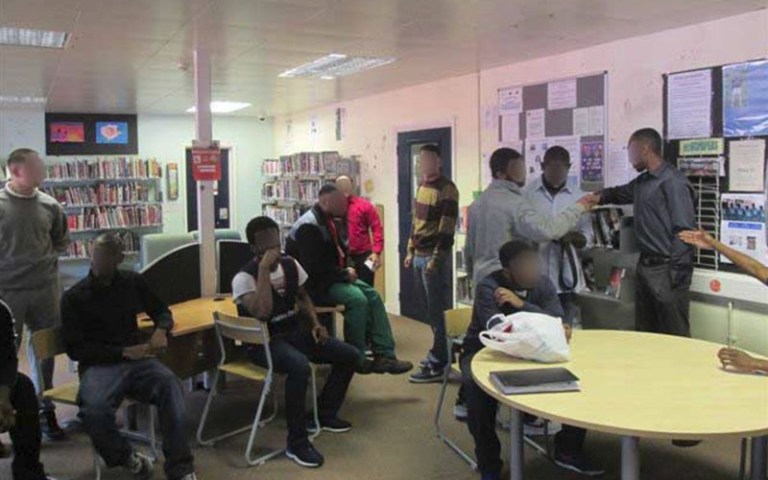
A photograph taken inside the prison at HMP Feltham “Young Offenders Institute,” during an abortive attempt to teach the inmates “entrepeneurship” skills.
More than half of all the under 18s currently in jail in Britain are nonwhite, and a quarter are Muslim, despite nonwhites allegedly only making up 13 percent of the population, new official figures from Her Majesty’s Inspectorate of Prisons has revealed.
According to the report titled “Children in Custody 2017–18 An analysis of 12–18-year-olds’ perceptions of their experiences in secure training centres and young offender institutions,” more than half the under-18s held in young offender institutions in 2017–18 were from a “black or minority ethnic background” (BME).
This figure is a three percent increase on the previous year, when it stood at 48 percent. The figure has been growing steadily ever since the HM Inspectorate of Prisons began carrying out the analysis in 2001—a figure which is perfectly explicable by the growth in the nonwhite population.
6.5164_HMIP_Children-in-Custody-2017-18_A4_v3
The report’s key findings include:
In relation to [secure training centers] STCs, our survey findings during 2017–18 show that:
– 42% of all children in STCs identified as being from a black or other minority ethnic background;
– 8% of children identified as female;
– one in eight (13%) children identified as Muslim;
– the proportion who said they were from a Gypsy, Romany or Traveller background was 11%, which compares with estimates of 0.01% in the population as a whole;
In relation to [young offender institutions] YOIs, our survey findings during 2017–18 show that:
– over half (51%) of boys identified as being from a black or minority ethnic background, the highest rate recorded through our surveys in the secure estate;
– the proportion of boys who had experienced local authority care was 39%;
– nearly a quarter (23%) of boys identified as Muslim;
– almost one-fifth (19%) of boys reported having a disability;
– fewer than one boy in 10 (6%) identified themselves as being from a Gypsy, Romany or Traveller background.
In addition, half of the “children” (50%) “reported that they had been physically restrained in their establishment”—in other words, were so violent that they could not be left unshackled.
It took no time at all for whites to be blamed—as usual—for the nonwhite crime statistics. A report in the Daily Mail quoted black Member of Parliament David Lammy as saying that “We are not only failing to make progress to address these racial inequalities; things are getting significantly worse. From childhood right through to courts and adult prisons, our justice system entrenches and exacerbates the divides in our society.”
In other words, it is not the nonwhites’ fault that they commit more crime, but rather it is the “fault” of white society in general. This is the standard excuse use whenever statistics show that nonwhites commit more crime than whites: it is never their fault that they get arrested more, it is always “racist police,”; and it is never their fault that they get sent to prison in larger numbers, it is always the “racist judicial system.”
This is the same sort of logic that claims that nonwhites do poorly academically because of “racist teachers”—and similar excuses heard ad infinitum all over Europe, America, and Australia.
This endless “blame whitey” is, of course, founded on the essential problem of race-denial by the liberal establishment. Until that issue is resolved, and race is acknowledged as a biological reality and is taken into account in the structuring of states, the current situation will continue.
Posted by DanielS on Thursday, 31 January 2019 15:24.
Donald Trump is President of The United States because he vowed to overturn the Iran Deal for Israel. Overturning the deal was not in the interest of most of the world, except for Israel, Saudi Arabia and The Russian Federation. By contrast, the rest of the world was served by the deal in its business resource interests and more - while the focus on commerce and modernization served not only practical and humanitarian ends but also contributed to a gradual process of liberalizing Iran away from Islam.
Britain, France and Germany are taking steps in their rational interests to skirt the sanctions:
Skirting U.S. sanctions, Europeans launch trade mechanism for Iran
PARIS/BERLIN (Reuters), 31 Jan 2019: France, Germany and Britain have set up a mechanism for non-dollar trade with Iran to avert U.S. sanctions, although diplomats acknowledge it is unlikely to free up the big transactions that Tehran says it needs to keep a nuclear deal afloat.
A few hours ago, President Trump capitulated on the government shutdown, handing Schulosi and the open borders lobby a historic victory. He did so after it became clear that the GOP leadership were planning to override him. A few days before that, Rep. Steve King was stripped of all of his committee assignments by the GOP for speaking up on behalf of “Western Civilization.”
At every turn, it’s the GOP which proves to be our true opposition, with the Democrats and the Jewish community cashing in on the concessions, compromises, and capitulations of the nominal “white guy party.” Alex Linder explained this in his essay, “Attack the Conservatives”:
“The rise of nationalism is almost a mathematical function of the decline of conservatism.”
George Lincoln Rockwell put it even more pointedly:
“To hell with the right wing!”
I have lived this myself. Back in 2010, I orchestrated a statewide robocall campaign, set up a plausibly deniable front group, and hustled the hell out of dozens of state legislators to pass Senate Bill 590, an illegal immigration bill. It took a tremendous amount of effort to get the GOP majority to even bring it to a vote. They didn’t want to. Then after it passed, the GOP governor, Mitch Daniels, vetoed it. I pumped thousands of my own money into an even greater putsch to override the veto. And we achieved it; then the Secretary of State, also GOP, declared it unconstitutional, shelved it.
So what does Parrott conclude? More “unite the right against ‘the left’ is needed”....
Ibid.
Charlottesville was a mistake because it was too deep into enemy territory, but the mistake wasn’t street activism. In Pikeville, we had several locals join us, both before, during, and after the event. At the end of the event, even the locals who came out to oppose us turned on the antifa, chasing them back into their charter buses with “Blue Lives Matter!” chants.
[...]
Say what you want about the lawsuits and arrests, the combined forces of America’s east coast left all joined together in one place to physically destroy us, and were decisively defeated. We only lost Charlottesville after they ran home to their attorneys and politicians, a setback which we could be confronting head on instead of with our backs turned.
How were they decisively defeated? More casualties?
Ibid.
Mentorship
Mike Enoch at Pikeville ...
Those Whites who know what’s good for them and their people will really say to hell with the right, stop leading with their chin, uniting line formation with motley anti-social idiots and provocateurs and walking into enemy traps and fire. So long as you want to unite the right, you will be uniting with nuts and infiltrators who are fixated in what should be provisional a-social perspectives.
Unite the right = unite the anti-social = oxymoronic
Why would Pat Buchanan rail against the “sewer of multiculturalism” and by default thus, in favor of integration?
The answer is that because they are advocating foolery - they cannot get out of their modernist way of thinking and adjust to the obvious requirement of (White) post modernity; that is, if one is to advocate a competent way of looking after our human ecology.
Ibid.
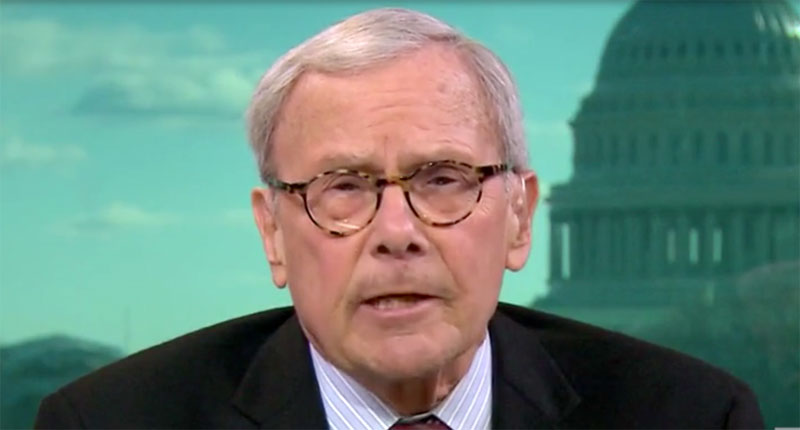
Tom Brokaw, the famed NBC News journalist, is very likely not a racist, as many have accused after comments he made on national television about Hispanic-Americans. I suspect the same is true of Duke University professor Megan Neely. Still, each of them recently proved they are blinded by tradition bias and a belief that being white is the default right, true and wise way to live in America.
During a discussion about immigration on “Meet the Press,” Brokaw said this:
“I also happen to believe that the Hispanics should work harder at assimilation. That’s one of the things I’ve been saying for a long time. You know, they ought not to be just codified in their communities but make sure that all their kids are learning to speak English, and that they feel comfortable in the communities. And that’s going to take outreach on both sides, frankly.”
Neely, who was serving as the school’s director of graduate studies in the biostatistics department before resigning on Saturday, used Brokaw’s logic to tell Chinese students to not speak their native tongue. “I have no idea how hard it has been and still is for you to come to the US and have to learn in a non-native language,” she wrote to the students after a couple of her colleagues were disturbed hearing Chinese being spoken in a common area. “As such, I have the upmost (sic) respect for what you are doing. That being said, I encourage you to commit to using English 100% of the time when you are in Hock or any other professional setting.”
There are legitimate reasons to believe Brokaw and Neely intended their words as guidance more than racist putdown. In the United States, the ability to speak and write clear English is an asset and a near-requirement for anyone aiming for the upper rungs in most high-profile industries, including journalism, academia, business and politics. Can you name a single leader in any of those industries in this country who doesn’t have a solid handle of the English language? Immigrants have long known this, which is why they have always been doing what Brokaw suggested they weren’t—adapting to and embracing some of the cultural norms of their adopted country, including the predominant language.
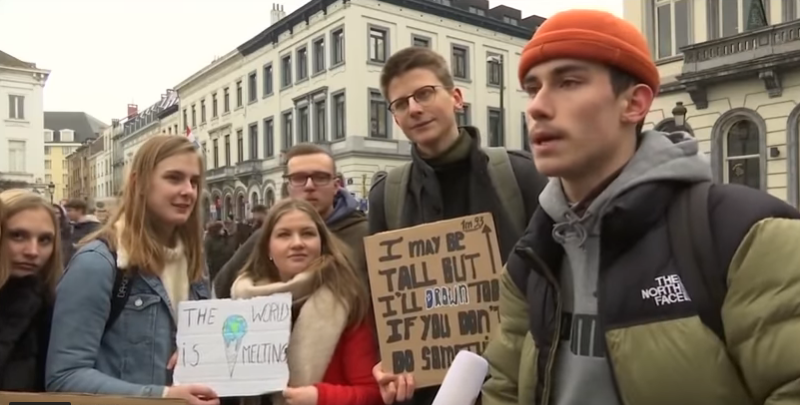
Belgian students gather to call for urgent measures to combat climate change during a demonstration in Brussels, Belgium, 24 January 2019. According the police more than 35,000 students are taking part in the demonstration.
Thousands of Belgian school children skipped classes on Thursday (24 January) to flood Brussels in an unprecedented protest against global warming and pollution, vowing to miss school once a week until the government takes action.
Students banging drums and carrying signs decrying man-made climate change gathered around the European Parliament.
Police said the 35,000-strong gathering was the biggest turnout of recent times for a student protest in the Belgian capital, which is also home to European Union institutions.
“If we skip every Thursday, if we don’t go to school, the big people in our country and in the world will see that this is a problem,” said high school student Joppe Mathys.
Another student held a sign saying: “Be part of the solution, not the pollution.”
A nine-year-old girl, who gave her name only as Lalla and was with her teacher, said it was time people stopped driving cars and walked and cycled instead.
“Dinosaurs thought they had time too,” read one banner.
Belgian school students feel abandoned by their politicians so they have started a weekly strike for the climate. Their protests pose a major question about how young people are represented in politics ahead of the EU elections in May.
Brussels police spokeswoman Ilse Van de Keere said the student demonstration was the biggest in recent memory.
Broad protests started across Belgium on 2 December with a “Claim the Climate” march, when over 65,000 demonstrators called for Belgian and European leaders to adopt ambitious climate policies in line with goals set by the Paris agreement in 2015. That demonstration came before the COP24 UN climate summit in Poland, where a report was released ranking Belgium 31 out of 60 on the 2019 Climate Change Performance Index, or a “medium” performance in implementing the Paris agreements. Brussels has been regularly ranked as one of the most congested cities in western Europe in recent years due to Belgium’s high population density and large number of commuters.
That is also a mark of shame for a capital where the EU sets European climate policies.
Across the EU, road congestion costs the bloc one percent of its annual economic output, or €100 billion per year, according to the European Commission.
In the run-up to the UN climate conference, which began in Katowice in Poland on 2 December, many thousands of people demonstrated to support accelerating the phasing out of the coal industry. EURACTIV Germany reports.
The sudden erosion of support from Senate Republicans ultimately forced Trump’s hand. “President Donald Trump touted GOP unity for 33 days of a partial government shutdown. But by the 34th day, it was clearly gone — and so was the shutdown by the end of the 35th.
Senate Republicans had finally had it and were struggling to continue to defend the president’s position and heap blame on the Democrats. Perhaps no one illustrated that dynamic more than Sen. Rob Portman.
The Ohio Republican, along with Sen. Lindsey Graham (R-S.C.), had spent more than two weeks pushing to reopen the government and then negotiate on border security, only to face repeated rejection by the president and Vice President Mike Pence. So when two votes came before the Senate this week, one on Trump’s plan, the other on a stopgap with no new guaranteed wall money, Portman nearly made a rare break with his party.
“I considered it, yes,” he said on Friday after the president finally caved on his position that the government would only reopen with a down payment on his wall.
Portman and most Republicans ultimately stuck with Trump after Pence’s pleas for unity. A sustained rebellion against Trump on Thursday, Portman argued, would mean the government “would not be open right now,“ because Trump would simply veto a Democrat-backed bill. “It would have been a real problem.” …”
So, the partial government shutdown is finally coming to an end.
Trump has been humiliated by Nancy Pelosi and Chuck Schumer. Senate Republicans caved and that forced Trump to cave. He isn’t getting any funding for his wall. The whole episode was nothing but a waste of time to look like he was fighting for the wall funding after two years of avoiding the issue.
I increasingly think it is a waste of time to sit here, day after day, following the news cycle to document the ongoing failure of Trump and American conservatism. It just discourages me from writing. I’ve been doing it for two years now and have grown tired of it. I will probably end up pivoting to history for a while.
Posted by DanielS on Saturday, 26 January 2019 10:52.
Propertarianism is an idea for a system of government devised and promoted by Doolittle and Mark to secure the interests of peoples where the U.S. Constitution has left vagueries to be exploited by the parasitic.
From what I’ve heard so far, most of it can be consonant with an ethnonational Left, White or otherwise.
The platform claims that it will be able to gain the adherence of Whites who do not heavily identify as White, either don’t care much, or emphatically do not want to be identified as racist. They maintain that as the rules-based platform provides the only guarantee of their interests that it will follow that a large percentage of these Whites will fall into the same camp as Whites whose main interest is maintaining their genetic kind. More, that this program will facilitate a groundswell to allow for revolutionary victory for racialists as it forces the right identifying elements among the military, police and citizenry to stand down when called upon to take arms against their own kind; and rather join with them.
Here is where the parasite may be rubbing its hands together unbeknownst to their “foolproof” anti-parasitism.
1) They insist on identifying as “The Right”, just as king parasite wants them to do at this point, now that it has vacuumed up all the money and assets that it possibly can.
2) With that, encourages misdefinitions of “Left/Right” as Mark promotes - “The Left is irrational, a creature that can’t be talked to.”
Or is it that they don’t want you to talk to me? Try me.
Try me. You won’t because your Jewish masters and fellow parasites told you not to.
.. “it seeks social justice… how laughable! ... has compassion for marginals - how quaint and effeminate .. the left is trying to deny us our nature as assholes.”
Who told you the Left is womanly and irrational?
The same people who pander to White girl’s puerile predilection and incitement; who want your legacy to become Mulatto so you can be more “manly”, hyper-assertive, non-reflective and unreasonable like a black?
How is it irrational to analogize national and group boundaries to unionization? Where does this unionization and accountability (of elites, marginals, rank and file) toward the end of social justice and group homeostasis need to say that “equality” is the goal and not symbiosis and homeostasis?; or that self interest is necessarily at odds if accountability to group interests exists as well? Does not accountability address the issue of “parasitism?”
Who told you that the left represents parasitism whereas the right does not?
Most people would say that capitalism, mega-wealth, investment beyond need, interest bearing loans, rent, etc, are right wing - no?
Who told you that social constuctionism does not deal with reality?
According to its tenets, you are free to come here in comments and help to construct our platform - help us deal with “reality” - in fact, that is the radical reality of how knowledge is generated.
Who told you to stay away? To see the “Left” as such a word that would have you running like a cockroach from the light?
Who supplied you with these stereotyped characterizations of an anthropmorphized “left” that is just so irrational that it can’t understand why Jews and these sociopathic Whites (that you want to get on your side on the sly), who’ve sold-out their race for their own selfish interests, are on top.
Who prevented you from joining me in this moribund White Left ethnonational position - seeing it as an opportunity to define it for ourselves, not as your masters see fit?
Such that it can provide for private property, wealth and a great deal of individual liberty, while maintaining accountability to our interests, bounds and borders?
Who told you that social constructonism was phony baloney?
I’m going to pretend for a moment that you will do the normal thing and join me as I watch this video; we’ll see what we can use, what may be off the mark - you will help in that corrective process, won’t you? Or will you refuse joint construction because your (((masters))) told you how to define what this left ethnonational platform is about and because those Whites who’ve bought their (((definitional package for right and left))) are too committed to their deal?
You see, there are all kinds of solutions to bring about borders and systems to run once borders are instituted. I never claimed to have all details figured out and in fact, am given to the reality of social constructionism, that that is simply not how knowledge is generated and disseminated - if people think, as Bowery apparently does, that I should come up with a system of “operationalization” or be ignored, then that is not reasonable. Someone else, if not him, is welcome to propose adjustments. These libertarians say to me, “that may be what should happen, but what do people actually do?
Well, I don’t know, what did the Jews tell you about how the right deals with reality, Stoicism, Jesus and all? That it provides the promise of perfect union with god after life….
Pleasure?! Ha ha ha! Don’t you know that shit has a divine place in the universe? Makes us perfect shit eaters, while your Epicurean palate, it pretends that it will get off, find the highest pleasure in figuring out how life is best conducted….
“The Stoic acceptance was an attempt to transubstantiate even the repugnant aspects of existence, the excremental, into the essentially divine.” - Kenneth Burke
In fact, Epicureanism promotes a hierarchicization of “pleasures” (contemplation being highest).... and our inextricable involvement in empirical reality which provides for accountability, e.g., to the materiality of our forebears and genetic legacy.
Ok, so I’ll watch this in my material reality; maybe you’ll join me in reflection upon it, probably you won’t… your gawd told you not to.
The “Green New Deal” endorsed by Rep. Alexandria Ocasio-Cortez, D.-N.Y., and more than 40 other House members has been criticized as imposing a too-heavy burden on the rich and upper-middle-class taxpayers who will have to pay for it. However, taxing the rich is not what the Green New Deal resolution proposes. It says funding would come primarily from certain public agencies, including the U.S. Federal Reserve and “a new public bank or system of regional and specialized public banks.”
Funding through the Federal Reserve may be controversial, but establishing a national public infrastructure and development bank should be a no-brainer. The real question is why we don’t already have one, as do China, Germany and other countries that are running circles around us in infrastructure development. Many European, Asian and Latin American countries have their own national development banks, as well as belong to bilateral or multinational development institutions that are jointly owned by multiple governments. Unlike the U.S. Federal Reserve, which considers itself “independent” of government, national development banks are wholly owned by their governments and carry out public development policies.
China not only has its own China Infrastructure Bank but has established the Asian Infrastructure Investment Bank, which counts many Asian and Middle Eastern countries in its membership, including Australia, New Zealand and Saudi Arabia. Both banks are helping to fund China’s trillion-dollar “One Belt One Road” infrastructure initiative. China is so far ahead of the United States in building infrastructure that Dan Slane, a former adviser on President Donald Trump’s transition team, has warned, “If we don’t get our act together very soon, we should all be brushing up on our Mandarin.”
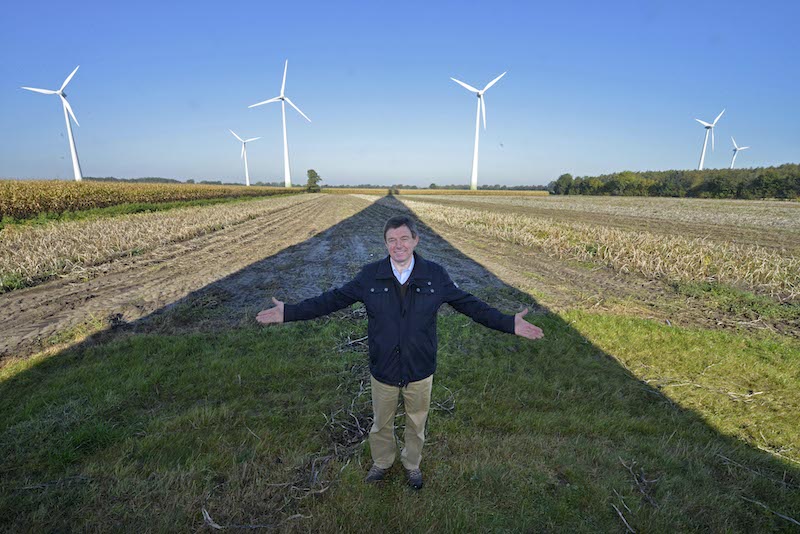
The leader in renewable energy, however, is Germany, called “the world’s first major renewable energy economy.” Germany has a public sector development bank called KfW (Kreditanstalt für Wiederaufbau or “Reconstruction Credit Institute”), which is even larger than the World Bank. Along with Germany’s nonprofit Sparkassen banks, KfW has largely funded the country’s green energy revolution.
Unlike private commercial banks, KfW does not have to focus on maximizing short-term profits for its shareholders while turning a blind eye to external costs, including those imposed on the environment. The bank has been free to support the energy revolution by funding major investments in renewable energy and energy efficiency. Its fossil fuel investments are close to zero. One of the key features of KfW, as with other development banks, is that much of its lending is driven in a strategic direction determined by the national government. Its key role in the green energy revolution has been played within a public policy framework under Germany’s renewable energy legislation, including policy measures that have made investment in renewables commercially attractive.
KfW is one of the world’s largest development banks, with assets totaling $566.5 billion as of December 2017. Ironically, the initial funding for its capitalization came from the United States, through the Marshall Plan in 1948. Why didn’t we fund a similar bank for ourselves? Simply because powerful Wall Street interests did not want the competition from a government-owned bank that could make below-market loans for infrastructure and development. Major U.S. investors today prefer funding infrastructure through public-private partnerships, in which private partners can reap the profits while losses are imposed on local governments.
KfW and Germany’s Energy Revolution
Renewable energy in Germany is mainly based on wind, solar and biomass. Renewables generated 41 percent of the country’s electricity in 2017, up from just 6 percent in 2000; and public banks provided over 72 percent of the financing for this transition. In 2007-09, KfW funded all of Germany’s investment in Solar Photovoltaic. After that, Solar PV was introduced nationwide on a major scale. This is the sort of catalytic role that development banks can play—kickstarting a major structural transformation by funding and showcasing new technologies and sectors.
KfW is not only one of the biggest financial institutions but has been ranked one of the two safest banks in the world. (The other, Switzerland’s Zurich Cantonal Bank, is also publicly owned.) KfW sports triple-A ratings from all three major rating agencies—Fitch, Standard and Poor’s, and Moody’s. The bank benefits from these top ratings and the statutory guarantee of the German government, which allow it to issue bonds on very favorable terms and therefore to lend on favorable terms, backing its loans with the bonds.
KfW does not work through public-private partnerships, and it does not trade in derivatives and other complex financial products. It relies on traditional lending and grants. The borrower is responsible for loan repayment. Private investors can participate, but not as shareholders or public-private partners. Rather, they can invest in “Green Bonds,” which are as safe and liquid as other government bonds and are prized for their green earmarking. The first “Green Bond—Made by KfW” was issued in 2014 with a volume of $1.7 billion and a maturity of five years. It was the largest Green Bond ever at the time of issuance and generated so much interest that the order book rapidly grew to $3.02 billion, although the bonds paid an annual coupon of only 0.375 percent. By 2017, the issue volume of KfW Green Bonds reached $4.21 billion.
Investors benefit from the high credit and sustainability ratings of KfW, the liquidity of its bonds, and the opportunity to support climate and environmental protection. For large institutional investors with funds that exceed the government deposit insurance limit, Green Bonds are the equivalent of savings accounts—a safe place to park their money that provides a modest interest. Green Bonds also appeal to “socially responsible” investors, who have the assurance with these simple and transparent bonds that their money is going where they want it to. The bonds are financed by KfW from the proceeds of its loans, which are also in high demand due to their low interest rates, which the bank can offer because its high ratings allow it to cheaply mobilize funds from capital markets and its public policy-oriented loans qualify it for targeted subsidies.
Roosevelt’s Development Bank: The Reconstruction Finance Corporation
KfW’s role in implementing government policy parallels that of the Reconstruction Finance Corporation (RFC) in funding the New Deal in the 1930s. At that time, U.S. banks were bankrupt and incapable of financing the country’s recovery. President Franklin D. Roosevelt attempted to set up a system of 12 public “industrial banks” through the Federal Reserve, but the measure failed. Roosevelt then made an end run around his opponents by using the RFC that had been set up earlier by President Herbert Hoover, expanding it to address the nation’s financing needs.
The RFC Act of 1932 provided the RFC with capital stock of $500 million and the authority to extend credit up to $1.5 billion (subsequently increased several times). With those resources, from 1932 to 1957 the RFC loaned or invested more than $40 billion. As with KfW’s loans, its funding source was the sale of bonds, mostly to the Treasury itself. Proceeds from the loans repaid the bonds, leaving the RFC with a net profit. The RFC financed roads, bridges, dams, post offices, universities, electrical power, mortgages, farms and much more; it funded all of this while generating income for the government.
The RFC was so successful that it became America’s largest corporation and the world’s largest banking organization. Its success, however, may have been its nemesis. Without the emergencies of depression and war, it was a too-powerful competitor of the private banking establishment; and in 1957, it was disbanded under President Dwight D. Eisenhower. That’s how the United States was left without a development bank at the same time Germany and other countries were hitting the ground running with theirs.
Ellen Brown is an attorney, chairman of the Public Banking Institute, and author of twelve books including “Web of Debt” and “The Public Bank Solution.”
Today some U.S. states have infrastructure and development banks, including California, but their reach is very small. One way they could be expanded to meet state infrastructure needs would be to turn them into depositories for state and municipal revenue. Rather than lending their capital directly in a revolving fund, this would allow them to leverage their capital into 10 times that sum in loans, as all depository banks are able to do, as I’ve previously explained.
The most profitable and efficient way for national and local governments to finance public infrastructure and development is with their own banks, as the impressive track records of KfW and other national development banks have shown. The RFC showed what could be done even by a country that was technically bankrupt, simply by mobilizing its own resources through a publicly owned financial institution. We need to resurrect that public funding engine today, not only to address the national and global crises we are facing now but for the ongoing development the country needs in order to manifest its true potential.


 Tom Brokaw, former anchor, NBC Nightly News.




 A photograph taken inside the prison at HMP Feltham “Young Offenders Institute,” during an abortive attempt to teach the inmates “entrepeneurship” skills.
 6.5164_HMIP_Children-in-Custody-2017-18_A4_v3
 Wind turbines in Nordhorn, Germany. (M. Meissner/AP)
 Ellen Brown is an attorney, chairman of the Public Banking Institute, and author of twelve books including “Web of Debt” and “The Public Bank Solution.”